
Short answer: A QC policy sets minimum control frequency, number of levels, acceptance rules and corrective action for every nonwaived test, per 42 CFR 493.1256. This free template downloads as a fillable PDF and an editable Word file.
Last reviewed November 26, 2026. Governing requirement: 42 CFR 493.1256.
These templates are free, general starting points, not legal or regulatory advice. Every template must be reviewed and approved, signed and dated by your laboratory director, and adapted to your lab's instruments, test systems and the manufacturer's instructions, your state rules and your accreditation organization's standards before use.
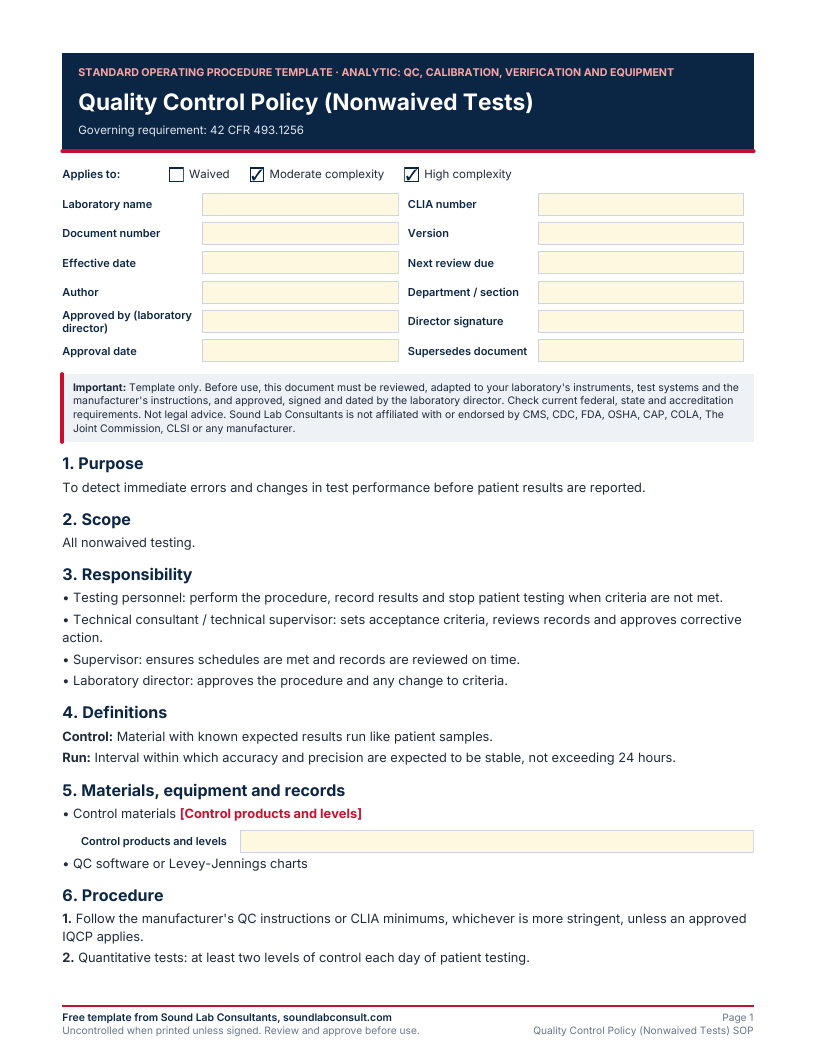
What this Quality Control Policy (Nonwaived Tests) SOP must contain
Purpose: To detect immediate errors and changes in test performance before patient results are reported.
Scope: All nonwaived testing.
The template includes these sections:
- Header block: laboratory name, CLIA number, document number, version, effective date, next review, author, approval by the laboratory director with signature and date
- Purpose and scope
- Responsibility by role
- Definitions
- Materials, equipment and records
- Step-by-step procedure (13 steps)
- Quality control
- Interpretation, reporting and documentation
- Limitations and cautions
- References to the governing regulation and guidance
- Fillable form: QC review log (7 columns)
- Lab-specific notes
- Revision history and annual review log (fillable)
Why labs need it
This procedure supports 42 CFR 493.1256. Under 42 CFR 493.1251, a nonwaived laboratory must have written procedures that staff follow, and the laboratory director must approve, sign and date each procedure and every change before use. Waived labs must follow the manufacturer's instructions exactly, and written procedures help show they do. Surveyors and accreditation inspectors usually ask to see the procedure, the related records and evidence that staff were trained on it.
Procedure outline
The highlighted items are fill-in fields in the PDF and Word versions.
- Follow the manufacturer's QC instructions or CLIA minimums, whichever is more stringent, unless an approved IQCP applies.
- Quantitative tests: at least two levels of control each day of patient testing.
- Qualitative tests: a positive and a negative control each day of testing.
- Graded or titered tests: a negative control and a control with graded or titered reactivity each day of testing.
- Tests with an extraction phase: two controls each day, including one that detects extraction errors; molecular amplification: two controls plus an inhibition control when inhibition is a significant cause of false negatives (493.1256(d)(3)(iv)-(v)).
- Electrophoresis: at least one control with each run; thin layer chromatography: calibrator and control on each plate (493.1256(d)(4)-(5)).
- Run QC before resuming patient testing after a complete reagent change, major preventive maintenance or critical part replacement.
- Run controls the same way as patient specimens and rotate operators.
- Establish ranges for unassayed controls; verify ranges for assayed controls [Range-setting method].
- Check new lots of reagents and controls before use.
- Review QC before reporting patient results; reject runs that fail acceptance rules [Westgard or other rules].
- When QC fails: do not report, investigate, correct, rerun and evaluate patient results since the last acceptable QC.
- Supervisor reviews QC records at least [Review frequency].
Quality control and documentation
- Follow the laboratory's QC policy and the manufacturer's instructions; record QC before reporting patient results.
- Stop patient testing and take corrective action when QC or acceptance criteria are not met.
- Keep QC records at least 2 years.
Limitations
- Specialty rules (e.g. 493.1261-1278) add requirements.
- This is a generic template. Adapt it to your instruments, test systems, manufacturer instructions, state law and accreditation standards before use.
Key definitions
- Control: Material with known expected results run like patient samples.
- Run: Interval within which accuracy and precision are expected to be stable, not exceeding 24 hours.
Fields you fill in
Besides the header block, revision history and annual review log, this template has 4 lab-specific fields:
- Control products and levels
- Range-setting method
- Westgard or other rules
- Review frequency
How to adopt this template
- Download the PDF or Word version above.
- Fill in the header block and every highlighted field. Where a field says "per manufacturer", copy the value from your current package insert or operator manual.
- Delete steps that do not apply and add any steps your test system or state requires.
- Have the technical consultant or technical supervisor review it, then have the laboratory director sign and date it before use.
- Train staff, document their review, and add the SOP to your document control master list.
Need procedures written for your lab?
Sound Lab Consultants writes and reviews complete procedure manuals that match your instruments, test menu and certificate type. Book a free consultation to talk through what your lab needs.
Book a free consultationFrequently asked questions
Is this Quality Control Policy (Nonwaived Tests) SOP template free?
Yes. The Quality Control Policy (Nonwaived Tests) SOP template is a free download as a fillable PDF and an editable Word (.docx) file. There is no email gate or sign-up.
What regulation does a quality control policy (nonwaived tests) procedure address?
This template is built around 42 CFR 493.1256. Read the current text at the official source linked on this page, and check your state and accreditation organization for added requirements.
Can our lab use this SOP as-is?
No. Use it as a starting point. Fill in the highlighted fields, adapt the steps to your instruments and the manufacturer's instructions, and have the laboratory director approve, sign and date it before use (42 CFR 493.1251(d)).
Which labs is this template for?
It is written for moderate and high complexity laboratories, as marked in the template's 'Applies to' boxes. Uncheck any that do not apply to your lab.
How do I fill in the PDF?
Open the PDF in a PDF reader that supports forms, click the shaded fields and type. Save a copy. In the Word version, click each highlighted field (a content control) and type over it.
Official sources
- eCFR, 42 CFR 493.1256
- eCFR, 42 CFR Part 493 Laboratory Requirements (CLIA)
- CMS, State Operations Manual Appendix C: Survey procedures and interpretive guidelines for laboratories
- CMS, Individualized Quality Control Plan (IQCP) frequently asked questions (PDF)
- CLSI guidelines relevant to this procedure (referenced by name only; obtain current editions from CLSI)
- eCFR, 42 CFR 493.1282
Related SOP templates
These templates are free, general starting points, not legal or regulatory advice. Every template must be reviewed and approved, signed and dated by your laboratory director, and adapted to your lab's instruments, test systems and the manufacturer's instructions, your state rules and your accreditation organization's standards before use. Sound Lab Consultants is not affiliated with or endorsed by CMS, CDC, FDA, OSHA, HHS, CAP, COLA, The Joint Commission, CLSI, any state agency, or any instrument or reagent manufacturer. CLSI and other standards are referenced by name only. Sound Lab Consultants, 25 Arizona Pl, Chandler, AZ 85225.