
The complete phlebotomy guide: order of draw, tubes and venipuncture standards
A free, practical guide to blood collection to the current CLSI PRE02 standard, for everyone who draws blood.
Contents
- Who this is for
- Standards and licensure
- Patient identification
- Supplies
- Site selection
- Tourniquet and cleaning
- Venipuncture steps
- Order of draw
- Tube types
- Fill and mixing
- Labeling
- Capillary collection
- Special collections
- Complications
- Preanalytical errors
- Processing and rejection
- Safety
Who this guide is for
- Phlebotomists
- Nurses
- Medical assistants
- Patient care technicians
- Laboratory assistants and processors
- EMTs and paramedics who draw blood
- Mobile and home-draw phlebotomists
- Physician office and urgent care staff
Most laboratory errors happen before the specimen reaches the analyzer, in the preanalytical phase: ordering, patient identification, collection, labeling, handling and transport. Good phlebotomy prevents redraws, delayed diagnoses and wrong results.
Standards and who can draw blood
The main U.S. consensus standard for venipuncture is CLSI PRE02, Collection of Diagnostic Venous Blood Specimens (8th edition, February 2025), which replaced CLSI GP41 (7th edition, 2017). Your laboratory's written procedures, the tube manufacturer's instructions and your employer's policies apply on top of it.
There is no federal phlebotomy license. California, Louisiana, Nevada and Washington require state licensure or certification for phlebotomists; in other states employers usually require national certification (for example ASCP, NHA, AMT or NCCT credentials). Nurses and medical assistants draw blood under their state scope of practice and employer training. Whatever your title, document your training and competency before collecting patient specimens.
Step 1: Identify the patient and check the order
- Use at least two patient identifiers, such as full name and date of birth, and have the patient state them when possible. Never use a room number as an identifier.
- Match the identifiers to the requisition or electronic order and the labels.
- Check special requirements: fasting, timed draws, medications, diet, latex allergy, preferred arm.
- Explain the procedure and confirm consent. Ask about fainting history so a reclining chair can be used.
Step 2: Gather supplies
| Item | Standard |
|---|---|
| Needles | 21 gauge for most adults; 22 gauge for smaller veins; 23 gauge winged (butterfly) sets for hand veins and children. Avoid smaller than 23 gauge for routine draws because of hemolysis. |
| Tube holder | Single use: discard the holder with the needle attached as one unit into the sharps container. |
| Safety devices | Engineered sharps injury protection, activated immediately after the needle leaves the vein (OSHA 29 CFR 1910.1030). |
| Tourniquet | Single-patient use is preferred for infection prevention. |
| Antiseptic | 70% isopropyl alcohol for routine draws; chlorhexidine or per policy for blood cultures; a non-alcohol antiseptic for blood alcohol tests. |
| Tubes | Correct tubes for the tests, checked for expiration date and cracks, kept at room temperature. |
| Syringe draws | Fill tubes with a safety transfer device, never by pushing the needle through the stopper. |
Step 3: Select the site
CLSI ranks the antecubital veins: median cubital first (well anchored, less painful), then the cephalic, and the basilic last, because it lies close to the brachial artery and the median nerve. Hand and wrist veins on the back of the hand are acceptable with a winged set. Avoid the palm side of the wrist.
Avoid: arms with an IV running (or draw below it only per facility policy after the infusion is stopped by authorized staff), the arm on the side of a mastectomy or lymph node removal unless a provider approves, arms with a fistula or graft, scarred, burned, edematous or bruised areas, and sites above a hematoma.
Step 4: Apply the tourniquet and clean the site
- Place the tourniquet 3 to 4 inches (7.5 to 10 cm) above the site and leave it on no more than 1 minute. If locating the vein takes longer, release it for 2 minutes before reapplying.
- Do not ask the patient to pump the fist; it can falsely raise potassium.
- Clean with 70% isopropyl alcohol and let it air dry completely. Do not fan, blow on or touch the site again.
Step 5: Perform the venipuncture
- Anchor the vein by pulling the skin taut below the site with your thumb.
- Insert the needle bevel up at a 15 to 30 degree angle, in line with the vein.
- Engage tubes in the correct order of draw, keeping the tube below the site so blood fills from the bottom up and does not flow back.
- Let each tube fill until the vacuum is exhausted.
- Release the tourniquet as soon as blood flow is established, and always before removing the needle.
- Gently invert each additive tube immediately after removing it from the holder.
- Remove the last tube, then the needle; activate the safety device immediately and apply pressure with gauze. Do not let the patient bend the arm.
- Discard the needle and holder as one unit in the sharps container. Never recap.
Order of draw
The order of draw prevents additive carryover from one tube to the next. CLSI PRE02 uses the same order for tube holders, syringes and winged sets:
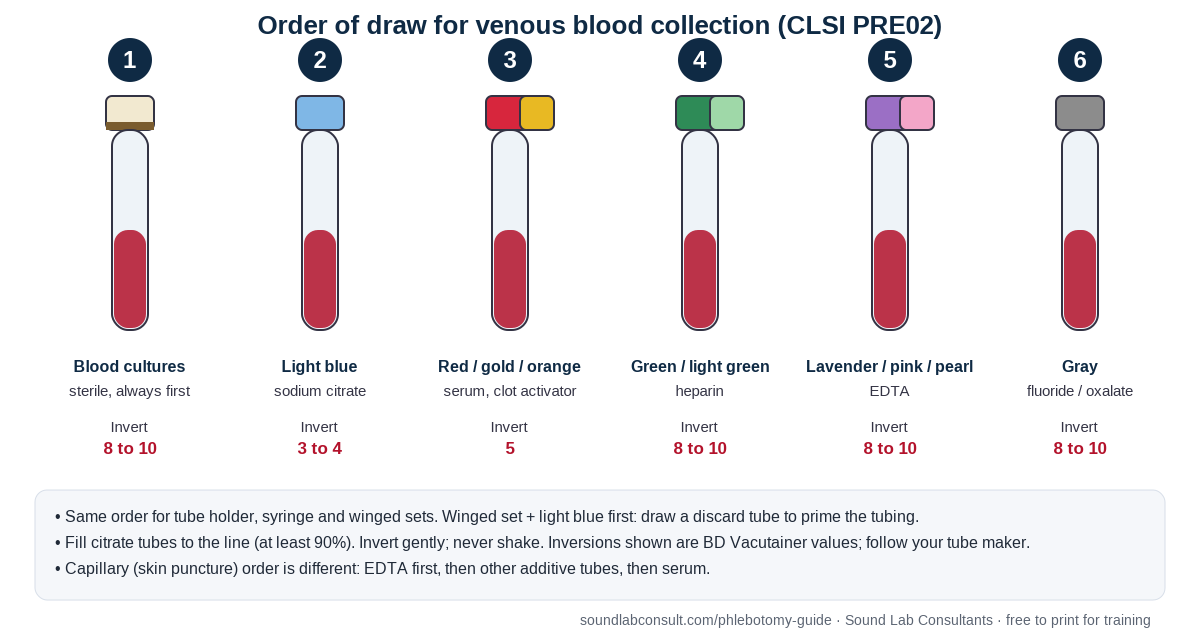
| # | Tube | Additive | Why it is in this position |
|---|---|---|---|
| 1 | Blood culture bottles or sterile tubes | Culture media (SPS in yellow SPS tubes) | Drawn first so the sterile specimen is not contaminated by other tubes or additives. |
| 2 | Light blue: sodium citrate 3.2% | Sodium citrate (binds calcium) | Coagulation tests. Drawn before serum and additive tubes so clot activator, heparin or EDTA cannot alter clotting results. |
| 3 | Red, gold (SST) or orange (RST): serum | Clot activator, with or without gel; RST has thrombin activator | Serum tests. Clot activator carried into a citrate tube would falsely shorten clotting times. |
| 4 | Green or light green (PST): heparin | Lithium or sodium heparin, with or without gel | Plasma chemistry. Heparin carried into a serum tube would stop clotting. |
| 5 | Lavender, pink or pearl (PPT): EDTA | K2EDTA (K3EDTA in some tubes) | Hematology and blood bank. EDTA carryover falsely raises potassium and lowers calcium, so EDTA comes after serum and heparin. |
| 6 | Gray: glycolytic inhibitor | Sodium fluoride with potassium oxalate (or Na2EDTA) | Glucose, lactate and alcohol. Fluoride and oxalate damage cells and bind calcium, so they come last. |
Discard tube rule: when a winged set is used and a light blue citrate tube is the first tube, draw a discard tube (a non-additive or citrate tube) first to fill the tubing's dead space, so the citrate tube gets its full volume.
Memory aid: "Cultures, Coag, Clot, Heparin, EDTA, Glucose."
Tube types, additives and tests
| Cap color | Additive | Inversions (BD) | Common tests | Notes |
|---|---|---|---|---|
| Blood culture bottles | Aerobic and anaerobic broth | Per manufacturer | Blood cultures | Fill to the bottle's volume marks; adults usually 8 to 10 mL per bottle. Disinfect bottle tops and skin first. |
| Yellow (SPS) | Sodium polyanethol sulfonate | 8 to 10 | Blood culture (tube method) | Drawn first with blood cultures. |
| Yellow (ACD) | Acid citrate dextrose A or B | 8 to 10 | HLA typing, paternity, some cell studies | Not interchangeable with SPS yellow tubes. |
| Light blue | 3.2% sodium citrate | 3 to 4 | PT/INR, aPTT, fibrinogen, D-dimer | Fill to the line (at least 90%) to keep the 9:1 blood-to-citrate ratio. |
| Black | Sodium citrate (4:1) | Per manufacturer | Westergren ESR in some systems | Different ratio from light blue; not for coagulation. |
| Red (plastic) | Clot activator (silica) | 5 | Serum chemistry, serology, some drug levels | Clot 60 minutes (BD) before centrifuging. |
| Red (glass) | None | None | Serum tests, discard tube | Clots slowly without activator. |
| Gold or red-gray (SST) | Clot activator and gel | 5 | Serum chemistry and serology | Clot 30 minutes (BD). Some labs avoid gel for certain drug levels. |
| Orange (RST) | Thrombin-based clot activator and gel | 5 to 6 | Stat serum chemistry | Clots in about 5 minutes. |
| Dark green | Lithium or sodium heparin | 8 to 10 | Plasma chemistry, ammonia; sodium heparin for cytogenetics | Do not use lithium heparin for lithium levels. |
| Light green or green-gray (PST) | Lithium heparin and gel | 8 to 10 | Plasma chemistry | No clotting wait; centrifuge promptly. |
| Lavender | K2EDTA | 8 to 10 | CBC, HbA1c, ESR (some methods) | Mix immediately to prevent microclots and falsely low platelets. |
| Pink | K2EDTA (blood bank label) | 8 to 10 | Type and screen, crossmatch, DAT | Blood bank labeling rules are strict; follow your transfusion service. |
| Pearl or white (PPT) | K2EDTA and gel | 8 to 10 | Molecular viral load testing | Plasma preparation tube. |
| Tan | K2EDTA, lead-certified | 8 to 10 | Blood lead | Certified low-lead tube. |
| Royal blue | K2EDTA, or none/clot activator (trace element certified) | Per label (8 to 10 for EDTA) | Trace metals such as zinc, copper, selenium | Check the label band color for the additive. |
| Gray | Sodium fluoride and potassium oxalate | 8 to 10 | Glucose, lactate, blood alcohol | Fluoride slows glycolysis; drawn last. |
Cap colors follow the common BD Vacutainer convention. Other manufacturers (for example Greiner Bio-One VACUETTE) use different colors and inversion counts for some tubes, so always read the tube label and your lab's test directory.
Tube fill and mixing standards
- Evacuated tubes draw a set volume. Let each fill until blood stops flowing. Short-draw (partial-volume) tubes exist for pediatric and difficult draws.
- Light blue citrate tubes must be filled to the fill line, at least 90% of the stated volume, to keep the 9:1 blood-to-citrate ratio. Underfilled citrate tubes falsely prolong PT and aPTT and are rejected.
- For patients with a hematocrit above 55%, the citrate volume must be adjusted (CLSI H21). Ask the laboratory for a special tube.
- Underfilled EDTA tubes have excess anticoagulant, which shrinks cells and can falsely lower the hematocrit and change cell counts.
- Invert gently, end over end, the number of times the manufacturer specifies. Never shake; it causes hemolysis.
| Tube (BD) | Inversions | Clotting time before centrifuge |
|---|---|---|
| Light blue citrate | 3 to 4 | Not applicable (plasma) |
| Red plastic serum | 5 | 60 minutes |
| Gold SST | 5 | 30 minutes |
| Orange RST | 5 to 6 | 5 minutes |
| Green heparin and PST | 8 to 10 | Not applicable (plasma) |
| Lavender, pink, pearl EDTA | 8 to 10 | Not applicable (whole blood or plasma) |
| Gray fluoride | 8 to 10 | Not applicable (plasma) |
Inversion counts and clotting times are BD Vacutainer values. Follow the instructions for the brand of tube you use.
Labeling
- Label every tube at the patient's side, in the patient's presence, immediately after collection. Never pre-label tubes.
- Include the patient's full name and a second identifier (date of birth or medical record number), the collection date and time, and your initials or ID. Add the specimen source and other details your lab requires.
- Blood bank (pink) tubes often have extra requirements, such as a separate armband number and signature. Mislabeled blood bank specimens are always rejected.
Capillary (skin puncture) collection
- Capillary order of draw is different: blood gases first (if collected), then EDTA, then other additive tubes, then serum. EDTA goes early because platelets clump as the puncture site begins to clot.
- Fingersticks: middle or ring finger of the non-dominant hand, on the fleshy pad slightly off center, perpendicular to the fingerprint lines. Not for infants under 1 year.
- Heel sticks (infants): the medial or lateral plantar surface of the heel only; never the back curve of the heel or the arch. Use a lancet no deeper than 2.0 mm.
- Warm the site if needed. Wipe away the first drop unless the test device instructs otherwise. Do not squeeze hard ("milk"); it dilutes the sample with tissue fluid and causes hemolysis.
Special collections
| Collection | Key requirement |
|---|---|
| Blood cultures | Strict skin antisepsis with full drying time, disinfect bottle tops, fill to the bottle's recommended volume (adults usually 8 to 10 mL per bottle), and draw sets from separate sites as ordered. Inoculate aerobic first when using a winged set. |
| Coagulation | Light blue tube filled to the line; discard tube with winged sets; deliver promptly per the lab's stability limits. |
| Timed draws and drug levels | Record the exact collection time. Trough levels are drawn just before the next dose; peaks at the time specified by the order. |
| Glucose tolerance | Collect at the exact intervals ordered; the patient stays seated and does not eat or smoke. |
| Blood alcohol | Use a non-alcohol antiseptic. Legal samples need chain of custody. |
| Chilled specimens | Ammonia, lactate and some hormones (for example ACTH) go on ice slurry immediately, per the test directory. |
| Warm specimens | Cold agglutinins and cryoglobulins are kept at body temperature (37 °C) until separated. |
| Light-sensitive | Bilirubin and some vitamins are protected from light with amber tubes or foil. |
| Line draws | Only trained, authorized staff draw from lines; follow the discard volume and flush policy to avoid dilution and contamination. |
Complications and what to do
| Problem | Signs | Action |
|---|---|---|
| Fainting (syncope) | Pallor, sweating, dizziness | Remove the tourniquet and needle, lower the patient's head or recline, stay with them, call for help per policy. |
| Nerve injury | Shooting, electric or tingling pain | Stop and remove the needle immediately. Never probe. Document and report. |
| Arterial puncture | Bright red, pulsing blood | Remove the needle and apply firm pressure for at least 5 minutes; notify the lab that the sample may be arterial. |
| Hematoma | Swelling at the site | Release the tourniquet, remove the needle, apply pressure. |
| No blood flow | Tube does not fill | Adjust the needle slightly forward or back; do not probe sideways. Try another tube (lost vacuum). After two unsuccessful attempts, ask another trained person. |
| Needlestick injury | Exposure to blood | Wash, report immediately and get post-exposure evaluation per your exposure control plan. |
Preanalytical errors and how they change results
| Error | Effect on results |
|---|---|
| Hemolysis (small needle, shaking, forcing blood through a syringe, milking) | Falsely high potassium, LD, AST, magnesium and phosphorus |
| EDTA carryover (wrong order of draw) | Falsely high potassium and falsely low calcium, magnesium and alkaline phosphatase |
| Tourniquet longer than 1 minute or fist pumping | Hemoconcentration: higher proteins, calcium, cholesterol; fist pumping raises potassium |
| Drawing above an IV | Dilution and contamination: glucose, electrolytes or drug levels match the IV fluid |
| Underfilled light blue tube | Falsely prolonged PT and aPTT |
| Clotted EDTA tube (poor mixing) | Falsely low platelet count and unreliable CBC |
| Delayed separation of serum or plasma | Falling glucose and rising potassium as cells keep metabolizing; CLSI guidance is to separate within 2 hours unless stability data allow longer |
| Wrong tube or wrong patient label | Results reported on the wrong patient or rejected specimens; the most dangerous error |
Handling, processing and transport
- Keep tubes upright, closed and at the temperature the test requires.
- Let serum tubes clot fully before centrifuging (see clotting times above); centrifuge at the speed and time in your procedure.
- Separate serum or plasma from cells within the time limit for each test.
- Ship specimens to reference labs as UN3373 Biological Substance, Category B, in triple packaging, by trained staff. See our free UN3373 shipping course.
Common rejection reasons
- Unlabeled or mislabeled specimen
- Wrong tube type or expired tube
- Underfilled citrate tube (quantity not sufficient)
- Clotted anticoagulated specimen
- Hemolyzed specimen for affected tests
- Specimen too old or stored at the wrong temperature
Safety and infection prevention
- Use standard precautions for every patient: hand hygiene before and after, and gloves for every draw.
- Use safety-engineered needles and activate them immediately; never recap, bend or break needles.
- Place sharps in a puncture-resistant container that is within reach and not overfilled.
- OSHA's Bloodborne Pathogens standard (29 CFR 1910.1030) requires an exposure control plan, hepatitis B vaccine offered to exposed staff, and annual training. Take our free bloodborne pathogens course.
Is your lab's collection process inspection-ready?
Specimen collection procedures, labeling and rejection policies, training records and competency for everyone who draws blood are inspected by CLIA surveyors and accreditors. Sound Lab Consultants trains and assesses collection staff and writes collection procedures for labs nationwide.
More phlebotomy resources
- Complete preanalytical phlebotomy guide
- Order of draw chart and infographic
- Blood collection tube colors and additives
- Tube fill volume, inversion and clotting standards
- Free phlebotomy quiz
- Free phlebotomy standards course with certificate
- Specimen processing and transport course
- Phlebotomist jobs
Frequently asked questions
What is the correct order of draw for blood tubes?
Per CLSI PRE02: 1) blood culture bottles or sterile tubes, 2) light blue sodium citrate, 3) serum tubes (red, gold SST, orange RST), 4) heparin (green, light green PST), 5) EDTA (lavender, pink, pearl), 6) gray fluoride/oxalate. Capillary collections use a different order with EDTA first.
Why does the order of draw matter?
It prevents additive carryover. For example, EDTA carried into a serum or heparin tube falsely raises potassium and lowers calcium, and clot activator carried into a citrate tube affects coagulation results.
How full does a light blue tube need to be?
Fill it to the fill line, at least 90% of the stated draw volume, to keep the 9:1 blood-to-citrate ratio. Underfilled tubes are rejected because they falsely prolong clotting times.
How many times should you invert blood tubes?
For BD Vacutainer tubes: light blue 3 to 4, red plastic and gold SST 5, orange RST 5 to 6, and green, lavender, pink and gray 8 to 10. Glass red tubes need no inversion. Always follow your tube manufacturer's instructions; never shake.
How long can a tourniquet stay on?
No more than 1 minute. Longer use causes hemoconcentration and can change test results.
What is the current CLSI venipuncture standard?
CLSI PRE02, Collection of Diagnostic Venous Blood Specimens, 8th edition, published in February 2025. It replaced CLSI GP41 (7th edition, 2017).
Which states require a phlebotomy license?
California, Louisiana, Nevada and Washington require state licensure or certification. Other states rely on employer requirements, often national certification.
Is there a free phlebotomy course with a certificate?
Yes. Sound Lab Consultants offers a free Phlebotomy Order of Draw and Venipuncture Standards Course with a quiz and an instant certificate, plus a free 25-question practice quiz.
Sound Lab Consultants handles CLIA applications, state licensing, director coverage, validations and survey prep, remotely or on site. Prefer software? MyLabCompliance.io tracks QC, competency and personnel files.
Book a free consultationor call (602) 874-1311