
Short answer: Definition: Method and instrument validation covers verification of unmodified FDA-cleared or approved test systems under 42 CFR 493.1253(b)(1), validation of modified methods and laboratory-developed tests under 42 CFR 493.1253(b)(2), and Individualized Quality Control Plans (IQCP) under 42 CFR 493.1256(d).
Last reviewed November 25, 2026 by Sound Lab Consultants. Primary sources: 42 CFR Part 493, CMS Clinical Laboratory Improvement Amendments (CLIA) program, 42 CFR 493.3.
Verification versus validation (42 CFR 493.1253)
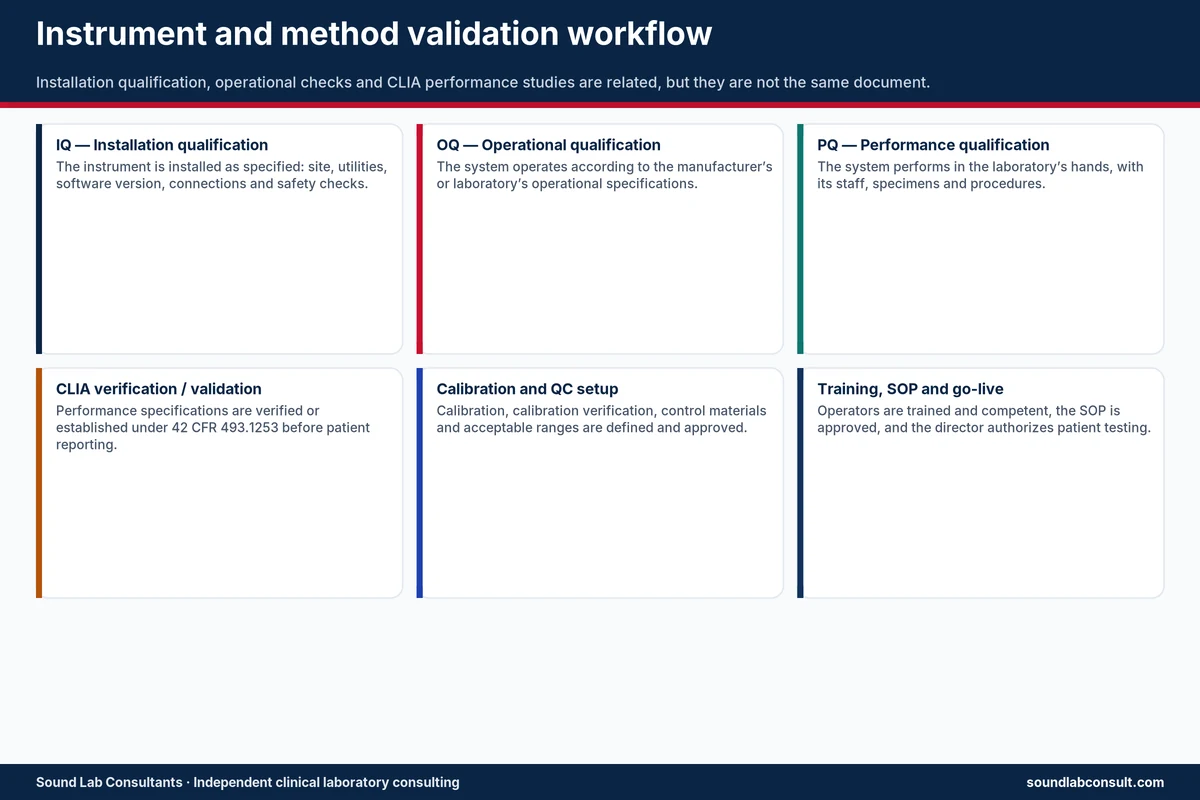
These studies sit inside the laboratory's quality management system under 42 CFR Part 493 Subpart K. A CLIA lab consultant helps the laboratory design the studies, document the results, and keep the quality system in use after go-live.
On this page
CLIA uses two different verbs on purpose. Verification is used when the laboratory is checking that an unmodified, FDA-cleared or approved test system performs as the manufacturer established. Validation is used when the laboratory must establish the performance specifications itself because it modified the method or developed the test, including a laboratory-developed test.
| Verification - 493.1253(b)(1) | Validation - 493.1253(b)(2) | |
|---|---|---|
| When it applies | Unmodified FDA-cleared or approved test system introduced by the laboratory | Modified test system, or a method developed by the laboratory (including an LDT) |
| What the laboratory must do | Demonstrate it can obtain performance specifications comparable to the manufacturer's | Establish performance specifications before reporting patient results |
| Minimum studies | Accuracy, precision, reportable range; verify reference intervals as appropriate | The verification characteristics plus analytical sensitivity, analytical specificity (interfering substances), and any other characteristic required for test performance |
Instrument and method work should be documented in a protocol and a report that a surveyor can follow: the intended use, the study design, acceptance criteria, raw data, calculations, deviations, and the Laboratory Director's approval before patient testing begins. Calibration verification and reportable-range checks continue after go-live on the schedule required by 42 CFR 493.1253 and 493.1255.
Individualized Quality Control Plan (42 CFR 493.1256(d))
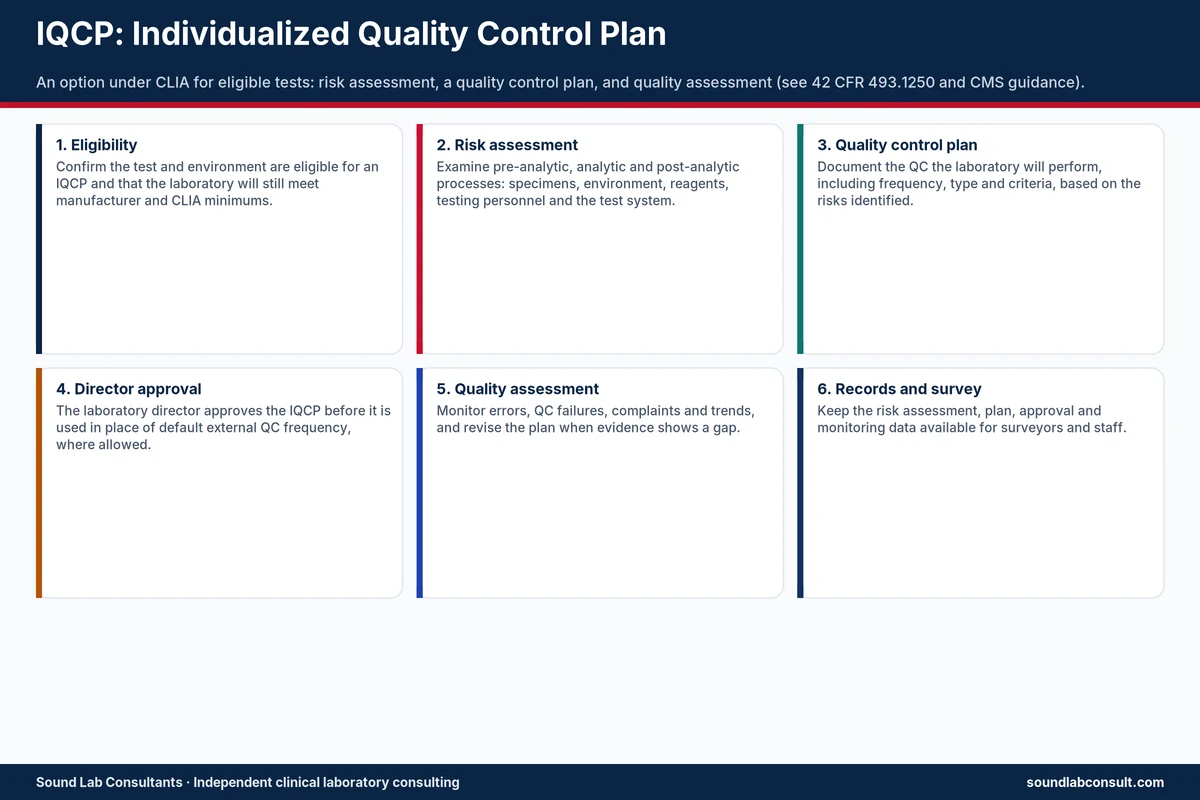
An IQCP is a documented alternative to the default CLIA quality control frequency for eligible nonwaived tests. It has three required parts: Risk Assessment, Quality Control Plan, and Quality Assessment.
- Risk Assessment evaluates potential failures across the testing process - specimen, test system, reagents, environment, and testing personnel.
- Quality Control Plan states the number, type, and frequency of quality control and the criteria for acceptable results, based on that risk assessment.
- Quality Assessment monitors the plan on an ongoing basis and revises it when the laboratory identifies failures or a change in risk.
An IQCP does not replace method verification or validation. Performance specifications must be established or verified first. The laboratory must also follow any more stringent manufacturer instructions or accreditation-organization rules that apply to that test system. Confirm current eligibility in CMS IQCP materials and in the eCFR text of 42 CFR 493.1256.
Questions about CLIA, instruments or laboratory operations?
Book a free consultation. Bring the certificate type and the question you want to sort out first.
Book a free consultationQuality management system architecture (Subpart K)
Validation and IQCP documents belong in a broader quality management system: policies and procedures, document control, pre-analytical, analytical, and post-analytical quality controls, quality assessment, and record retention. A surveyor should be able to trace a reported result back to the approved validation or verification, the current procedure, the QC or IQCP in use that day, and the competency of the person who performed the test. See also laboratory quality management system guidance.
Workflow, LIS, and technology selection
Method validation is easier to defend when the laboratory has already chosen the instruments, reagents, and laboratory information system it will use, and has designed the pre-analytical, analytical, and post-analytical workflows around those systems. Interface verification, result-reporting checks, and specimen-identification controls should be part of the operations package, not an afterthought after patient testing starts. This is the operations half of lab start-ups and operations.
Talk with Sound Lab Consultants
Book a free consultation. Tell us the laboratory type, the certificate or accreditor and what you want help with first.
Book a free consultationFrequently asked questions
What is method and instrument validation under CLIA?
Method and instrument validation covers verification of unmodified FDA-cleared or approved test systems under 42 CFR 493.1253(b)(1), validation of modified methods and laboratory-developed tests under 42 CFR 493.1253(b)(2), and Individualized Quality Control Plans (IQCP) under 42 CFR 493.1256(d).
What is the difference between verification and validation under 42 CFR 493.1253?
Verification under 493.1253(b)(1) applies when the laboratory introduces an unmodified FDA-cleared or approved test system and must show it can obtain performance specifications comparable to the manufacturer's, including accuracy, precision, and reportable range, plus reference intervals as appropriate. Validation under 493.1253(b)(2) applies when the laboratory modifies a test or develops its own method, including an LDT, and must establish performance specifications, including analytical sensitivity and analytical specificity, before reporting patient results.
What is IQCP under CLIA?
An Individualized Quality Control Plan under 42 CFR 493.1256(d) has three parts: Risk Assessment, Quality Control Plan, and Quality Assessment. It may be used for eligible nonwaived tests in place of the default QC frequency when the plan is properly documented and followed. An IQCP does not replace method verification or validation.
Which tests are IQCP-eligible?
IQCP is an option for eligible nonwaived test systems. It is not a substitute for following manufacturer instructions on waived tests, and it is not available for every specialty or procedure. Confirm eligibility in current CMS IQCP guidance and in the eCFR text of 42 CFR 493.1256 before writing a plan. Specialty rules (for example, some immunology or pathology procedures) may still require the default QC frequency.
Does Sound Lab Consultants write IQCPs and validation protocols?
Yes. Sound Lab Consultants writes and reviews method verification and validation protocols and reports, including studies for unmodified, modified, and laboratory-developed methods, and writes Individualized Quality Control Plans with the three required parts under 42 CFR 493.1256(d).
Sources
- 42 CFR Part 493, Laboratory Requirements (CLIA)
- CMS Clinical Laboratory Improvement Amendments (CLIA) program
- 42 CFR 493.3
- 42 CFR 493.1253
- 42 CFR 493.1256
- CMS: How to apply for a CLIA certificate
Related pages
Last reviewed November 25, 2026. Sound Lab Consultants is an independent laboratory consulting firm. This page is general information, not legal advice; confirm current requirements with CMS, your state agency and your accreditor. We are not affiliated with or endorsed by CMS, CDC, FDA, OSHA, CAP, COLA, The Joint Commission, any state agency or any instrument manufacturer. Illustrations are original works by Sound Lab Consultants. Sound Lab Consultants, 25 Arizona Pl, Chandler, AZ 85225.