
Short answer: A lab director (laboratory director) is the person responsible for the overall operation and administration of a clinical laboratory: qualified and competent staff, accurate and timely test results, and compliance with CLIA (42 CFR 493.1407 for moderate complexity and 493.1445 for high complexity testing). The director can delegate duties in writing but stays responsible for all of them. Under CLIA, one person may direct no more than five nonwaived laboratories and must be on site at least once every 6 months, with at least 4 months between visits. Qualifications depend on test complexity.
Need a lab director now? Sound Lab Consultants places, hires and oversees CLIA lab directors. See find a lab director or lab director services.
Last reviewed: November 28, 2026. Rules checked against the eCFR text of 42 CFR Part 493 current as of November 24, 2026. Links are in Official sources.
What is a lab director?
A lab director is the person a clinical laboratory names on its CLIA application (form CMS-116) as responsible for the laboratory. Federal rules give the director responsibility for "the overall operation and administration of the laboratory," including employing competent personnel, reporting results promptly and accurately, and "assuring compliance with the applicable regulations" (42 CFR 493.1445).
In practice, the lab director answers three questions for every test the lab reports: Is the method right for patient care? Are the people running it qualified and competent? Is the quality system catching problems before results go out? A lab manager runs the day-to-day schedule and budget. The lab director carries the regulatory accountability, and CMS can hold the director responsible when a survey finds the lab out of compliance.
| Question | Answer | Rule |
|---|---|---|
| What the director is responsible for | Overall operation, administration, staffing, quality and compliance of the lab, across the preanalytic, analytic and postanalytic phases | 493.1407, 493.1445 |
| Can duties be delegated? | Yes, in writing, to qualified people; the director stays responsible for every delegated duty | 493.1407(a)-(b), 493.1445(a)-(b) |
| How many labs one director may direct | No more than five (moderate, high and PPM certificates) | 493.1407(d), 493.1445(d), 493.1359(a) |
| On-site visits | At least once every 6 months, at least 4 months apart, documented, plus remote availability between visits | 493.1407(c), 493.1445(c) |
| Who qualifies | Depends on complexity: no federal minimum for waived; physician, midlevel practitioner or dentist for PPM; set pathways for moderate and high | 493.1357, 493.1405, 493.1443 |
| Change of director | Notify the CLIA state agency within 30 days | 493.39, 493.51 |
Key CLIA responsibilities of a lab director
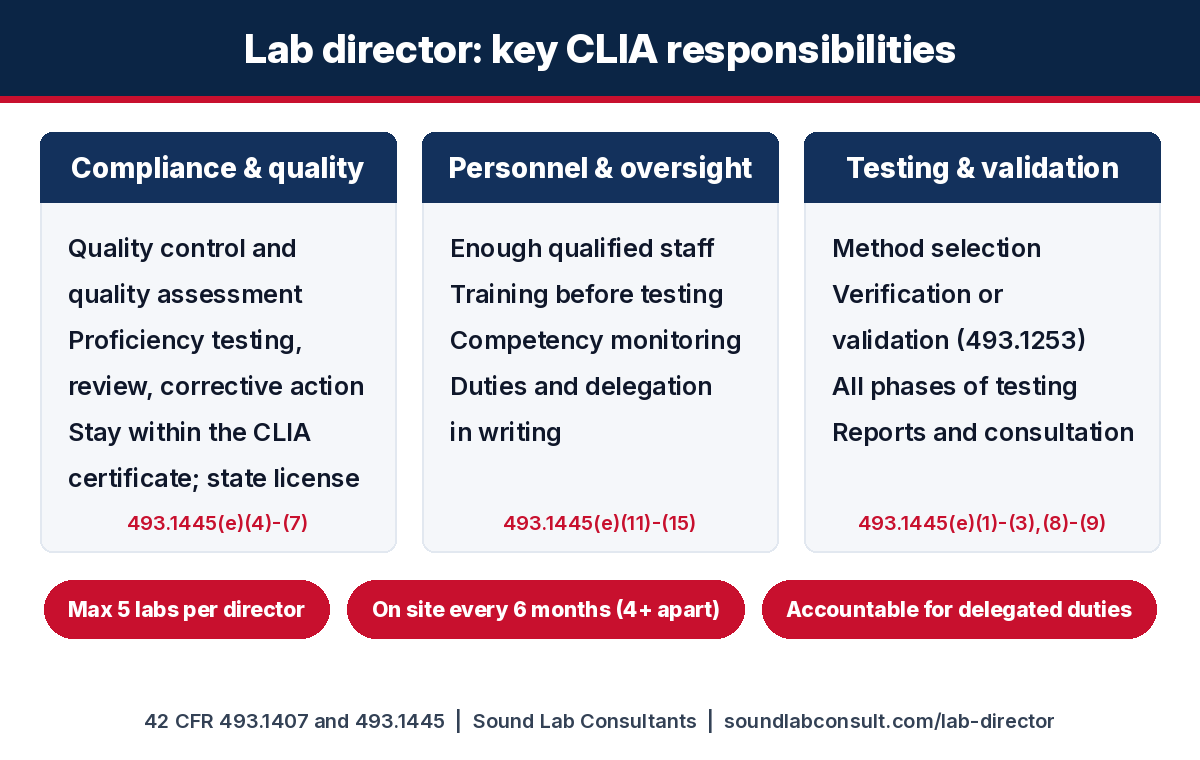
The director's duties are listed in 42 CFR 493.1407 (moderate complexity) and 42 CFR 493.1445 (high complexity). They fall into three groups.
Compliance and quality
The lab director makes sure the laboratory has a working quality system and stays within its CLIA certificate.
- Quality control and quality assessment. The director ensures QC and quality assessment programs are established and maintained so failures are caught as they occur (493.1445(e)(5)).
- Proficiency testing (PT). The lab must be enrolled in an HHS-approved PT program for each regulated analyte it tests. PT samples are tested like patient samples, results go back on time, every PT report is reviewed, and an approved corrective action plan is followed after any unacceptable result (493.1445(e)(4); 493.801).
- Analytical performance. The director ensures each test system keeps acceptable performance and that remedial action is taken and documented when it drifts. Patient results are released only when the system is working properly (493.1445(e)(6)-(7)).
- Accreditation and state rules. Accredited labs also meet their accrediting organization's standards (for example CAP, COLA or The Joint Commission), and the director must hold any state director license the state requires (493.1405(a), 493.1443(a)).
Personnel and oversight
The lab director decides who may test, makes sure they are trained, and shows up in person.
- Qualified staff. Employ enough qualified people to consult, supervise, test and report results (493.1445(e)(11)).
- Training before testing. Every person must have the right education and training and show they can perform the testing reliably before testing patient specimens (493.1445(e)(12)).
- Competency. Policies must monitor each person's competency across all phases of testing and trigger retraining when needed (493.1445(e)(13)).
- Written duties. Each consultant, supervisor and testing person's duties are specified in writing, including which tests they may perform and whether supervisor or director review is required before results are reported (493.1445(e)(15)).
- Five-lab limit. One person may direct no more than five laboratories (493.1407(d), 493.1445(d)). The same limit applies to PPM directors (493.1359(a)).
- On-site visits. The director must be on site at least once every 6 months, with at least 4 months between the two minimum visits, must document each visit with evidence of director activities, and must stay reachable for telephone or electronic consultation between visits (493.1407(c), 493.1445(c)). CMS says these on-site duties cannot be delegated (CMS lab director brochure).
Testing and validation
The lab director owns the choice of tests and the evidence that they work.
- Method selection. Test methodologies must be capable of the quality of results patient care requires (493.1445(e)(3)(i)).
- Verification and validation. Before reporting results, the lab verifies an unmodified FDA-cleared or approved test's accuracy, precision, reportable range and reference intervals, and establishes full performance specifications for a modified test or laboratory developed test (42 CFR 493.1253). The director signs off that these procedures are adequate (493.1445(e)(3)(ii)).
- All phases of testing. Test systems must give quality results from specimen collection through reporting (493.1445(e)(1)), and an approved procedure manual must be available to staff (493.1445(e)(14)).
- Reporting and consultation. Reports must include the information needed to interpret results, and consultation must be available to clients on result quality and interpretation (493.1445(e)(8)-(9)).
- Safe facilities. The physical plant and environment must suit the testing and protect staff from physical, chemical and biological hazards (493.1445(e)(2)).
| Responsibility | Who usually performs it | Delegable? |
|---|---|---|
| Overall compliance and the quality system | Lab director | No: the director stays accountable |
| On-site visits every 6 months and visit records | Lab director | No |
| Method verification, QC review, PT review | Technical consultant (moderate) or technical supervisor (high) | Yes, in writing |
| Competency assessment of testing personnel | Technical consultant or technical supervisor, with general supervisor help in high complexity labs | Yes, in writing |
| Result interpretation and client consultation | Clinical consultant | Yes, in writing |
| Day-to-day supervision of high complexity testing | General supervisor | Yes, in writing |
For a full duty-by-duty checklist, see our guide to CLIA lab director responsibilities.
Lab director qualifications by test complexity
Who can be a lab director depends on the most complex testing the lab performs. The federal minimums are below; some states add a director license.
| Testing level | Who can be the lab director | Rule |
|---|---|---|
| Waived tests only (Certificate of Waiver) | No federal education or experience minimum. The lab must follow the manufacturer's instructions and the state's rules. | 493.15; CMS |
| Provider-performed microscopy (PPM certificate) | A physician, a midlevel practitioner authorized to practice independently in the state, or a dentist | 493.1357 |
| Moderate complexity | MD or DO board certified in anatomic or clinical pathology; or MD, DO or DPM with 1 year directing or supervising nonwaived testing; or a doctoral scientist with HHS-approved board certification; or a master's or bachelor's degree with set years of nonwaived lab and supervisory experience | 493.1405 |
| High complexity | MD or DO board certified in anatomic or clinical pathology; or MD, DO or DPM with 2 years directing or supervising high complexity testing; or a doctoral scientist with current HHS-approved board certification and 2 years of high complexity experience | 493.1443 |
Moderate complexity lab director
Under 42 CFR 493.1405(b), a moderate complexity lab director must meet one of five pathways:
- A licensed MD or DO certified in anatomic or clinical pathology by the American Board of Pathology or the American Osteopathic Board of Pathology.
- A licensed MD, DO or DPM with at least 1 year directing or supervising nonwaived testing and 20 CE hours covering director responsibilities.
- An earned doctoral degree in a chemical, biological, clinical or medical laboratory science or medical technology (or a doctorate with qualifying coursework or a lab-related thesis), current HHS-approved board certification, 1 year directing or supervising nonwaived testing and 20 CE hours.
- A master's degree in a qualifying science (or equivalent coursework), 1 year of nonwaived lab training or experience, 1 year of nonwaived supervisory experience and 20 CE hours.
- A bachelor's degree in a qualifying science (or 120 semester hours with set science credits), 2 years of nonwaived lab training or experience, 2 years of nonwaived supervisory experience and 20 CE hours.
High complexity lab director
Under 42 CFR 493.1443(b), a high complexity lab director must be a pathologist (licensed MD or DO with anatomic or clinical pathology board certification), a licensed MD, DO or DPM with 2 years directing or supervising high complexity testing and 20 CE hours, or a doctoral scientist with current HHS-approved board certification, 2 years of lab training or experience and 2 years directing or supervising high complexity testing, plus 20 CE hours. Oral pathology has its own board requirement. Bachelor's and master's degrees do not qualify a person to direct a high complexity lab. See high complexity lab director requirements.
State lab director licenses
CLIA requires the director to hold a state director license wherever the state requires one (493.1405(a), 493.1443(a)). California and New York, for example, run their own director licensing or certificate of qualification programs, so check the state rule before naming a director.
What changed on December 28, 2024
The CLIA personnel final rule (88 FR 89976, published December 28, 2023) took effect for personnel on December 28, 2024. For lab directors it:
- Narrowed qualifying degrees to chemical, biological, clinical or medical laboratory science or medical technology, with coursework or thesis routes for other doctorates. Physical science degrees no longer appear in the director pathways.
- Added 20 CE credit hours on director responsibilities to most pathways.
- Wrote the twice-yearly on-site visit rule (6 months, at least 4 months apart) into the director standards.
- Grandfathered anyone qualified and serving as a director on December 28, 2024, as long as they serve continuously (493.1405(b)(6), 493.1443(b)(4)).
In June 2025, CMS memo QSO-25-21-CLIA said CMS will not require the additional 20 CE hours for several pathways and will accept either 1 year of experience or 20 CE hours for physician directors of moderate complexity labs. On October 8, 2026 CMS published proposed rule CMS-3478-P, which proposes further changes to personnel qualifications. It is not final, and comments are due December 7, 2026.
Lab director vs technical consultant, technical supervisor and other CLIA roles
Every nonwaived lab must fill a set of CLIA roles. One qualified person may hold several of them, and the lab director can fill any role he or she qualifies for (493.1407(a), 493.1445(a)).
| Role | Required for | Main job |
|---|---|---|
| Lab director | All CLIA labs | Overall operation, compliance and quality; final accountability |
| Technical consultant | Moderate complexity | Technical and scientific oversight: method verification, QC, PT review, competency (493.1413) |
| Technical supervisor | High complexity | Technical oversight by specialty: methods, validation, QC, PT and competency (493.1451) |
| Clinical consultant | Moderate and high complexity | Advice on test selection and result interpretation for clients (493.1417, 493.1455) |
| General supervisor | High complexity | Day-to-day supervision of testing personnel and test performance (493.1461) |
| Testing personnel | Moderate and high complexity | Perform and report authorized tests, follow QC and procedures |
The key difference: a technical consultant or technical supervisor runs the science of individual tests, while the lab director is accountable for the whole laboratory, including the people in those roles.
Lab director pay
The U.S. Bureau of Labor Statistics does not publish a separate wage for clinical lab directors. Its closest broad category, medical and health services managers, had a median annual wage of $123,860 in May 2025 (BLS Occupational Outlook Handbook). Pathologist directors, doctoral-scientist directors and part-time directorships are paid on different terms, so use a current salary survey for your specialty and region.
How to find or hire a lab director
Sound Lab Consultants places, hires and oversees CLIA lab directors for moderate and high complexity laboratories, and has set up 150 labs in the last 12 months. We match the director's pathway to your test menu, confirm state licensure, and set up the documentation the director must keep. See find and hire a CLIA lab director and lab director services.
Before you name a lab director, check these points:
- Match the complexity. Confirm the highest complexity on your test menu, then the director's pathway under 493.1405 or 493.1443.
- Get the documents. Diplomas or transcripts, board certification, experience letters showing nonwaived (or high complexity) direction or supervision, and CE records where required.
- Check state licensure. Confirm any state director license before the start date.
- Count the labs. Confirm the person directs no more than five labs, counting yours.
- Plan the on-site visits. Put two documented visits per year on the calendar, at least 4 months apart, and agree how the director is reached between visits.
- Delegate in writing. Sign a written delegation of duties to the technical consultant or supervisor, clinical consultant and general supervisor.
- Notify CLIA. Report a change of director to your state agency within 30 days (493.51, 493.39), usually with an updated CMS-116.
Want to become a lab director instead? Start with how to become a CLIA lab director, the free CDC Laboratory Director University courses, and our notes on the 20 CE hours.
Lab director FAQ
What does a lab director do?
A lab director is responsible for the overall operation and administration of a clinical laboratory. That includes hiring qualified staff, making sure tests are accurate and properly verified, running quality control and proficiency testing, documenting corrective actions, and keeping the lab in compliance with CLIA (42 CFR 493.1407 and 493.1445).
Is a lab director the same as a laboratory director?
Yes. Lab director is the short form of laboratory director, the title CLIA uses for the person responsible for a clinical laboratory.
How many labs can a lab director oversee?
Under CLIA, one person may direct no more than five laboratories (42 CFR 493.1407(d) and 493.1445(d)). The same five-lab limit applies to directors of provider-performed microscopy labs (493.1359(a)).
How often must a lab director be on site?
At least once every 6 months, with at least 4 months between the two minimum visits. The director must document each visit with evidence of director activities and stay available for telephone or electronic consultation between visits (42 CFR 493.1407(c) and 493.1445(c)).
Can a lab director delegate responsibilities?
Yes. A director may delegate duties in writing to people who meet the qualifications for technical consultant, technical supervisor, clinical consultant, general supervisor or testing personnel. The director remains responsible for making sure every delegated duty is done properly.
What qualifications does a lab director need?
It depends on complexity. Waived labs have no federal minimum. PPM labs need a physician, independent midlevel practitioner or dentist. Moderate complexity labs follow 42 CFR 493.1405, and high complexity labs follow 42 CFR 493.1443, which requires a pathologist, an experienced physician or a board-certified doctoral scientist.
Can someone with a bachelor's degree be a lab director?
Only for moderate complexity testing. Under 42 CFR 493.1405(b)(5), a person with a qualifying bachelor's degree, 2 years of nonwaived lab experience and 2 years of nonwaived supervisory experience can direct a moderate complexity lab. A bachelor's or master's degree does not qualify someone to direct a high complexity lab.
Does a lab director have to be a pathologist?
No. A board-certified pathologist qualifies for every complexity level, but CLIA also allows other physicians with the required experience and doctoral scientists with HHS-approved board certification. Moderate complexity labs also accept certain master's and bachelor's pathways.
What changed for lab directors on December 28, 2024?
The CLIA personnel final rule took effect. It narrowed qualifying degrees, added 20 CE hours on director responsibilities to most pathways, wrote the twice-yearly on-site visit rule into the director standards and grandfathered directors who were qualified and serving that day. CMS later said in QSO-25-21-CLIA that it will not require the extra 20 CE hours for several pathways.
Who needs a lab director?
Every laboratory with a CLIA certificate must name a director, including waived labs. Labs doing moderate or high complexity testing must name a director who meets the federal qualifications for that level.
What is the difference between a lab director and a technical consultant?
The lab director is accountable for the whole laboratory. A technical consultant, required in moderate complexity labs, handles the technical and scientific oversight of tests, such as method verification, QC review, proficiency testing review and competency assessment. One qualified person can hold both roles.
What happens when a lab changes its director?
The lab must notify its CLIA state agency within 30 days of the change (42 CFR 493.51 for a Certificate of Compliance, 493.39 for a Certificate of Waiver), and the new director should review and approve the procedure manual and delegation records.
How do I find a lab director for my lab?
Confirm the highest complexity you test, then find someone whose qualification pathway, state license and current lab count fit. Sound Lab Consultants places, hires and oversees CLIA lab directors for moderate and high complexity labs. Book a free consultation to start.
Need a qualified lab director?
Book a free consultation. Tell us your test menu and state, and we will map the director pathway and coverage your lab needs.
Book a free consultationOfficial sources
- 42 CFR 493.1407, laboratory director responsibilities (moderate complexity)
- 42 CFR 493.1445, laboratory director responsibilities (high complexity)
- 42 CFR 493.1405, laboratory director qualifications (moderate complexity)
- 42 CFR 493.1443, laboratory director qualifications (high complexity)
- 42 CFR 493.1357, PPM laboratory director qualifications
- 42 CFR 493.1359, PPM laboratory director responsibilities
- 42 CFR 493.15, laboratories performing waived tests
- 42 CFR 493.1253, establishment and verification of performance specifications
- 42 CFR 493.801, proficiency testing enrollment and testing
- 42 CFR 493.1413, technical consultant responsibilities
- 42 CFR 493.1451, technical supervisor responsibilities
- 42 CFR 493.1417, clinical consultant responsibilities (moderate complexity)
- 42 CFR 493.1455, clinical consultant responsibilities (high complexity)
- 42 CFR 493.1461, general supervisor responsibilities
- 42 CFR 493.51, notification requirements (certificate of compliance)
- 42 CFR 493.39, notification requirements (certificate of waiver)
- 42 CFR Part 493 (eCFR)
- CMS, For Laboratory Directors
- CMS, Laboratory Director Responsibilities brochure
- CMS, QSO-25-21-CLIA (June 23, 2025)
- Federal Register, CLIA personnel final rule, 88 FR 89976 (December 28, 2023)
- Federal Register, proposed rule CMS-3478-P (October 8, 2026)
- CMS-116 CLIA application form
- CDC, Laboratory Director University
- BLS Occupational Outlook Handbook, medical and health services managers
Related pages
Last reviewed: November 28, 2026. Checked against 42 CFR Part 493 (eCFR, current as of November 24, 2026), CMS lab director guidance, memo QSO-25-21-CLIA and proposed rule CMS-3478-P. This page is general regulatory information, not legal advice. Sound Lab Consultants is an independent laboratory consulting firm and is not affiliated with or endorsed by CMS, CDC, HHS, FDA, CAP, COLA, The Joint Commission or AAB. Illustrations are original works by Sound Lab Consultants.