
Short answer: Lab director services help a clinical laboratory obtain a qualified CLIA laboratory director and keep the oversight CLIA requires. Sound Lab Consultants maps your state, certificate type and test menu to the director pathways in 42 CFR 493.1405 (moderate complexity) or 493.1443 (high complexity), looks for a qualified director in our lab director network, and supports procedures, proficiency testing and survey records for the director's review. Coverage can be fractional, part-time or full-time.
Last reviewed: November 27, 2026. Checked against 42 CFR 493.1405, 493.1407, 493.1443, 493.1445 and 493.51 and Form CMS-116. Links are in Official sources.
What lab director services include
Every laboratory that performs moderate or high complexity testing under CLIA must have a qualified laboratory director. The director is responsible for the overall operation and administration of the lab, including the employment of qualified personnel (42 CFR 493.1407 and 493.1445). Lab director services exist because many labs, especially physician office labs, startups and specialty molecular or toxicology labs, need a qualified director of record without hiring a full-time employee, and because director qualifications differ by certificate type, test menu and state.
With Sound Lab Consultants, lab director services typically cover:
- Requirement mapping. We match your state, CLIA certificate type, test menu and specialty to the correct director pathway and to any state director license.
- Finding a qualified director. We look for a director in our lab director network who fits those requirements and has capacity under the five-lab limit. See find a CLIA lab director.
- Coverage models. Fractional, part-time or full-time directorships, including remote review between required on-site visits.
- High complexity pathways. Directors who meet high complexity lab director qualifications under 42 CFR 493.1443, including doctoral board certification where that pathway applies.
- Compliance support for the director. Our team drafts procedures, tracks proficiency testing and competency, and prepares survey documentation for the director's review. The director keeps the responsibilities CLIA assigns to the director.
- Related consulting. Help with starting a clinical laboratory, CLIA consulting, and CAP or COLA accreditation work, when your lab needs it.
These services are focused on laboratory directorship and compliance consulting. They are not a general recruiting or temporary staffing service for every clinical or pathology role in the lab.
Talk through lab director services for your lab
Book a free consultation with your state, certificate type and test menu.
Find a qualified CLIA lab director
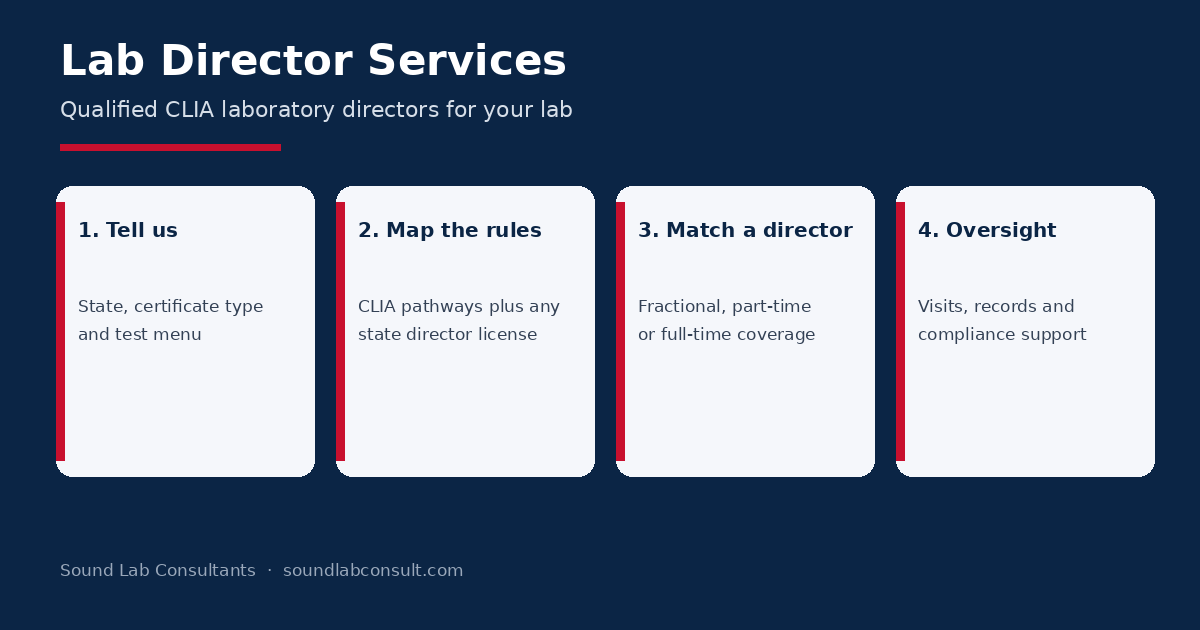
To find the right director, start with the lab, not with a resume. The qualifications that apply depend on whether your testing is moderate complexity (42 CFR 493.1405) or high complexity (42 CFR 493.1443), and some states require an additional director license. Our process for laboratories has three steps, described in more detail on find a CLIA lab director:
- Tell us about your lab. Share your state and city, CLIA certificate type, test menu and specialty, and whether you are opening, adding complexity or replacing a director. Include your accreditor if you have one (CAP, COLA or The Joint Commission).
- We map the requirements. We match your menu to the CLIA director pathway and flag any state license, board certification or experience rules that apply, including the five-lab limit and the on-site visit schedule.
- We look for a qualified director and help you onboard. When a network director fits, we help you document qualifications, name the director on the right CMS or state forms, set a visit schedule and write down any delegated duties.
If you are a physician, pathologist or doctoral scientist seeking a directorship, you can apply to the lab director network or review part-time lab director jobs.
Fractional, part-time or full-time coverage
| Model | What it means | CLIA basics |
|---|---|---|
| Fractional | One qualified director serves several labs, each with a defined share of time. See fractional CLIA lab director. | Up to five labs per director; on site at least every 6 months, at least 4 months apart |
| Part-time | Scheduled visits plus remote review for one lab. See part-time CLIA laboratory director. | Same visit rule; documented visits and director activities |
| Full-time | Director on staff, usually high-volume or hospital-based labs. | All director duties in 493.1407 or 493.1445 |
| Remote oversight | Electronic review between visits. See remote laboratory management. | Must stay accessible for telephone or electronic consultation |
| Multi-state | Director qualified for labs in more than one state. | State licenses can apply on top of CLIA, for example New York, California, Florida and New Jersey |
Federal rules set no hours-per-month minimum. How much monthly time your lab needs depends on test volume, complexity, and your accreditor and state. We scope that with you during the consultation rather than promising a standard package or a fixed start date.
High complexity and moderate complexity directors
The director pathway changes with the complexity of your testing:
- Moderate complexity. Director qualifications are in 42 CFR 493.1405. Many physicians who meet the regulation's training or experience options can serve, and the responsibilities are in 493.1407.
- High complexity. Director qualifications are in 42 CFR 493.1443. Pathways include a licensed pathologist, a licensed physician with the required directing experience, and a doctoral scientist certified by an HHS-approved board (for example ABB High-complexity Clinical Laboratory Director certification). See high complexity lab director and board certification.
- Technical supervisors and consultants. High complexity labs also need a technical supervisor who meets 42 CFR 493.1449. Moderate complexity labs need a technical consultant under 493.1409 through 493.1411. See CLIA laboratory director and supervisor services.
If your lab is moving from waived to moderate or high complexity, name a qualified director before you submit the certificate change. See lab director for a new laboratory and how to start a clinical laboratory.
What the director oversees, and what we support
CLIA assigns the director ultimate responsibility for the lab, including test systems, quality control, proficiency testing, quality assessment and qualified staffing (42 CFR 493.1407 and 493.1445). The director may delegate some duties in writing, but may not delegate the responsibility itself. A useful way to split the work:
| Area | The director must ensure | How our team supports the director |
|---|---|---|
| Compliance and testing systems | Quality testing in all phases; methods that meet clinical needs; verification of performance specifications before patient testing. | Draft procedures and method-verification records for the director to review and approve. |
| Proficiency testing and QC | Enrollment in approved PT for regulated analytes; QC and quality assessment programs that are followed. | Track PT enrollment, events and corrective action, and compile monthly QC review packets. |
| Personnel and competency | Enough qualified staff, training before patient testing, and ongoing competency assessment. | Assemble qualification files and competency calendars for the director's sign-off. |
| On-site visits and access | On site at least every 6 months, at least 4 months apart; accessible for telephone or electronic consultation. | Maintain the visit calendar and visit notes the director signs. |
| Survey documentation | The lab can show how it meets CLIA and, if accredited, CAP, COLA or Joint Commission requirements. | Prepare survey documentation for the director's review. |
For the full duty list, see CLIA lab director responsibilities and laboratory director and technical consultant services for multi-site coverage.
Director qualifications at a glance
We do not invent shortcuts around the regulation. The current text, the official sources below, and any state license rules control who may serve. Points labs ask about most often:
- One person may direct no more than five laboratories (42 CFR 493.1407(d) and 493.1445(d)).
- The director must be on site at least once every six months, with at least four months between the two minimum visits, and must document those visits (42 CFR 493.1407(c) and 493.1445(c)).
- High complexity doctoral-scientist directors must hold certification from an HHS-approved board and keep that certification current (42 CFR 493.1443). The list of boards is published by CMS and HHS and can change.
- CMS has issued enforcement discretion and a later proposed rule about the 20 continuing education hours that appear in some director pathways. See CLIA lab director 20 CE hours for the current status. Confirm the rule that applies to your lab before you rely on a CE pathway.
We are not affiliated with CMS, HHS, FDA, CAP, COLA, The Joint Commission or any certification board. Board and agency pages are cited as sources only.
Paperwork when a director starts
- New laboratory. Name the director on Form CMS-116. See lab director for a new laboratory.
- Director change at an existing lab. Notify CMS or the state agency within 30 days (42 CFR 493.51 for certificates of compliance). Accredited labs also notify their accreditor.
- Qualification file. Diploma, transcripts or board certificate, licenses, and CE records if a CE pathway is used.
- Delegation and visits. Written delegation of duties and a documented on-site visit schedule.
New labs and labs adding complexity
If you are starting a clinical laboratory, the director is one of the first decisions, not a later add-on. The startup sequence, forms and state licensing steps are on how to start a clinical laboratory. Cost categories, without published prices, are on cost to start a clinical lab.
If a director is leaving, treat the change as a compliance event: confirm the five-lab limit and state license of any incoming director, file the 30-day notice, and keep visit and competency records continuous. Book a free consultation if you want us to map the requirements and look for a qualified director.
Book a free consultation
Share your state, certificate type and test menu and we will map the director requirements.
Lab director services: FAQ
What are lab director services?
Lab director services help a clinical laboratory obtain and work with a qualified CLIA laboratory director. That can include mapping the qualifications your certificate and test menu require, matching a director from a lab director network, and supporting the records, visits and procedures the director must oversee.
Do I need a full-time lab director?
Not always. CLIA does not require a full-time director. The director must be on site at least once every 6 months, with at least 4 months between the two minimum visits, stay accessible for telephone or electronic consultation, and direct no more than five laboratories (42 CFR 493.1407 and 493.1445). Many physician office, startup and specialty labs use a part-time or fractional director.
What is the difference between part-time and fractional lab director services?
A part-time director usually covers one lab on a scheduled basis, with remote review between visits. A fractional director serves several labs, each with a defined share of time, still within the five-lab limit and the same on-site visit rule. See our part-time and fractional director pages for the details.
Can you help my lab find a high complexity lab director?
Yes. High complexity labs need a director who meets 42 CFR 493.1443, which includes pathologists, certain physicians with required experience, and doctoral scientists certified by an HHS-approved board. We map your menu to that pathway and look for a qualified director in our network. See our high complexity lab director guide.
Do you recruit bench staff or pathologists for every lab role?
Our lab director services focus on finding and supporting a qualified CLIA laboratory director, plus related consulting such as lab startup and CLIA, CAP or COLA compliance. We do not operate as a general clinical or pathology staffing agency.
How quickly can a director start?
It depends on qualification documents, any state director license, and the CMS or state agency paperwork. A new lab names its director on Form CMS-116. An existing lab must notify CMS or its state agency within 30 days of a director change (42 CFR 493.51). We give you a realistic plan in the free consultation; we do not promise a fixed start date.
What does Sound Lab Consultants do after a director is in place?
The director keeps the responsibilities CLIA assigns to the director. Our compliance team drafts procedures, tracks proficiency testing and competency, and prepares survey documentation for the director's review, so the director can focus on the duties that cannot be handed off.
Does a waived lab need lab director services?
A Certificate of Waiver lab must follow the manufacturer's instructions and CLIA's waived-testing rules, but the Subpart M director qualifications apply to PPM and nonwaived labs. Waived labs often still name a responsible physician, and they need a qualified director before moving to moderate or high complexity testing.
Do states have extra director license rules?
Yes. States such as New York, California, Florida and New Jersey license laboratory directors on top of CLIA. The director you choose must hold any state credential that applies to your laboratory. See our lab director license by state guide.
Official sources
- eCFR, 42 CFR 493.1405, Moderate complexity laboratory director qualifications
- eCFR, 42 CFR 493.1407, Moderate complexity laboratory director responsibilities
- eCFR, 42 CFR 493.1443, High complexity laboratory director qualifications
- eCFR, 42 CFR 493.1445, High complexity laboratory director responsibilities
- eCFR, 42 CFR 493.51, Notification requirements (director change within 30 days)
- CMS, Form CMS-116 CLIA application
- CMS, CLIA laboratory directors
Related pages
Last reviewed: November 27, 2026. Sound Lab Consultants is an independent laboratory compliance consulting firm. This page is general regulatory information, not legal advice. Joining our lab director network does not guarantee placement, assignments, hours or compensation. We do not issue continuing education credit, and we are not affiliated with or endorsed by CMS, CDC, APHL, HHS, FDA, CAP, COLA, The Joint Commission, any certification board or any state agency; public programs are linked as outside resources only. Illustrations are original works by Sound Lab Consultants. Sound Lab Consultants, 25 Arizona Pl, Chandler, AZ 85225.