
Short answer: A molecular laboratory director is the CLIA laboratory director of a lab that runs molecular tests such as PCR, qPCR, sequencing and NGS. The director leads operations, regulatory compliance, quality assessment and clinical and technical oversight, signs off on test validation and verification, enrolls the lab in proficiency testing and makes sure staff are qualified and competency-assessed. Because most molecular methods are high complexity, the director must meet 42 CFR 493.1443, for example a board-certified pathologist or a doctoral scientist certified by an HHS-approved board with at least 2 years of high complexity experience.
Last reviewed: November 27, 2026. Checked against 42 CFR 493.1441-1445, 493.1253, 493.1236, 493.1449 and 493.1451, 88 FR 89976 and CMS memo QSO-25-21-CLIA. Links are in Official sources.
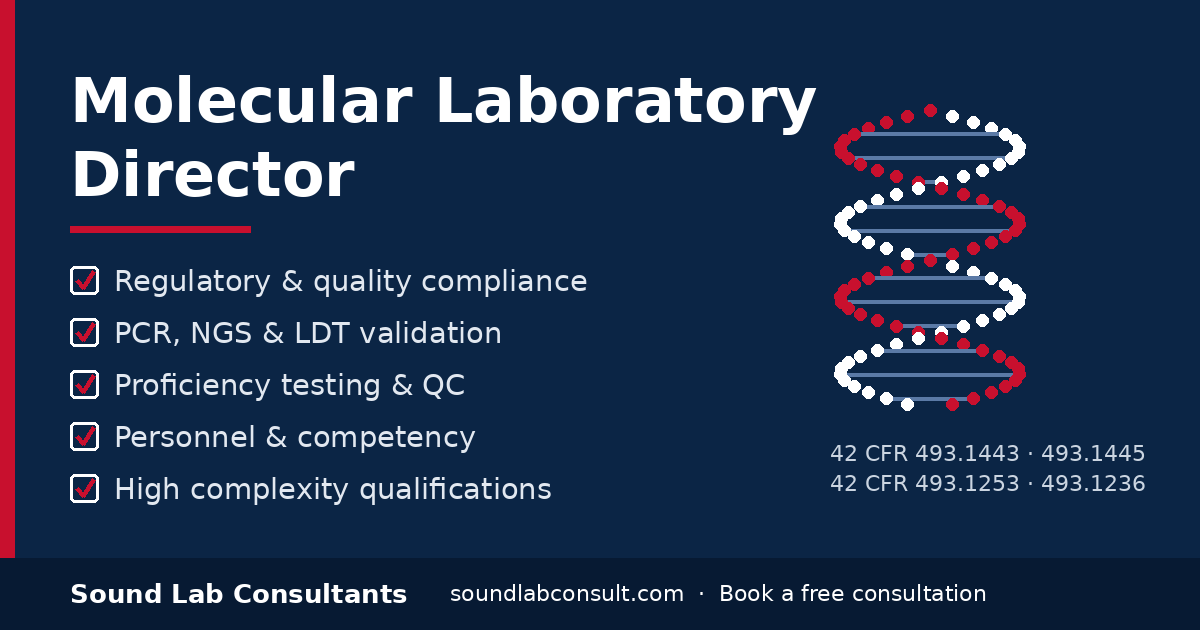
What a molecular laboratory director does
Every CLIA-certified laboratory that performs high complexity testing must have a director who meets 42 CFR 493.1443 and provides overall management and direction under 493.1445. In a molecular lab that means the director answers for every phase of nucleic acid testing: specimen collection and transport rules, extraction and amplification, sequencing and bioinformatics where they apply, result interpretation and the final report. The director may delegate many tasks in writing, but stays responsible for how they are performed.
Molecular testing raises the stakes on a few director duties in particular. Many molecular assays are laboratory developed tests (LDTs) or modified FDA-authorized tests, which CLIA treats as high complexity (42 CFR 493.17), so the lab itself has to establish performance before reporting. Contamination control, unidirectional workflow and amplicon handling affect result quality directly. And because many molecular tests are not CLIA regulated analytes, the director has to set up a twice-yearly accuracy check rather than relying on a ready-made PT event. For the wider program, see our CLIA laboratory director guide and our molecular diagnostics laboratory hub.
Core responsibilities
Regulatory and quality compliance
- Keep the CLIA certificate, specialty and subspecialty listings, and any state license current, and notify CMS or the state agency within 30 days of a director change (42 CFR 493.51).
- Make sure the physical plant and environment support accurate molecular testing, including separated pre- and post-amplification areas, and that safety and biohazard requirements are met.
- Run a quality assessment program that monitors the pre-analytic, analytic and post-analytic phases and documents corrective actions.
- Prepare the lab for CMS or state agency surveys and for accreditation inspections if the lab chooses an accrediting organization.
Test validation and reporting
- Select test methods that can produce the quality of results needed for patient care, and approve each method's performance specifications before use (42 CFR 493.1253).
- Establish acceptable levels of analytical performance, quality control and calibration, and make sure remedial action is taken when performance drops.
- Confirm that reports include what clinicians need to interpret a molecular result, such as the method, its limitations and any interpretive comments, and that consultation on results is available.
Personnel and operations
- Employ enough qualified personnel, define each person's duties in writing, and make sure staff are trained before testing patient specimens.
- Make sure a technical supervisor qualified under 42 CFR 493.1449 covers each specialty or subspecialty the lab tests in, and that competency is assessed on schedule.
- Keep procedures current, approved, signed and dated, and make sure they are available to testing personnel.
Test validation and verification for PCR, NGS and LDTs
Validation is where molecular directors spend the most time, and where survey findings often start. CLIA draws a clear line between two cases:
| Test type | What the lab must do (42 CFR 493.1253) | Director sign-off focus |
|---|---|---|
| Unmodified FDA-cleared or approved test (for example a commercial PCR panel run per the package insert) | Verify accuracy, precision, reportable range and that the manufacturer's reference intervals fit your patient population | Verification plan, acceptance criteria, data review and approval before first patient report |
| Laboratory developed test, or FDA test with any modification (new specimen type, extraction method, cutoff or instrument) | Establish accuracy, precision, analytical sensitivity (limit of detection), analytical specificity including interfering substances and cross-reactivity, reportable range, reference intervals and any other needed characteristic | Study design, sample numbers and matrices, limit of detection and inclusivity or exclusivity data, calibration and control procedures, final approval |
| NGS assays and bioinformatics pipelines | Treat the full wet-bench and informatics workflow as the test system: establish performance across variant types and regions, and re-verify after pipeline or software changes | Version control, change management and documented re-validation |
The director also decides when a change is big enough to require new validation work, such as a new extraction kit, a different thermocycler model or an updated reference database. Our guides on molecular PCR LDT validation and developing and validating an LDT go deeper. On the FDA side, a federal court vacated FDA's 2024 LDT rule in March 2025, so LDT oversight continues under CLIA; check FDA's LDT page for current status.
Proficiency testing and quality control
- Enroll and test like patient samples. The director makes sure the lab enrolls in an approved PT program for any regulated analytes, that PT samples are tested in the same way as patient specimens by the people who normally test them, and that PT results are never shared with another lab before the deadline.
- Twice-yearly accuracy checks for everything else. For molecular tests that are not regulated analytes, the lab must verify accuracy at least twice a year (42 CFR 493.1236(c)), using an external PT survey where one exists, split-sample comparison or another documented method.
- Act on failures. Unacceptable PT results need documented investigation and corrective action. Repeated failures can lead to sanctions on the specialty or the certificate; see non-compliance due to unsuccessful PT participation.
- Molecular quality control. Negative, positive and extraction or internal controls in each run, with contamination monitoring and documented review. Some labs use an IQCP for molecular testing where it applies.
Personnel, competency and the technical supervisor
CLIA does not list "molecular" as a stand-alone specialty. Molecular tests are certified under the specialty or subspecialty of what they detect, for example virology or bacteriology for infectious disease PCR. A high complexity lab therefore needs a technical supervisor qualified under 42 CFR 493.1449 for each of those specialties, plus a clinical consultant, a general supervisor and qualified testing personnel. The director may serve in more than one role if qualified for each. Staffing detail is on molecular lab staffing and personnel requirements and molecular lab technical supervisor.
Competency assessment for high complexity testing is the technical supervisor's duty under 42 CFR 493.1451, and the director makes sure it happens: before reporting, every 6 months during the first year a person tests patient specimens, and at least annually after that. Each assessment covers the six CLIA elements, from direct observation of testing to problem-solving skills. See the six elements of CLIA competency assessment.
Qualifications and board certification
A molecular lab director must hold any state laboratory director license that applies and meet one pathway in 42 CFR 493.1443(b):
| Pathway | Key requirements (as written) | Notes for molecular labs |
|---|---|---|
| MD or DO, pathology-certified | Licensed in the state, certified in anatomic or clinical pathology (or both) by the American Board of Pathology or the American Osteopathic Board of Pathology | The most direct route; molecular pathology training is common but not a separate CLIA requirement |
| MD, DO or DPM with experience | Licensed in the state, at least 2 years directing or supervising high complexity testing, plus 20 CE credit hours covering director duties | CMS is not currently enforcing the extra 20 CE hours (QSO-25-21-CLIA) |
| Doctoral scientist | Doctoral degree in a chemical, biological, clinical or medical laboratory science or medical technology (or another doctorate with 16 semester hours of qualifying coursework or a qualifying thesis), certification by an HHS-approved board, 2 years of training or experience and of directing or supervising high complexity testing, plus 20 CE hours | Typical route for PhD molecular scientists. CMS reads the experience as 2 years total and is not enforcing the 20 CE hours |
| Grandfathered director | Qualified and serving as a high complexity director in a CLIA-certified lab as of December 28, 2024, and serving continuously since | Keep employment and appointment records that prove continuous service |
Board certification. Doctoral directors need a board from the HHS list of approved boards. For molecular labs, a common route is the High-complexity Clinical Laboratory Director (HCLD) certification with the Molecular Diagnostics examination from the American Board of Bioanalysis, which defines molecular diagnostics as testing that manipulates and examines nucleic acid in a high complexity setting. Its standards require at least 4 years of experience in a CLIA-certified high complexity lab within the last 10 years, including 2 years directing or supervising high complexity testing; the board says it has also suspended its 20 CE requirement while CMS enforcement is paused. Other approved boards cover areas such as laboratory genetics and genomics, medical microbiology and clinical chemistry. Our high complexity lab director board certification and high complexity lab director (HCLD) guides compare the options.
2024 rule changes and the 2025 CMS enforcement discretion
- The 2023 final rule. CMS published the CLIA personnel rule at 88 FR 89976 on December 28, 2023; its personnel provisions took effect December 28, 2024. It narrowed which doctoral degrees qualify, added 20 CE credit hours to several director pathways, wrote the twice-yearly on-site visit rule into the director standards, and grandfathered directors serving on the effective date.
- The 2025 memo. CMS memo QSO-25-21-CLIA (June 23, 2025) says CMS will not require the additional 20 CE hours under 493.1443(b)(2)(iii) and (b)(3)(iv), and clarifies that the doctoral pathway needs 2, not 4, total years of training or experience and directing or supervising high complexity testing. CMS plans to address these points in future rulemaking, so recheck before you hire.
- What has not changed. The board certification requirement for doctoral directors, state license rules, the five-lab limit and the director's full set of responsibilities still apply. More detail is on CLIA personnel rule changes 2024 and CLIA lab director 20 CE hours.
On-site visits, the five-lab limit and state licenses
A high complexity director must be on site at least once every 6 months, with at least 4 months between the two minimum visits, document each visit, and be accessible for on-site, telephone or electronic consultation as needed. A person may direct no more than five laboratories (42 CFR 493.1445(d)). States such as New York, California, Florida and New Jersey add their own director licenses or certificates of qualification on top of CLIA, and New York requires approval for each specialty; see lab director license by state.
How Sound Lab Consultants helps
Sound Lab Consultants provides lab director services, including interim and long-term laboratory director coverage, and technical consultant services. For molecular labs we:
- Map your test menu, CLIA certificate and state to the director qualifications and specialty coverage you need.
- Arrange interim coverage when a director leaves, or long-term coverage for a new or growing molecular lab, within the five-lab limit and visit rules.
- Prepare validation and verification plans, PT and accuracy-check schedules, competency files and procedures for the director's review and approval.
- Help new labs plan the director role early; see how to start a clinical laboratory and how to start a molecular PCR lab.
Need a molecular lab director?
Share your state, certificate type and molecular test menu, and we will map the director requirements and coverage options.
Molecular laboratory director FAQ
What is a molecular laboratory director?
A molecular laboratory director is the CLIA laboratory director of a lab that performs molecular testing such as PCR, sequencing and other nucleic acid methods. The director is responsible for the lab's overall operation, regulatory compliance, quality assessment, test validation and verification, proficiency testing and personnel, and stays responsible for any duty that is delegated (42 CFR 493.1441 and 493.1445).
What qualifications does a molecular lab director need?
Most molecular methods are high complexity, so the director must meet 42 CFR 493.1443: any state director license that applies, plus one pathway such as an MD or DO certified in anatomic or clinical pathology, an MD, DO or DPM with at least 2 years directing or supervising high complexity testing, or a qualifying doctoral degree with certification by an HHS-approved board and at least 2 years of high complexity experience. Directors who were qualified and serving as of December 28, 2024 and have served continuously since keep their qualification.
Which boards qualify a PhD to direct a molecular lab?
A doctoral scientist needs certification by a board on the HHS list of approved boards for high complexity laboratory directors. One commonly used route for molecular labs is the High-complexity Clinical Laboratory Director (HCLD) certification with the Molecular Diagnostics examination offered by the American Board of Bioanalysis. Other HHS-approved boards cover areas such as laboratory genetics and genomics, medical microbiology and clinical chemistry. Check the current HHS list before you rely on a specific board.
Is the 20 CE credit hour requirement enforced for molecular lab directors?
Not at this time for most pathways. The 2023 personnel rule added 20 CE credit hours to several director pathways, but CMS memo QSO-25-21-CLIA (June 23, 2025) says CMS will not require the additional 20 CE hours under 493.1443(b)(2)(iii) and (b)(3)(iv), and that the doctoral pathway needs a total of 2, not 4, years of training or experience and directing or supervising high complexity testing. CMS plans to address these points in future rulemaking.
Does a technologist-level molecular biology certification qualify someone as director?
No. Technologist-level certifications in molecular biology document bench competence and can support testing personnel or supervisor qualifications, but they are not the doctoral board certification that the 493.1443(b)(3) pathway requires, and they do not replace the degree, experience and state license rules.
Who has to validate a PCR or NGS laboratory developed test?
The laboratory does, under the director's responsibility. For an unmodified FDA-cleared or approved test the lab verifies accuracy, precision, reportable range and reference intervals before reporting patient results. For a laboratory developed test or a modified FDA test the lab must establish accuracy, precision, analytical sensitivity, analytical specificity including interfering substances, reportable range, reference intervals and any other needed characteristic (42 CFR 493.1253). The director approves the study and signs off before go-live.
How does proficiency testing work for molecular tests?
Many molecular tests are not on CLIA's list of regulated analytes. For those tests the lab must still verify the accuracy of each test at least twice a year (42 CFR 493.1236(c)), usually through an external PT program, split samples with another lab or another documented method. The director makes sure PT samples are tested like patient samples and that unacceptable results lead to documented corrective action.
Can one person direct several molecular labs?
Yes, up to a limit. A person may direct no more than five laboratories (42 CFR 493.1445(d)) and must be on site at least once every 6 months with at least 4 months between the two minimum visits, with each visit documented. Between visits the director must be accessible for on-site, telephone or electronic consultation.
Does Sound Lab Consultants provide molecular lab director coverage?
Yes. Sound Lab Consultants provides lab director services, including interim and long-term laboratory director coverage, and technical consultant services. We map your test menu, CLIA certificate and state rules to the director qualifications that apply, then support the procedures, validation files, proficiency testing and competency records the director reviews. Book a free consultation to discuss your lab.
Official sources
- eCFR, 42 CFR 493.1441, Condition: high complexity laboratory director
- eCFR, 42 CFR 493.1443, High complexity laboratory director qualifications
- eCFR, 42 CFR 493.1445, High complexity laboratory director responsibilities
- eCFR, 42 CFR 493.1449, Technical supervisor qualifications
- eCFR, 42 CFR 493.1451, Technical supervisor responsibilities
- eCFR, 42 CFR 493.1253, Establishment and verification of performance specifications
- eCFR, 42 CFR 493.1236, Evaluation of proficiency testing performance
- eCFR, 42 CFR 493.17, Test categorization (modified and unreviewed tests are high complexity)
- eCFR, 42 CFR 493.51, Notification requirements (director change within 30 days)
- Federal Register, 88 FR 89976 (Dec. 28, 2023), CLIA fees, histocompatibility, personnel and alternative sanctions final rule (CMS-3326-F)
- CMS, QSO-25-21-CLIA, Enforcement discretion and clarification on personnel regulations (June 23, 2025)
- HHS/CMS guidance, Certification boards for laboratory directors of high complexity testing
- American Board of Bioanalysis (ABB), HCLD certification standards
- FDA, Laboratory developed tests
Related pages
Last reviewed: November 27, 2026. Sound Lab Consultants is an independent laboratory compliance consulting firm. This page is general regulatory information, not legal advice; confirm current requirements with CMS, your state agency and your accreditor. We are not affiliated with or endorsed by CMS, CDC, HHS, FDA, CAP, COLA, The Joint Commission, the American Association of Bioanalysts, the American Board of Bioanalysis or any other certification board or state agency. Board standards are summarized from the board's own page on November 27, 2026 and can change. Illustrations are original works by Sound Lab Consultants. Sound Lab Consultants, 25 S Arizona Pl, Chandler, AZ 85225.