
Short answer: Whether FeNO is a CLIA test depends on the exact analyzer, the site and the workflow, and the public record does not settle it. FDA has cleared several FeNO analyzers as Class II devices under 21 CFR 862.3080 (product code MXA). But SLC checked all 15 MXA premarket records against the 81,314 entries in FDA's November 23, 2026 CLIA categorization file and found no matching entry, so no FeNO analyzer appears there as waived, moderate or high complexity. In July 2026 CMS and CDC said the current CLIA regulations do not specifically address breath testing. In New York, the state's laboratory program decides the permit route. A site that wants to report FeNO results should get that determination in writing before it goes live.
Last reviewed: November 28, 2026. Regulatory sources checked November 28, 2026, including FDA device records and the FDA CLIA categorization file dated November 23, 2026. Links are in Sources.
Case summary: a health system weighing FeNO at outpatient sites
A large New York City public hospital system was considering fractional exhaled nitric oxide (FeNO) testing at its outpatient sites for asthma care. Before a planning meeting, its team needed more than a device list. They needed to know whether the proposed analyzer and workflow would count as clinical laboratory testing, which permits and quality rules would follow, and what to measure in a first pilot. Sound Lab Consultants (SLC) put together the regulatory pathway analysis and implementation plan summarized on this page.
| Item | Detail |
|---|---|
| Organization | A large New York City public hospital system (not named on this page) |
| Test | FeNO, a point-of-care breath measurement used in asthma care |
| Core question | Would the exact analyzer and workflow be treated as clinical laboratory testing at the intended site? |
| What SLC prepared | A pathway analysis across FDA, CLIA and New York rules, a pre-reporting checklist, a billing check and a written question for the state laboratory program |
| Sources checked | Federal and New York regulatory sources, FDA device records and clinical guidelines, checked November 28, 2026 |
| Status | Planning stage. This is an analysis and an implementation plan, not a report of a completed launch. Agency determinations, go-live dates and results are not part of this case. |
What FeNO measures and when it helps
Fractional exhaled nitric oxide is the concentration of nitric oxide gas in exhaled breath, reported in parts per billion (ppb). In type 2 airway inflammation, cytokines such as IL-13 prompt bronchial epithelial cells to make more inducible nitric oxide synthase, which raises the nitric oxide in the breath. FeNO therefore reflects one airway inflammation signal (airway epithelium study). A blood eosinophil count captures a different part of type 2 inflammation, so the two can disagree, and spirometry answers a separate question about airflow. FeNO adds information to symptoms, exacerbation history and lung-function testing. It does not replace them (ATS interpretation guideline; GINA 2026 Strategy Report).
| Clinical question | What FeNO adds |
|---|---|
| Could this be asthma? | In a patient with typical symptoms, a high result supports type 2 asthma when spirometry is normal, inconclusive or unavailable. The U.S. NAEPP guideline conditionally supports this use from age 5 when the diagnosis is still uncertain. A low result does not rule asthma out, especially after corticosteroid treatment or in asthma with less type 2 inflammation. |
| Is corticosteroid-responsive inflammation likely? | In a symptomatic patient, a high result makes an eosinophilic airway component, and a response to inhaled corticosteroids, more likely. A high result during treatment is a prompt to review inhaler technique, adherence and allergen exposure before concluding that inflammation persists despite adequate treatment. |
| Would serial results help manage established asthma? | In selected patients, repeat FeNO can help judge response when treatment decisions are uncertain. Read the trend with symptoms, exacerbations and lung function. NAEPP recommends against using FeNO alone to assess asthma control, predict exacerbations or grade an acute exacerbation. |
| Could it inform severe-asthma phenotyping? | GINA treats a FeNO of 20 ppb or higher as one possible sign of persistent type 2 inflammation in its adult and adolescent severe-asthma pathway. Biologic eligibility still depends on the drug, the history and payer criteria. |
Sources: U.S. NAEPP focused updates, recommendations 1-4; ATS treatment guideline; GINA 2026 severe-asthma guide.
How to read a FeNO result
For nonsmoking patients being evaluated for asthma who are not taking corticosteroids, the U.S. NAEPP interpretation table uses these bands. Treat them as clinical decision bands, and record anything that could move a result.
| Interpretation | Adults and older adolescents | Children ages 5-12 |
|---|---|---|
| Low: eosinophilic inflammation and corticosteroid responsiveness are less likely | Under 25 ppb | Under 20 ppb |
| Intermediate: interpret with symptoms, treatment and lung function | 25-50 ppb | 20-35 ppb |
| High: type 2 airway inflammation and corticosteroid responsiveness are more likely in a symptomatic patient | Over 50 ppb | Over 35 ppb |
Atopy, allergic rhinitis and allergen exposure can raise FeNO. Smoking and inhaled or systemic corticosteroids can lower it. A recent respiratory illness, exercise, nitrate-rich food, time of day and the analyzer used can also shift a result. For serial measurements, use the same device under comparable conditions when feasible. ATS suggests that a fall of at least 20% from a value above 50 ppb, or of more than 10 ppb from a value below 50 ppb, can indicate a meaningful response to anti-inflammatory treatment. ATS grades that trend recommendation as weak.
For a pediatric workflow, check two sets of ages: the ages in the clinical guideline and the ages in the device's U.S. labeling. They are not always the same (NAEPP Table II; ATS interpretation guideline; GINA 2026, Appendix A).
What the outcomes evidence supports
ATS conditionally recommends adding FeNO to usual care when asthma treatment is being considered. Its pooled analysis estimated a lower risk of an exacerbation with FeNO-guided care, with a relative risk of 0.72 (95% CI 0.56-0.93). The evidence for hospitalizations and day-to-day symptom control was less conclusive (ATS evidence review). In the later RAACENO randomized trial of 509 children aged 6 to 15, 48.2% of the FeNO-guided group and 51.4% of the usual-care group had an exacerbation treated with oral corticosteroids, a difference that was not statistically significant (RAACENO trial). For a pediatric pilot, the practical lesson is to measure whether the result changes clinical decisions before assuming an effect on emergency visits or admissions.
How the test is performed
The patient inhales through the device as directed, seals their lips around a single-patient mouthpiece or filter, and breathes out steadily against resistance. The standard oral measurement targets an exhalation flow of 50 mL/sec, because the measured concentration changes with the rate of exhalation. The maneuver and device design help limit contributions from nasal and ambient nitric oxide. Traditional analyzers use chemiluminescence, and several handheld systems use electrochemical sensing. When FeNO and spirometry are both scheduled, FeNO goes first. For acceptable maneuvers, repeat attempts and result release, follow the selected model's instructions, and record a failed maneuver as unable to obtain a valid measurement (ATS/ERS standardized procedures; ERS technical standard).
The regulatory pathway: five questions in order
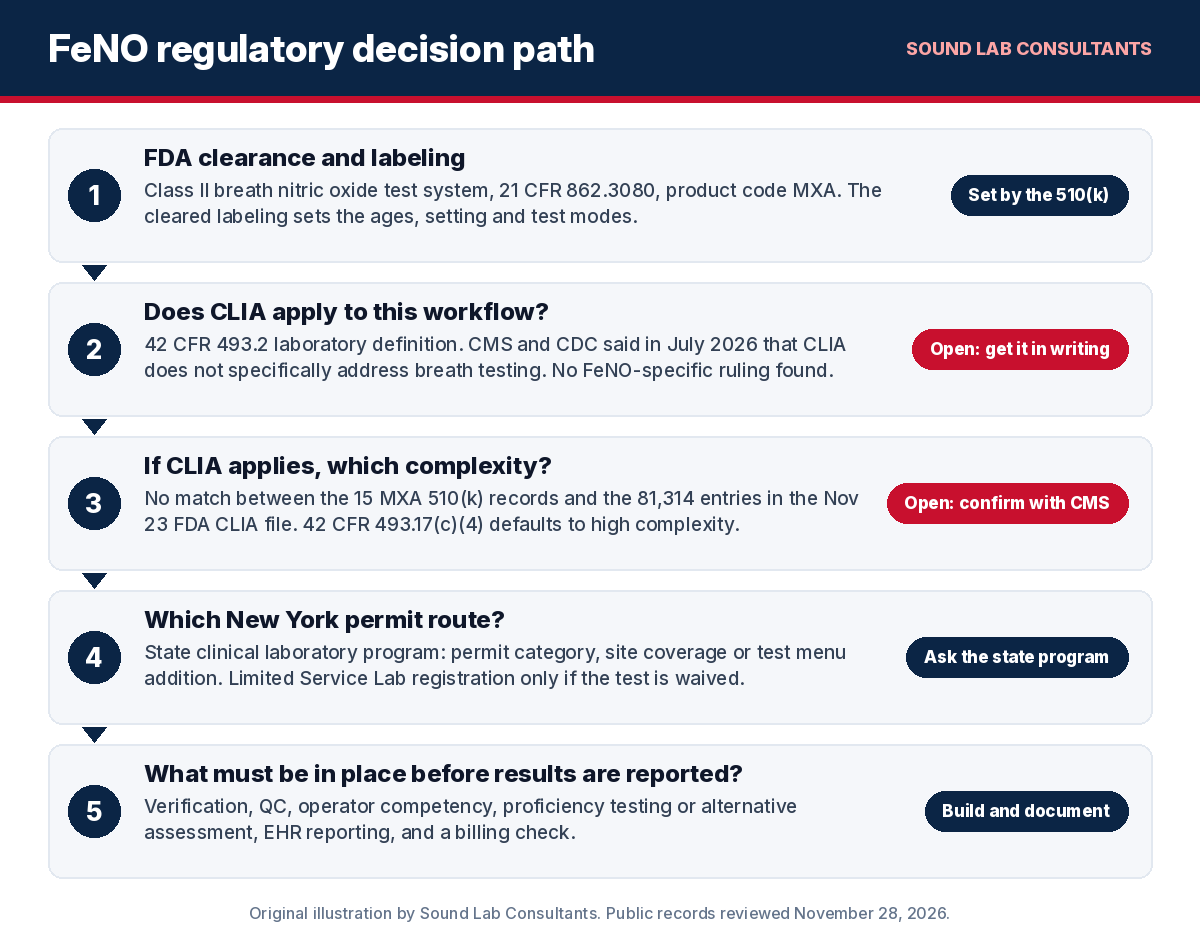
The analysis separated questions that people often blend together. FDA clearance of a device, CLIA applicability, CLIA test complexity and a New York permit are four different determinations, and the fifth step is the quality system that has to exist before results reach a chart.
1. FDA regulates the analyzer and its labeled use
FDA classifies breath nitric oxide test systems as Class II devices with special controls under 21 CFR 862.3080, product code MXA (FDA classification record). The regulation describes an adjunctive role in evaluating response to anti-inflammatory therapy, and FDA has special-controls guidance for these systems (FDA guidance). The exact U.S. labeling for the model sets the cleared population, setting and test modes. That matters for procurement, particularly when a site wants to test young children.
| Device and FDA record | Pediatric labeling detail |
|---|---|
| NIOX VERO - K170983 | Age 7 and older. The six-second mode is for ages 7-10 who cannot complete the 10-second maneuver. |
| NObreath - K203695 | Age 7 and older. The 10-second mode is for ages 7-10 who cannot complete the 12-second maneuver. |
| Fenom Pro - K213611 | Age 6 and older under this clearance. Confirm the exact device version and instructions. |
| Fenom Flo - K251674 | Labeled for age 7 and older. |
| Vivatmo pro-S - K243926 | Describes pediatric use at approximately 7-17 years, plus adults. |
Device names appear only as factual references to FDA records. SLC has no affiliation with, and does not endorse, any device or manufacturer.
2. CLIA applicability comes first
The federal laboratory definition in 42 CFR 493.2 covers the examination of materials derived from the human body for diagnosis, treatment, prevention or health assessment. In July 2026, CMS and CDC said that the current CLIA regulations do not specifically address breath testing, and they asked for input on clinical breath-testing workflows. That request for information is a step toward possible rulemaking (July 2026 request for information). The public material reviewed for this case contained no FeNO-specific ruling for the proposed workflow.
3. Complexity comes next, if CLIA applies
SLC compared FDA's 15 MXA premarket records with the 81,314 entries in the November 23 FDA CLIA file, matching on submission numbers, device names and analyte terms, and found zero matches (FDA premarket data; FDA CLIA categorization data). That tells us what the public file shows. It does not settle whether the workflow falls under CLIA, and it does not rule out a separate written decision issued to a manufacturer. If CMS determines that the workflow is covered and the system is uncategorized, 42 CFR 493.17(c)(4) provides the high complexity default until it is categorized. A "point-of-care" label describes where a test is used. A CLIA waiver needs its own basis.
4. New York decides the site's permit and oversight route
New York Public Health Law Article 5, Title V, including section 571 and section 574, together with 10 NYCRR Subpart 58-1, governs covered clinical laboratory testing. CMS recognizes New York's state laboratory program under CLIA. For covered testing, Wadsworth Center's Clinical Laboratory Evaluation Program (CLEP) should confirm the performing site, the permit category and any addition to the test menu or site coverage (CLEP permits). If a health system proposes a pulmonary-function or respiratory-care workflow outside the clinical laboratory, it should describe that workflow explicitly and ask CLEP for its determination. For hospital extension clinics and hospital-owned practices, New York's Limited Service Laboratory registration covers waived testing and provider-performed microscopy, and that route depends on the test's actual status (Limited Service Laboratories).
New York also amended Subpart 58-1 and adopted Subpart 58-6 on September 2, 2026, which updated permit and director qualification requirements (September 2026 amendments). See also our guides to the CLEP permit and the partial CLIA exemption and New York clinical laboratory forms.
5. Modified use can trigger test review
The plan kept the initial workflow inside the chosen model's U.S. instructions. For an unmodified FDA-cleared assay that falls within an existing, appropriate permit category, CLEP generally allows use without a separate assay approval submission. Material changes to the specimen, the procedure, the test's purpose or the target population can bring New York's assay-modification and laboratory-developed test review into play. Bag collection with delayed analysis, a custom sensor, a younger population and an altered test purpose are all examples to raise with CLEP before implementation (Wadsworth test approval and modification policy). FDA's 2024 LDT rule was vacated in 2025, and New York continues to run its own review program (FDA LDT rule status). For background, see LDT vs IVD and New York CLEP LDT approval.
| Question | What the record shows | Status |
|---|---|---|
| Is the analyzer FDA-cleared? | Yes. Class II, 21 CFR 862.3080, product code MXA, with model-specific labeling. | Confirm the exact model and 510(k) |
| Does CLIA apply to the workflow? | No FeNO-specific ruling found. CMS and CDC published a breath-testing request for information in July 2026. | Open |
| What is the CLIA complexity? | Zero matches between 15 MXA records and 81,314 entries in the Nov 23 FDA CLIA file. High complexity default under 493.17(c)(4) if CMS finds the workflow covered and uncategorized. | Open |
| What New York permit route applies? | Depends on whether the workflow is clinical laboratory testing and on the test's status. | Ask CLEP in writing |
| Is the use modified? | Not in the initial plan. Changes to specimen, procedure, purpose or population can trigger review. | Keep to the labeled use |
What a site needs in place before reporting results
Whatever the final regulatory answer, the plan set out five areas a site should document before FeNO results reach the record. If laboratory standards apply, several of these become formal CLIA and state requirements. If they do not, they are still the controls that make a result trustworthy.
| Area | What to document |
|---|---|
| Ownership and site coverage | Name the ordering service, the performing location, the accountable medical director and the team that releases results. Include respiratory therapy, pulmonary function, laboratory or point-of-care leadership, and compliance in the decision. If the test falls under laboratory oversight, verify the site's permit coverage and operator qualifications before launch. |
| Method verification | For a covered nonwaived laboratory workflow, document verification of accuracy, precision, reportable range and the appropriateness of reference values for the population. If the method or intended use changes, determine what added validation is needed. Include performance near the clinical decision points, and agreement across devices or sites if their results will be trended together. |
| QC and maintenance | Use the model's U.S. instructions for control type, frequency and limits, daily checks, sensor and consumable expiry, and maintenance. For example, the U.S. NIOX VERO manual requires QC to be enabled and a qualified QC measurement each day the device is used clinically. Define when to hold results, how to investigate a failure and how to review affected patient results. |
| Competency and external assessment | Train operators in patient coaching, recognizing invalid maneuvers, infection prevention, QC and reporting. If laboratory standards apply, document competency on the applicable schedule and settle the proficiency testing route. New York's General Systems Standards specify at least semiannual reliability and accuracy assessment when the alternative-to-proficiency-testing standard applies. |
| Reporting and traceability | Report the numeric FeNO in ppb with the date and site. Keep device, operator and QC information traceable. Distinguish a valid low reading, a result outside the device's reportable range and an unsuccessful test. Capture corticosteroid use and other interpretation factors in the clinical record, and check patient identification, interfaces and result corrections before clinical use. |
Sources: 42 CFR Part 493, including section 493.1253; CMS competency guidance; Wadsworth General Systems Standards; NIOX VERO U.S. manual, section 5.8. Related guides: method verification and validation, CLIA quality control, competency assessment, proficiency testing and LIS and interface verification.
Check billing early
The procedure code for FeNO is CPT 95012 (CMS procedure-code reference). New York Medicaid lists it under Never Pay Procedures Under APG Reimbursement, with "No" in the carve-out column (NYSDOH APG Never Pay list; NYSDOH APG billing guidance). That is material for a hospital outpatient pilot paid under that methodology. Before projecting any revenue, revenue cycle staff should verify the exact site, claim type and payer contract, including Medicaid managed care and professional billing. Our clinical lab billing team runs this kind of check alongside the regulatory work.
Four decisions to settle at the planning stage
- Which clinical decision should FeNO change? Clarifying suspected asthma, monitoring response to treatment and evaluating severe asthma each need different ordering and follow-up.
- Where, and by whom, would testing happen? Identify the first site, the legal entity performing the test, the expected patient ages, the operators and who releases the result. Decide whether the health system wants advice on its own service or expects an outside team to perform or oversee testing.
- Which exact analyzer and workflow are under consideration? Get the model, the 510(k) number, the current U.S. instructions and any written FDA or CMS communication on CLIA status. Bring those details and the site's existing permit information to the state program.
- What would justify expansion? For an initial site, measure valid-result rates by age, whether FeNO changed the documented clinical decision, turnaround time, cost per valid result and actual reimbursement where billed.
The written question to the state laboratory program
The most useful single step was a precise written question to the state program. Vague questions get general answers. A question that names the analyzer, the site and the workflow can get a determination a team can file and rely on. SLC helps clients draft this kind of question and the supporting packet. Here is the template SLC drafted for the case, with placeholders in brackets:
At [site name and address], staff would use [analyzer model and 510(k) number] to measure breath directly from the patient and enter the numeric FeNO result in the electronic health record for asthma care. Does New York treat this workflow as clinical laboratory testing? If so, what permit category, site coverage, test complexity, personnel qualifications and quality requirements apply?
Send it to Wadsworth CLEP through the contact options on its CLEP contact page. If federal applicability stays open, CMS lists its CLIA inquiry channel on its CLIA support page. Three items were still to be confirmed when this analysis was prepared: the exact analyzer, the performing site with its existing permit coverage, and a written agency determination.
How SLC helps bring a new test in-house
FeNO is one example. The same questions come up whenever a hospital, clinic or laboratory adds a test it has never run: Is it laboratory testing? Under which certificate or permit? What has to be verified or validated? Who performs it, and how are results reported and billed? SLC works through them in order, and builds the documents an inspector or state program will ask for.
| Workstream | What SLC does | Related guide |
|---|---|---|
| Applicability and complexity | Determines whether CLIA applies and which complexity category fits, from FDA records, CMS data and written agency answers. | CLIA certificate types and test complexity |
| Certificates and permits | Plans CLIA certificate changes, New York CLEP permits, test menu and site coverage additions, and Limited Service Laboratory registration where it fits. | CLIA certification; New York lab consulting |
| LDT and modified-test validation | Classifies a test as unmodified, modified or laboratory developed, then writes the validation plan and report and prepares New York review submissions. | LDT consulting; LDT validation; LDT CLIA requirements |
| Method verification | Designs and documents verification of accuracy, precision, reportable range and reference values for FDA-cleared methods. | test menu expansion and new test validation |
| QC, competency and PT | Sets QC plans, operator training and competency records, and proficiency testing or alternative assessment. | CLIA quality control; proficiency testing |
| EHR reporting | Reviews result formats, units, reportable ranges, interfaces and corrected-result handling. | LIS verification |
| Billing checks | Checks codes, payer rules and claim types before volume or revenue is projected. | clinical lab billing |
| Full lab setup | Builds a new laboratory from the test menu through licensing, personnel, procedures, validation and accreditation. | Lab Startup Program; hospital laboratory management |
If your team is weighing a new test, a new analyzer or a new site, the planning questions on this page are a good starting list. For menu planning, see our guide to expanding a CLIA laboratory's test menu.
Adding a new test or a new site?
Book a free consultation. Bring the test, the analyzer or method, the site and your current permit information.
Book a free consultationTakeaways for any lab adding a new test
- FDA clearance is not a CLIA category. A cleared device does not by itself tell you whether CLIA applies or how complex the test is.
- Check the labeling, not just the guideline. Cleared ages, settings and test modes can be narrower than what a clinical guideline supports.
- Ask the regulator in writing, and be specific. Name the analyzer, the site, the workflow and who reports the result.
- Define the performing site and legal entity first. Permits and personnel rules attach to the site that performs the test.
- Stay inside the labeled use at the start. Changes to specimen, procedure, purpose or population can add a review pathway.
- Check billing before you build the business case. Payer rules can change the economics of a test that looks sound clinically.
- Pilot with measures that matter. Valid-result rate, change in the documented clinical decision, turnaround time, cost per valid result and actual reimbursement.
Frequently asked questions
Is FeNO a CLIA test?
It depends on the analyzer, the site and the workflow, and the public record does not give a clear answer. CLIA applies to the examination of materials from the human body for diagnosis, treatment, prevention or health assessment (42 CFR 493.2). In July 2026 CMS and CDC said the current CLIA regulations do not specifically address breath testing and asked for input. A site should seek a written determination from the state laboratory program and, if federal applicability stays open, from CMS.
Is FeNO CLIA waived?
No FeNO analyzer appeared as waived in the records SLC reviewed. A cross-check of all 15 FDA premarket records under product code MXA against the 81,314 entries in FDA's November 23, 2026 CLIA categorization file found no matching entry. Being cleared by FDA, or labeled for point-of-care use, is not the same as being CLIA waived, which needs its own basis.
Does a New York site need a CLEP permit to offer FeNO testing?
That depends on whether New York treats the specific workflow as clinical laboratory testing. If it does, Wadsworth CLEP confirms the permit category and any addition to the site's test menu or coverage. Hospital extension clinics and hospital-owned practices may use Limited Service Laboratory registration, but only for waived testing and provider-performed microscopy. The safest step is to describe the analyzer, site and workflow in writing and ask CLEP for its determination.
Is breath testing covered by CLIA?
The CLIA regulations do not specifically address breath testing. CMS and CDC published a request for information on clinical breath-testing workflows in July 2026, which is a step toward possible rulemaking. Until rules change, applicability is judged against the general laboratory definition in 42 CFR 493.2 and the facts of the workflow.
Which FeNO analyzers has FDA cleared, and for what ages?
Examples from FDA records include NIOX VERO (K170983, age 7 and older), NObreath (K203695, age 7 and older), Fenom Pro (K213611, age 6 and older under that clearance), Fenom Flo (K251674, age 7 and older) and Vivatmo pro-S (K243926, approximately 7 to 17 years plus adults). Always confirm the exact device version and current U.S. instructions. This is not an endorsement of any device.
What do FeNO results mean?
For nonsmoking patients evaluated for asthma and off corticosteroids, NAEPP bands adults and older adolescents as low under 25 ppb, intermediate 25 to 50 ppb and high over 50 ppb. For children ages 5 to 12 the bands are under 20, 20 to 35 and over 35 ppb. Results are read with symptoms, treatment and lung function, and several factors such as allergen exposure, smoking, corticosteroids and recent illness can shift them.
What does a site need before it reports FeNO results?
Document who orders, performs and releases results and at which site, verify the method for the population where laboratory standards apply, set QC and maintenance from the model's U.S. instructions, train and assess operators, settle proficiency testing or an alternative assessment, and confirm EHR reporting in ppb with traceable device, operator and QC data. Check billing before projecting revenue.
Can a hospital bill for FeNO testing in New York?
The procedure code is CPT 95012. New York Medicaid lists it under Never Pay Procedures Under APG Reimbursement with No in the carve-out column, which matters for hospital outpatient services paid under that methodology. Revenue cycle teams should verify the site, claim type and payer contract, including Medicaid managed care and professional billing, before projecting revenue.
Is FeNO testing an LDT?
An unmodified FDA-cleared FeNO analyzer used within its U.S. instructions is not a laboratory developed test. Material changes to the specimen, procedure, test purpose or target population, such as bag collection with delayed analysis or a custom sensor, can bring New York's assay-modification and LDT review into play. FDA's 2024 LDT rule was vacated in 2025, and New York continues to operate its own review program.
How does a hospital or lab bring a new test in-house?
Start by confirming whether CLIA and state rules apply and at what complexity. Then secure the right certificate or permit and site coverage, verify or validate the method, set QC, competency and proficiency testing, build and test EHR reporting, and check billing. SLC helps with each step, from applicability and complexity determinations to full lab setup.
Ready to plan a new test?
Book a free consultation. We will review the test, the site and the regulatory questions to settle first.
Book a free consultationSources
- GINA 2026 Strategy Report
- FDA device classification, product code MXA
- FDA CLIA categorization data
- Human airway epithelium study
- ATS interpretation guideline
- U.S. NAEPP focused updates (recommendations 1-4, Table II)
- ATS treatment guideline and evidence review
- GINA 2026 severe-asthma guide
- RAACENO randomized trial
- ATS/ERS standardized measurement procedures
- ERS technical standard
- 21 CFR 862.3080, breath nitric oxide test system
- FDA special-controls guidance
- NIOX VERO, K170983
- NObreath, K203695
- Fenom Pro, K213611
- Fenom Flo, K251674
- Vivatmo pro-S, K243926
- 42 CFR 493.2
- CMS/CDC July 2026 request for information on CLIA and breath testing
- FDA premarket (510(k)) data
- 42 CFR 493.17
- New York Public Health Law section 571
- New York Public Health Law section 574
- Wadsworth CLEP: obtain a permit
- Wadsworth CLEP: Limited Service Laboratories
- Wadsworth: September 2026 amended regulations
- Wadsworth: test approval and modification policy
- FDA: laboratory developed tests
- 42 CFR Part 493, including section 493.1253
- CMS competency guidance
- Wadsworth General Systems Standards
- NIOX VERO U.S. user manual
- CMS procedure-code reference
- NYSDOH APG Never Pay procedures
- NYSDOH APG billing guidance
- Wadsworth CLEP contact page
- CMS CLIA support
This case study describes a regulatory pathway analysis and implementation plan prepared for a planning meeting. It is general information, not legal advice, and it does not report a completed launch, an agency determination or any outcome. Always confirm requirements with the relevant agencies. We are not affiliated with or endorsed by FDA, CMS, CDC, CAP, COLA, The Joint Commission, AAB, the New York State Department of Health, Wadsworth Center, any device manufacturer or any health system. Illustrations are original works by Sound Lab Consultants.