
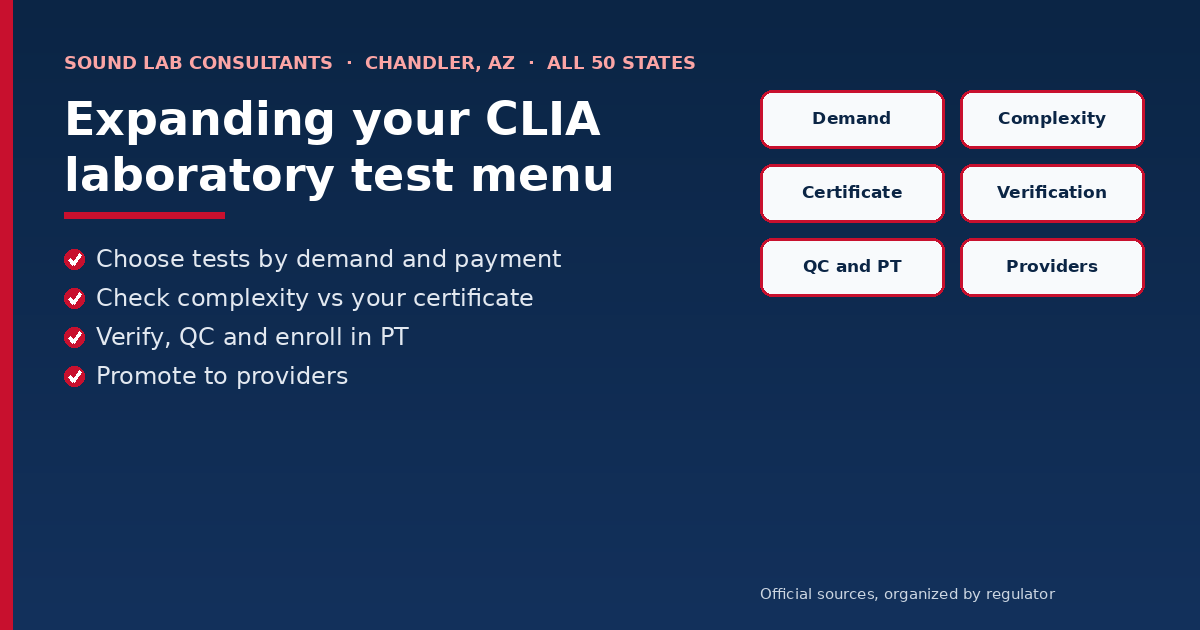
Short answer: Adding a test to a CLIA menu starts with demand and reimbursement, then a regulatory check: the test's FDA complexity must fit your CLIA certificate, your director and staff must be qualified for it, and nonwaived tests need method verification (or full validation for modified or laboratory-developed tests), quality control and proficiency testing before patient results are reported.
Last reviewed November 25, 2026. Primary sources: FDA CLIA categorizations, 42 CFR 493.1253.
This guide first ran as an edition of the Sound Lab Consultants newsletter on our lab news page. It now lives here, and the news page has become our lab regulatory news and official sources hub.
Introduction
Adding tests to your CLIA (Clinical Laboratory Improvement Amendments) test menu is one of the most direct ways a clinical laboratory can grow. A broader menu can increase revenue and make life easier for the physicians and providers who send you specimens.
Clinical laboratories provide the diagnostic information that guides patient care. New tests let you meet changing diagnostic needs, stand out from other testing options in your market, and contribute to better patient outcomes. This guide walks through the benefits, how to choose tests, what to plan for, and how to keep quality and compliance intact.
Understanding CLIA and laboratory test menus
CLIA sets federal quality standards for laboratory testing on human specimens. The Centers for Medicare & Medicaid Services (CMS) runs the program, the FDA assigns each commercial test a complexity (waived, moderate or high), and the CDC supports the program with research and guidance.
Your test menu is the set of tests your laboratory performs under its CLIA certificate. Expanding it broadens the services you can offer, but every new test has to fit the certificate you hold. A Certificate of Waiver lab can add only waived tests; adding a moderate or high complexity test means upgrading to a Certificate of Compliance or Certificate of Accreditation first, with a qualified laboratory director. See CLIA certificate types and test complexity.
Benefits of expanding laboratory test menus
- More revenue: a broader range of tests can bring in more referrals and higher test volume.
- Better diagnostic capability: new tests let your laboratory support more complete patient assessments.
- A stronger position in your market: physicians and providers value having a wide range of tests available from one laboratory.
Strategies for selecting new laboratory tests
- Market analysis: identify what your referring providers order today and send out, and which tests match current clinical practice.
- Relevance and clinical utility: choose tests that address common conditions, add diagnostic value and complement your existing menu.
- Cost analysis: weigh instrument and reagent costs, staffing, reimbursement rates and expected return. Check Medicare rates on the CMS Clinical Laboratory Fee Schedule and coverage in the Medicare Coverage Database.
- Complexity check: look up each test system in the FDA CLIA categorizations database before you commit.
Considerations for implementing new tests
- Facility and equipment: make sure you have the space, instruments, utilities and trained personnel to support the new tests.
- Verification and validation: for unmodified FDA-cleared or approved nonwaived tests, verify accuracy, precision, reportable range and reference intervals under 42 CFR 493.1253 before reporting patient results. Modified tests and laboratory-developed tests need full validation.
- Quality control: set up QC procedures, calibration and calibration verification so results stay accurate and reliable over time.
- Certificate and state updates: notify your State Agency or accrediting organization of new specialties, and check any state license requirements.
Adding tests and not sure what your certificate covers?
We map complexity, personnel, verification and PT for every new test before you buy the instrument.
Book a free consultationPromoting new tests to physicians and providers
- Educational outreach: hold short sessions or webinars that explain the new tests and their clinical uses.
- Relationships with providers: work with local practices, hospitals and medical societies to raise awareness and referrals.
- Updated materials: refresh your test directory, requisitions, fact sheets and website so providers can find and order the new tests.
Keep marketing within federal fraud and abuse rules; see the HHS OIG Compliance Program Guidance for Clinical Laboratories.
Enhancing revenue opportunities
- Outreach programs: offer testing services to community clinics, nursing homes and physician offices.
- Reference testing: offer specialized tests to other laboratories and health care facilities.
- Payer coverage: work with payers on coverage and reimbursement for the new tests, and make sure coding and medical necessity documentation are in place.
Ensuring quality and compliance
- Proficiency testing: enroll regulated analytes in a CMS-approved PT program and review every event (see 42 CFR 493 Subpart H).
- Regulatory compliance: stay current on CLIA regulations, accreditation standards and state rules. Our lab regulatory news and official sources page links to every official source.
- Quality improvement: monitor the new tests' performance, turnaround time and error rates, and act on what you find.
Maximizing physician and provider satisfaction
- Convenience: a broad in-house menu saves providers time and simplifies ordering.
- Collaboration: ask providers for feedback and involve them in choosing and rolling out new tests.
- Clinical support: offer prompt, reliable help with test selection and result interpretation.
Conclusion
Expanding your test menu under CLIA can grow revenue and improve satisfaction among physicians and providers. Success comes from understanding your market, choosing relevant tests, implementing them with proper verification and quality control, and building strong relationships with the providers who order them.
If you are planning a menu expansion, Sound Lab Consultants can map the certificate, personnel, verification and PT steps for each new test.
Related pages
Frequently asked questions
Do I need a new CLIA certificate to add a test?
Not always. If the new test's FDA complexity is covered by your current certificate, you add it under the same certificate, though you may need to notify your State Agency or accreditor of new specialties. A Certificate of Waiver lab adding a moderate or high complexity test must first upgrade its certificate.
What has to happen before reporting patient results on a new test?
For a nonwaived test, the laboratory must complete method verification (or full validation for modified tests and LDTs), set up QC and calibration, train and assess staff, and have the procedure approved by the laboratory director.
How do I check a test's complexity?
Search the test system in the FDA CLIA categorizations database. The listing shows whether the test is waived, moderate or high complexity.
Need help applying these rules to your lab?
Sound Lab Consultants helps laboratories turn CMS, FDA, state and accreditor requirements into a working compliance program: CLIA applications, state licenses, COLA, CAP and Joint Commission accreditation, policies, PT and survey preparation.
Book a free consultationLinks are provided for reference; Sound Lab Consultants (SLC) is not affiliated with, endorsed by or acting for these organizations, including CMS, FDA, CDC, OSHA, DOT, SAMHSA, NIH, NIST, HHS OIG, CAP, COLA, The Joint Commission, A2LA, AABB, ASHI, any state agency, any association or any manufacturer. This page is general information, not legal advice; confirm requirements with the agency or accreditor. Sound Lab Consultants, 25 Arizona Pl, Chandler, AZ 85225.