
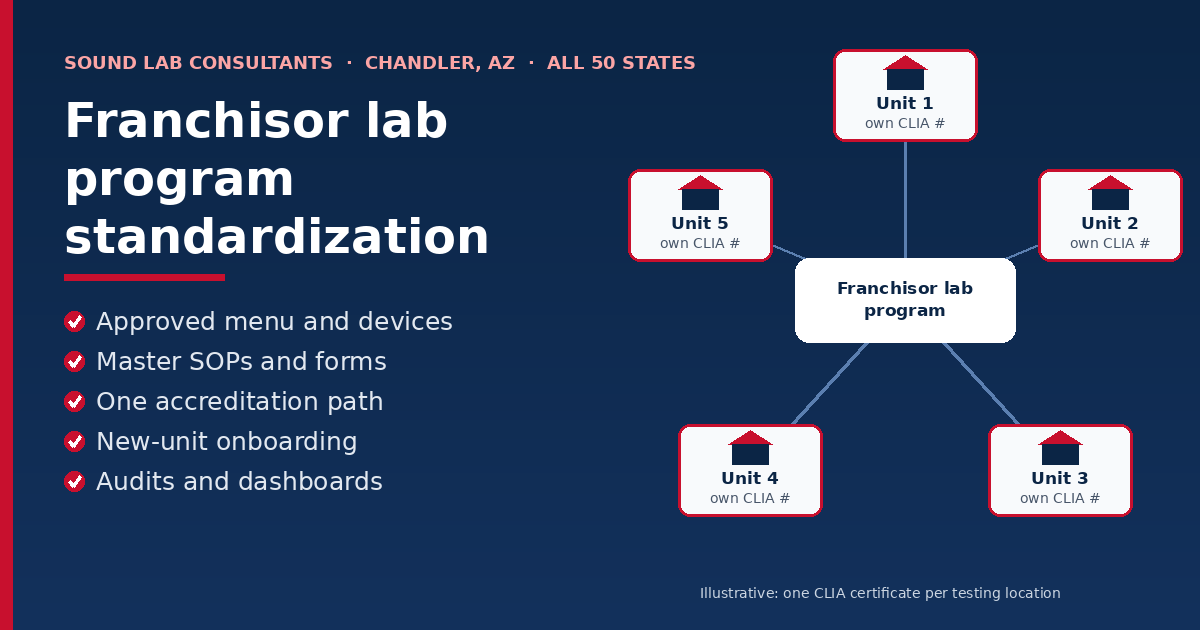
Short answer: A franchisor lab program usually includes an approved test menu by unit tier, an approved device list checked against FDA categorization, master SOP and form templates, a QC and competency framework, one accreditation or survey path for non-waived units, a new-unit lab onboarding timeline, minimum director and technical consultant standards, and a periodic audit with a status dashboard. Franchisees remain the CLIA certificate holders and adapt templates to their own lab.
Last reviewed November 25, 2026. Primary sources: CMS Clinical Laboratory Improvement Amendments (CLIA) program, FDA CLIA test categorization database, 42 CFR 493.1251.
Why franchisors standardize the lab
Lab problems in one unit can affect the whole brand: a survey finding, a billing denial pattern, a missed critical result or a patient complaint. Standardization reduces the number of ways units can go wrong, makes training portable when staff move between units, and makes it possible to see compliance across the system. It also lowers the effort for each franchisee, because the hard regulatory reading has been done once.
Components of a franchise lab program
| Component | What the franchisor provides | What each franchisee does |
|---|---|---|
| Test menu by tier | Waived, PPM and moderate complexity tiers with criteria for each | Chooses a tier per unit; applies for the matching certificate |
| Approved devices | Device list with FDA categorization, specimen types and vendor terms | Uses only approved devices; checks categorization at changes |
| Master SOPs | Templates for each test and process | Adapts to the unit, has the unit director approve and sign |
| Forms and logs | QC, temperature, maintenance, competency, PT review, corrective action | Completes them; keeps records at the unit |
| Personnel standards | Minimum director and technical consultant qualifications and coverage models | Engages qualified people and keeps personnel files |
| Accreditation path | One path for non-waived units | Applies and hosts surveys |
| Reference lab | System arrangement or approved list | Follows specimen and courier procedures |
| Onboarding | New-unit lab timeline and checklist | Completes steps before opening |
| Audit | Periodic remote and on-site review with a scorecard | Corrects findings and documents |
Writing brand standards that do not conflict with CLIA
Brand standards must meet or exceed the regulations and the manufacturer's instructions. Watch for these conflicts:
- QC frequency in the brand manual lower than the package insert or 42 CFR 493.1256 requires.
- A single corporate SOP that does not match the device, kit or workflow at a given unit; procedures must reflect what is actually done and be approved by that unit's director.
- Competency forms that skip one of the six required elements for non-waived testing.
- Expectations that medical assistants perform tests their education does not qualify them for.
- Pressure to open units on a schedule before the certificate, director and verification are complete.
- Brand incentives or fees tied to lab volume, which should be reviewed by healthcare counsel.
Planning a franchise lab, or adding units?
Tell us your brand, your test menu and how many locations you are opening. We will map certificates, director coverage and a setup timeline for each unit.
Book a free consultationNew-unit lab onboarding
A standard onboarding timeline makes the lab part of opening rather than an afterthought. A typical sequence: tier selection at lease signing; director and technical consultant engaged; CMS-116 and state license filed; devices ordered from the approved list; SOP templates adapted; staff trained; verification completed for non-waived tests; PT enrolled; interface verified; go-live sign-off by the unit director; first audit within the first few months. See the franchise lab consulting hub for the full step-by-step setup.
Audits, scorecards and dashboards
An audit program tells the franchisor which units need help before a surveyor finds out. A practical scorecard covers certificate status and expiration, director roster and visits, PT enrollment and results, QC review, competency currency, procedure approval dates, temperature logs, reagent expiration and open corrective actions. Remote monthly review of a few records, combined with periodic on-site visits and mock surveys, catches most drift. Results should go to the franchisee, who owns the correction.
Managing device and vendor changes across the system
Brands change respiratory test vendors, analyzer platforms and reference labs. Each change ripples into every unit's lab. A change management process should cover: checking the FDA categorization of the new device for each specimen type, confirming that no unit's certificate is exceeded, updating SOP templates and forms, scheduling training and, for non-waived tests, verification and competency before the new system reports patient results, updating PT enrollment, adjusting interfaces, and setting a cutover date per unit. Units should not start using a new device until their own director has approved the updated procedure.
| Change | Lab steps required at each unit |
|---|---|
| New waived device | Check categorization; update SOP; train; start QC per insert |
| New non-waived analyzer | Certificate check; verification; QC plan; PT; competency; interface verification |
| New reference lab | Update collection and shipping procedures, supplies and result routing |
| Test removed from menu | Retire SOP; update PT enrollment; notify providers |
A system-wide lab training program
Franchise systems already train every new hire on brand operations. Adding a lab module keeps testing consistent: waived testing basics and the brand's approved devices; specimen collection and labeling; QC and what to do when it fails; result entry and critical values; PPM training for providers where applicable; bloodborne pathogens and safety; and, for non-waived units, the competency program. Training is not the same as competency assessment, which must be performed and documented at each laboratory by a qualified assessor. A shared curriculum, delivered online with unit-level sign-off, gives franchisees a head start.
Choosing one accreditation path for the system
Picking one path for non-waived units, whether COLA, CAP, The Joint Commission or CLIA-only state surveys, lets the system write one set of forms and train once. Consider the brand's care model, whether units are inside health systems that already use an accreditor, and the level of checklist detail the system wants. See COLA vs CAP vs The Joint Commission.
Franchisor lab program checklist
| Program element | In place? |
|---|---|
| Tiered test menu with criteria | Yes / No |
| Approved device list with categorization | Yes / No |
| Master SOPs and forms | Yes / No |
| Personnel standards and coverage models | Yes / No |
| Accreditation path chosen | Yes / No |
| Reference lab arrangement | Yes / No |
| New-unit onboarding timeline | Yes / No |
| Audit scorecard and schedule | Yes / No |
| Change management for device or vendor switches | Yes / No |
How a lab consultant supports franchisors
Sound Lab Consultants can write the lab program, build the templates, review device categorization, design the audit and scorecard, train franchisee teams and perform audits and mock surveys. Franchisees can engage the same consultant for unit-level director, technical consultant and oversight work, which keeps the system consistent. See laboratory quality management system and SOP writing services.
Get your franchise lab set up right, unit by unit
Sound Lab Consultants helps franchisees, multi-unit operators and franchisors set up in-office labs, obtain CLIA certificates for every location, choose COLA, CAP or Joint Commission accreditation, cover director roles and keep every unit compliant.
Book a free consultationFrequently asked questions
Can a franchisor require franchisees to use certain lab devices?
Franchise agreements commonly set approved supplier and equipment lists. From a CLIA perspective, each franchisee still verifies and operates the devices in its own lab under its own certificate.
Can a franchisor write SOPs for franchisee labs?
Yes, as templates. Each laboratory's procedures must reflect what that lab actually does and be approved by that lab's director.
Is the franchisor liable for franchisee lab compliance?
CLIA obligations fall on the certificate holder and director. Questions about franchisor liability under franchise and healthcare law should go to counsel.
Should every unit be accredited?
Waived and PPM units do not need accreditation. For non-waived units, choosing one path across the system simplifies forms and training.
How often should franchisors audit unit labs?
Many programs combine monthly remote record review with periodic on-site audits and a mock survey before each inspection window.
Franchise lab guides
- Franchise lab consulting (overview)
- Urgent care franchise lab setup
- Physician office franchise labs
- Occupational health franchise labs
- Women's health franchise labs
- Med spa and weight loss franchise labs
- Men's health franchise labs
- Multi-location CLIA compliance
Sources
- CMS Clinical Laboratory Improvement Amendments (CLIA) program
- FDA CLIA test categorization database
- 42 CFR 493.1251, Procedure manual
- 42 CFR 493.1256, Control procedures
- 42 CFR 493.1235, Personnel competency assessment policies
- 42 CFR 493.801, Condition: Enrollment and testing of samples (proficiency testing)
- CMS State Operations Manual Appendix C: Survey Procedures and Interpretive Guidelines for Laboratories
- College of American Pathologists, accreditation checklists
- 42 CFR 493.35, 493.43 and 493.55, application per location and multiple-site exceptions (eCFR)
- CMS, How to obtain a CLIA certificate
- CDC, To Test or Not to Test: considerations for waived testing
- 29 CFR 1910.1030, Bloodborne pathogens (OSHA)
- COLA, laboratory accreditation (public site)
- The Joint Commission, laboratory accreditation (public site)
Related pages
Sound Lab Consultants is an independent clinical laboratory consulting company. We are not affiliated with or endorsed by CMS, FDA, CDC, OSHA, DOT, CAP, COLA, The Joint Commission, any state agency, any instrument manufacturer or any franchise brand. This page is general information, not legal, franchise or billing advice; confirm requirements with the agency, accreditor, payer or your counsel. Sound Lab Consultants, 25 Arizona Pl, Chandler, AZ 85225.