
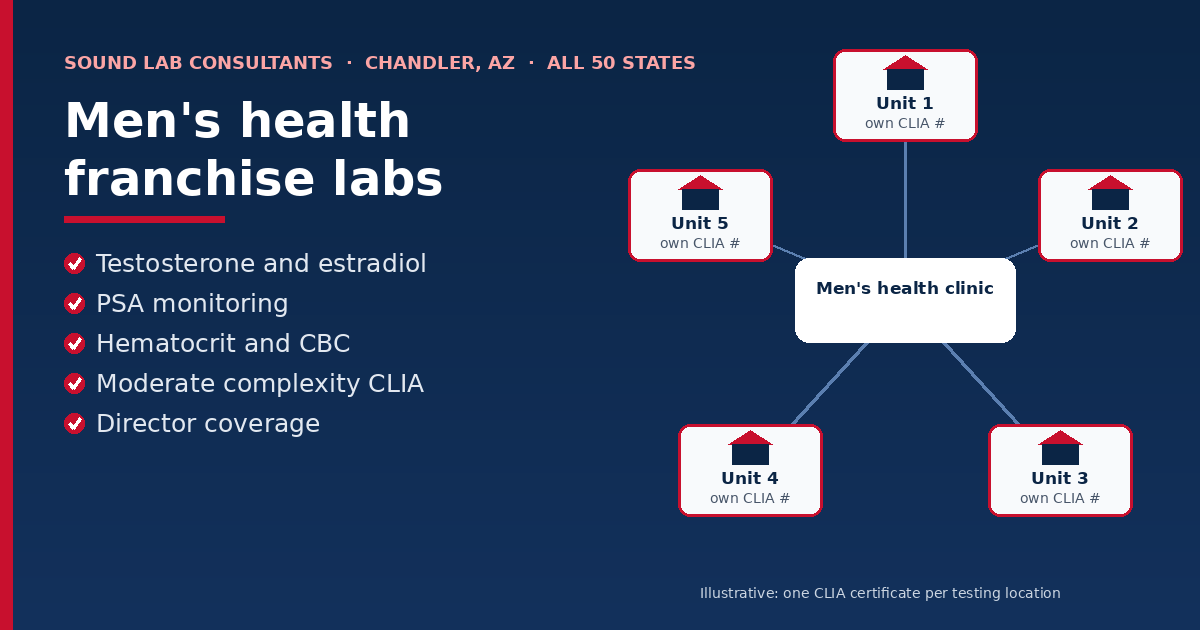
Short answer: A men's health franchise unit that runs testosterone, estradiol, PSA or similar immunoassays on a benchtop analyzer is usually a moderate complexity laboratory. It needs a Certificate of Compliance or Accreditation, a laboratory director qualified under 42 CFR 493.1405 who directs no more than five non-waived labs, a technical consultant, qualified testing personnel, method verification, daily QC, calibration verification, proficiency testing and competency assessment. Hematocrit may be waived or moderate depending on the device.
Last reviewed November 25, 2026. Primary sources: CMS Clinical Laboratory Improvement Amendments (CLIA) program, CMS Form CMS-116, FDA CLIA test categorization database.
Men's health franchise test menu
| Test | Typical method | Usual category |
|---|---|---|
| Total testosterone | Benchtop immunoassay analyzer or send-out | Moderate on most analyzers |
| Free testosterone, SHBG | Usually send-out | Moderate to high |
| Estradiol | Immunoassay analyzer or send-out | Moderate |
| PSA | Immunoassay analyzer or send-out | Moderate |
| Hematocrit or hemoglobin | Point-of-care device or hematology analyzer | Waived or moderate depending on device |
| CBC | Hematology analyzer or send-out | Moderate |
| Lipids, CMP, A1c | Chemistry analyzer, point-of-care or send-out | Waived or moderate |
| LH, FSH, prolactin, TSH | Immunoassay analyzer or send-out | Moderate |
Clinical guidelines from specialty societies describe which tests are used for evaluation and monitoring of testosterone therapy; the brand's medical leadership sets the protocol, and the lab plan follows it. Our testosterone lab testing page covers methods and pitfalls.
What moderate complexity means for every unit
Putting an immunoassay analyzer in a franchise unit makes that unit a full CLIA laboratory for those tests:
| Requirement | Rule | Practical note |
|---|---|---|
| Certificate | Certificate of Compliance or Accreditation | Certificate of Registration first; survey or inspection follows |
| Laboratory director | 42 CFR 493.1405 | On site at least every 6 months; no more than five PPM or non-waived labs |
| Technical consultant | 42 CFR 493.1411 | Verification, QC review, PT review, competency |
| Testing personnel | 42 CFR 493.1423 | Education records for every person who runs the analyzer |
| Method verification | 42 CFR 493.1253 | Accuracy, precision, reportable range, reference intervals |
| QC | 42 CFR 493.1256 | Two levels each day of testing by default, or approved IQCP |
| Calibration verification | 42 CFR 493.1255 | At least every 6 months and after major changes |
| Proficiency testing | 42 CFR 493.801 | Enroll for regulated analytes on the menu |
| Competency | 42 CFR 493.1235 | Semiannual first year, then annual; six elements |
Reference intervals and result consistency across units
Hormone results vary by method. If units use different analyzers, or if some units send out while others test in-house, a patient's testosterone results may not be directly comparable from one location to another. Franchise systems should standardize the analyzer platform where possible, verify reference intervals at each unit, print the method and interval on reports, and tell providers when a patient's results come from a different method. When a brand changes platforms, plan a comparison study before switching.
Planning a franchise lab, or adding units?
Tell us your brand, your test menu and how many locations you are opening. We will map certificates, director coverage and a setup timeline for each unit.
Book a free consultationDirector coverage for multi-unit men's health operators
Because almost every men's health unit with an analyzer is non-waived, the five-laboratory limit bites quickly. A franchisee with twelve units needs at least three qualified directors. Each director must make documented on-site visits to each lab at least once every six months, with at least four months between visits, and must be reachable for consultation. Plan director coverage before signing for new territories, and keep a roster showing which director covers which CLIA number. See laboratory director services and the multi-location guide.
Proficiency testing for hormone analyzers
Several hormone and tumor marker analytes are regulated for proficiency testing purposes, and the list was updated in recent CLIA rulemaking. Each unit enrolls separately, tests PT samples the same way as patient specimens, and investigates any unacceptable result. PT samples must never be sent to another laboratory, including a sister clinic, and results must never be compared with another unit before submission. For non-regulated analytes, the lab must still verify accuracy at least twice a year. See proficiency testing requirements.
Analyzer selection, space and downtime planning
Choosing the analyzer is a compliance decision as much as a purchasing one. Before a brand standardizes on a platform, confirm the FDA categorization of each assay on that system, the reportable range against the values the clinic expects to see in treated patients, sample type, run time, reagent stability once opened, calibration frequency, QC material availability, interface options and service response times. Ask how many tests per day the unit must run to keep reagents in date.
The bench needs dedicated power with surge protection, stable room temperature within the manufacturer's range, a centrifuge for serum or plasma separation, a laboratory refrigerator with a temperature log, and room to separate specimen processing from testing. Every unit also needs a written downtime plan: which tests go to the reference lab when the analyzer is down, how specimens are stored and shipped, and how providers are told results will be delayed.
| Selection question | Why it matters |
|---|---|
| Is each assay moderate complexity on this platform? | Sets the certificate, personnel and QC requirements |
| Does the reportable range cover expected treated values? | High results may need dilution or send-out |
| How long are opened reagents stable? | Drives waste at low-volume units |
| What QC material and PT programs exist for each assay? | Needed before go-live |
| Can results interface to the EHR? | Avoids manual transcription errors |
| What is the service response time? | Determines downtime frequency and send-out cost |
Billing and payer realities
Many men's health franchises are cash-pay, but some bill insurance for evaluation and monitoring labs. Where claims are filed, the unit's CLIA number must be active for the address and certificate type, and payers may restrict which in-office tests they pay to the clinic. In cash-pay models, the lab must still meet every CLIA requirement; payment method does not change the regulations. Brands that bundle lab testing into memberships should make sure the clinical protocol, not the bundle, drives which tests are ordered. See physician office lab billing.
Men's health franchise lab checklist
| Item | Status before first patient result |
|---|---|
| Certificate of Registration for moderate complexity | Issued |
| Director qualified, named and under the five-lab limit | Documented |
| Technical consultant agreement | Signed |
| Testing personnel education records | On file |
| Method verification and reference intervals | Approved by director |
| QC plan or IQCP | Approved |
| PT enrollment | Confirmed for regulated analytes |
| Calibration and calibration verification schedule | Set |
| Competency calendar | Set for each tester |
| SOP manual | Director-approved |
| EHR result interface | Verified |
| Accreditation path | COLA, CAP, Joint Commission or state survey chosen |
Ongoing oversight for men's health franchise labs
Monthly oversight covers QC review, calibration and calibration verification dates, PT events, competency, reagent lot changes, director visit documentation and survey preparation. For multi-unit operators, a consultant also keeps the director roster and certificate calendar. See the franchise lab consulting hub and our men's health clinic startup guide.
Get your franchise lab set up right, unit by unit
Sound Lab Consultants helps franchisees, multi-unit operators and franchisors set up in-office labs, obtain CLIA certificates for every location, choose COLA, CAP or Joint Commission accreditation, cover director roles and keep every unit compliant.
Book a free consultationFrequently asked questions
Is in-house testosterone testing CLIA waived?
Generally no. Most analyzer-based testosterone tests are moderate complexity, which requires a Certificate of Compliance or Accreditation and full non-waived requirements. Check the device in the FDA CLIA database.
Can our men's health franchise share one lab director across all units?
One person may direct no more than five PPM or non-waived laboratories, so larger operators need more than one director.
Do men's health franchise labs need proficiency testing?
Yes, for regulated analytes performed on non-waived systems. Each unit enrolls and tests its own PT samples.
Can medical assistants run the hormone analyzer?
Only if they meet the testing personnel requirements in 42 CFR 493.1423 for moderate complexity testing and have documented training and competency.
Should every unit use the same analyzer?
Standardizing the platform makes results more comparable across units and simplifies procedures, training and PT. Each unit still verifies its own instrument.
Franchise lab guides
- Franchise lab consulting (overview)
- Urgent care franchise lab setup
- Physician office franchise labs
- Occupational health franchise labs
- Women's health franchise labs
- Med spa and weight loss franchise labs
- Multi-location CLIA compliance
- Franchisor lab program standardization
Sources
- CMS Clinical Laboratory Improvement Amendments (CLIA) program
- CMS Form CMS-116, CLIA application for certification
- FDA CLIA test categorization database
- 42 CFR 493.1405, Laboratory director qualifications (moderate complexity)
- 42 CFR 493.1253, Establishment and verification of performance specifications
- 42 CFR 493.1255, Calibration and calibration verification
- 42 CFR 493.1256, Control procedures
- 42 CFR 493.801, Condition: Enrollment and testing of samples (proficiency testing)
- 42 CFR 493.1235, Personnel competency assessment policies
- 42 CFR 493.35, 493.43 and 493.55, application per location and multiple-site exceptions (eCFR)
- CMS, How to obtain a CLIA certificate
- CDC, To Test or Not to Test: considerations for waived testing
- 29 CFR 1910.1030, Bloodborne pathogens (OSHA)
- COLA, laboratory accreditation (public site)
- The Joint Commission, laboratory accreditation (public site)
Related pages
Sound Lab Consultants is an independent clinical laboratory consulting company. We are not affiliated with or endorsed by CMS, FDA, CDC, OSHA, DOT, CAP, COLA, The Joint Commission, any state agency, any instrument manufacturer or any franchise brand. This page is general information, not legal, franchise or billing advice; confirm requirements with the agency, accreditor, payer or your counsel. Sound Lab Consultants, 25 Arizona Pl, Chandler, AZ 85225.