
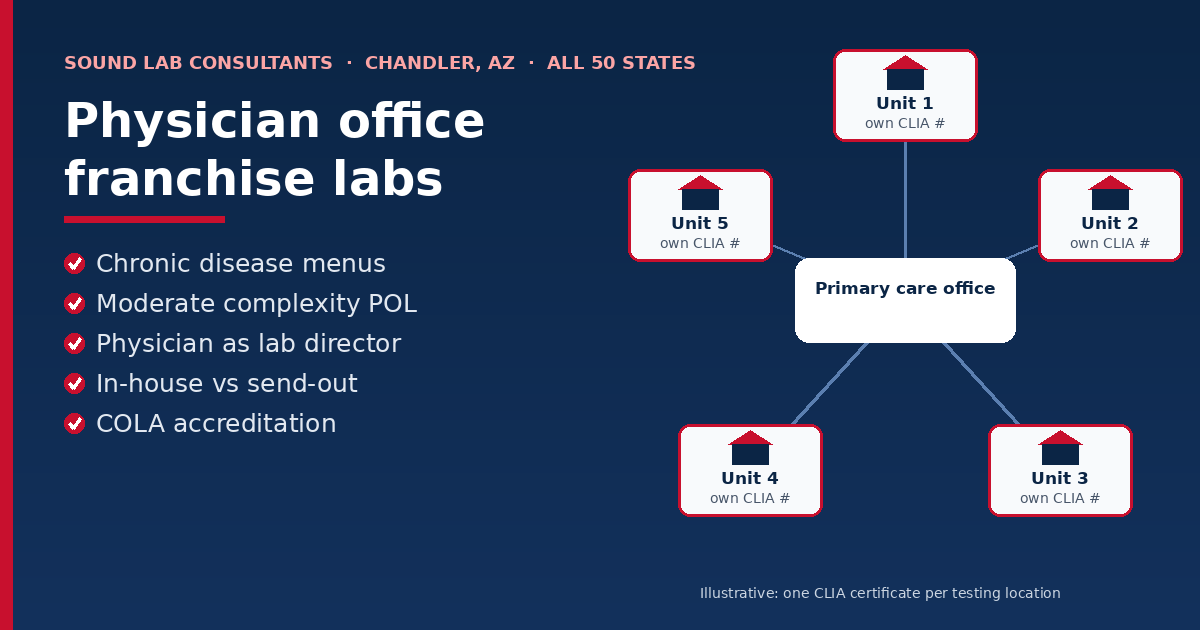
Short answer: A primary care franchise unit with only point-of-care tests such as A1c, glucose, urinalysis and rapid strep can operate under a Certificate of Waiver. Units that run a chemistry, lipid or CBC analyzer become moderate complexity physician office laboratories and need a Certificate of Compliance or Accreditation, a laboratory director qualified under 42 CFR 493.1405, a technical consultant, method verification, QC, calibration verification, proficiency testing and competency assessment. Many franchise POLs use COLA accreditation.
Last reviewed November 25, 2026. Primary sources: CMS Clinical Laboratory Improvement Amendments (CLIA) program, CMS Form CMS-116, FDA CLIA test categorization database.
Primary care franchise test menus
A primary care menu follows the conditions the clinic manages most: diabetes, high blood pressure, high cholesterol, thyroid disease, anemia, kidney function, infections and pregnancy. Pediatric units add lead screening, hemoglobin and rapid infectious disease tests.
| Test group | Common approach | Category |
|---|---|---|
| A1c, glucose, urine albumin | Point-of-care device in the exam area | Many waived; check the device and its intended use, since some A1c systems are cleared for monitoring only |
| Lipid panel | Waived point-of-care device or chemistry analyzer | Waived or moderate depending on system |
| BMP, CMP, liver and kidney panels | Benchtop chemistry analyzer or send-out | Moderate on most analyzers |
| CBC with differential | Benchtop hematology analyzer or send-out | Moderate |
| TSH, vitamin D, other immunoassays | Usually send-out; immunoassay analyzer in high-volume units | Moderate |
| Urinalysis | Dipstick or reader; microscopy by provider | Waived; PPM for sediment |
| Rapid strep, flu, COVID-19, RSV, mono | Point-of-care | Mostly waived |
| Hemoglobin, lead (pediatrics) | Point-of-care | Waived devices available |
Deciding what to run in-house versus send out
Not every test that is ordered often should be run in the office. A franchise system should give units a decision rule rather than an analyzer list. Weigh:
- Clinical value of a same-visit result: A1c and lipids at a diabetes visit change the conversation; a vitamin D level rarely needs to be back in 15 minutes.
- Volume and reagent stability: low-volume tests waste reagent and controls and are harder to keep competent on.
- Personnel: moderate complexity testing requires qualified testing personnel and a director and technical consultant who can cover the unit.
- Quality workload: each analyzer brings QC, calibration and calibration verification every six months under 42 CFR 493.1255, PT and competency.
- Reference lab service: turnaround, courier times and result delivery into the EHR.
- Compliance of the business model: in-office testing billed by physicians relies on conditions in the physician self-referral law's in-office ancillary services exception; counsel should confirm ownership and supervision structures, especially in franchise models.
Our physician office laboratory guide goes into the single-practice version of this decision.
The physician as laboratory director
In many primary care franchise units, the clinic's medical director wants to serve as laboratory director. For a moderate complexity POL that is possible if the physician meets 42 CFR 493.1405. Since the December 2024 personnel changes, a licensed MD or DO who is not board certified in pathology generally needs at least one year directing or supervising non-waived testing and at least 20 continuing education credit hours covering laboratory director responsibilities. Physicians who were already qualified and serving as a moderate complexity director as of December 28, 2024 and have served continuously are grandfathered.
| Requirement | What a franchise physician director must do |
|---|---|
| Qualifications | Meet 42 CFR 493.1405 and any state director license; submit proof with the CMS-116 |
| On-site presence | Be on site at least once every 6 months, with at least 4 months between visits, and document what was done |
| Five-lab limit | Direct no more than five PPM or non-waived laboratories |
| Responsibilities | Overall operation: test selection, verification, QC, PT, competency, procedures, reporting and personnel |
| Delegation | May delegate duties in writing to qualified people, but remains responsible |
Where the medical director does not qualify, or the operator has more units than one director can cover, an outside laboratory director and technical consultant are common.
Planning a franchise lab, or adding units?
Tell us your brand, your test menu and how many locations you are opening. We will map certificates, director coverage and a setup timeline for each unit.
Book a free consultationMethod verification and quality system for a new POL
Before a new chemistry or CBC analyzer reports a patient result, the laboratory must verify that the FDA-cleared test performs as the manufacturer states in that lab, with those staff. For unmodified tests that means accuracy, precision, reportable range and verification that the manufacturer's reference intervals fit the patient population (42 CFR 493.1253). The verification study and the director's approval should be on file before go-live. See instrument verification.
After go-live, the quality system includes daily QC under 42 CFR 493.1256 or an approved IQCP, calibration and calibration verification, proficiency testing for regulated analytes under 42 CFR 493.801, competency assessment, a director-approved procedure manual, temperature and maintenance logs, and a quality assessment program that looks for problems across the whole testing process.
Running the same POL model across franchise units
A primary care brand that opens analyzer units in several territories should standardize the parts that can be standardized: the approved analyzer models, the master procedure manual, QC rules and forms, PT provider, competency checklists and interface specifications. What cannot be standardized is the certificate, the director's on-site presence, the verification study and the people. Each unit verifies its own analyzer and assesses its own staff. Where a system runs the same test on more than one instrument or at more than one site, see IQCP for new tests at multiple sites and the multi-location CLIA compliance guide.
Billing basics for franchise POLs
The certificate type must support every code billed, the CLIA number on claims must be active for the unit's address, and waived codes carry the QW modifier on Medicare claims where required. Many payers also limit which in-office tests they will pay to the office versus a contracted reference lab, so confirm payer policies before adding a test. See POL billing and Medicare lab billing basics.
Primary care franchise POL checklist
| Area | Checklist item |
|---|---|
| Menu | Test list approved by medical leadership; categorization checked per device |
| Certificate | Waiver, PPM, Compliance or Accreditation chosen per unit; CMS-116 and state license filed |
| Director | Qualifications documented; on-site visit schedule set; five-lab count checked |
| Technical consultant | Named; responsibilities written; competency assessor qualified |
| Testing personnel | Education records on file for everyone who runs non-waived tests |
| Verification | Accuracy, precision, reportable range and reference intervals documented |
| QC and calibration | QC rules written; calibration verification every 6 months |
| PT | Enrolled for regulated analytes; results reviewed and signed |
| Procedures | Director-approved SOP for every test, matching current kits |
| Interfaces | Orders and results verified in the EHR |
| Safety | OSHA bloodborne pathogens and hazard communication programs |
| Accreditation | COLA, CAP, Joint Commission or state survey path chosen |
Ongoing oversight for physician office franchise labs
Monthly oversight for a franchise POL typically includes QC review, PT tracking, competency scheduling, calibration verification due dates, procedure updates, director visit documentation and mock surveys before COLA, CAP or state surveys. See the franchise lab consulting hub for the full franchise program and COLA survey preparation for inspection help.
Get your franchise lab set up right, unit by unit
Sound Lab Consultants helps franchisees, multi-unit operators and franchisors set up in-office labs, obtain CLIA certificates for every location, choose COLA, CAP or Joint Commission accreditation, cover director roles and keep every unit compliant.
Book a free consultationFrequently asked questions
Can our medical director be the laboratory director for a franchise POL?
Yes, if the physician meets 42 CFR 493.1405 and any state requirement. A licensed MD or DO without pathology board certification generally needs at least one year directing or supervising non-waived testing and 20 CE credit hours covering director responsibilities, unless grandfathered.
Which primary care tests are waived?
Many point-of-care A1c, glucose, lipid, urine dipstick, urine hCG, hemoglobin and rapid infectious disease tests are waived. Categorization depends on the exact device, so check the FDA CLIA database.
Does a primary care franchise lab need COLA accreditation?
No. Moderate complexity labs may choose a Certificate of Compliance with state surveys or a Certificate of Accreditation through COLA, CAP or The Joint Commission. Many POLs choose COLA.
How often must a franchise POL perform calibration verification?
For non-waived tests, calibration verification is required at least every six months and when certain events occur, such as major maintenance or reagent changes, under 42 CFR 493.1255.
Can franchise units share one analyzer verification study?
No. Each laboratory verifies the performance of its own test systems before reporting patient results. A franchisor can supply a common protocol and forms.
Franchise lab guides
- Franchise lab consulting (overview)
- Urgent care franchise lab setup
- Occupational health franchise labs
- Women's health franchise labs
- Med spa and weight loss franchise labs
- Men's health franchise labs
- Multi-location CLIA compliance
- Franchisor lab program standardization
Sources
- CMS Clinical Laboratory Improvement Amendments (CLIA) program
- CMS Form CMS-116, CLIA application for certification
- FDA CLIA test categorization database
- 42 CFR 493.1405, Laboratory director qualifications (moderate complexity)
- 42 CFR 493.1253, Establishment and verification of performance specifications
- 42 CFR 493.1255, Calibration and calibration verification
- 42 CFR 493.1256, Control procedures
- 42 CFR 493.1235, Personnel competency assessment policies
- 42 CFR 493.801, Condition: Enrollment and testing of samples (proficiency testing)
- 42 CFR 411.355(b), in-office ancillary services exception
- 42 CFR 493.35, 493.43 and 493.55, application per location and multiple-site exceptions (eCFR)
- CMS, How to obtain a CLIA certificate
- CDC, To Test or Not to Test: considerations for waived testing
- 29 CFR 1910.1030, Bloodborne pathogens (OSHA)
- COLA, laboratory accreditation (public site)
- The Joint Commission, laboratory accreditation (public site)
Related pages
Sound Lab Consultants is an independent clinical laboratory consulting company. We are not affiliated with or endorsed by CMS, FDA, CDC, OSHA, DOT, CAP, COLA, The Joint Commission, any state agency, any instrument manufacturer or any franchise brand. This page is general information, not legal, franchise or billing advice; confirm requirements with the agency, accreditor, payer or your counsel. Sound Lab Consultants, 25 Arizona Pl, Chandler, AZ 85225.