
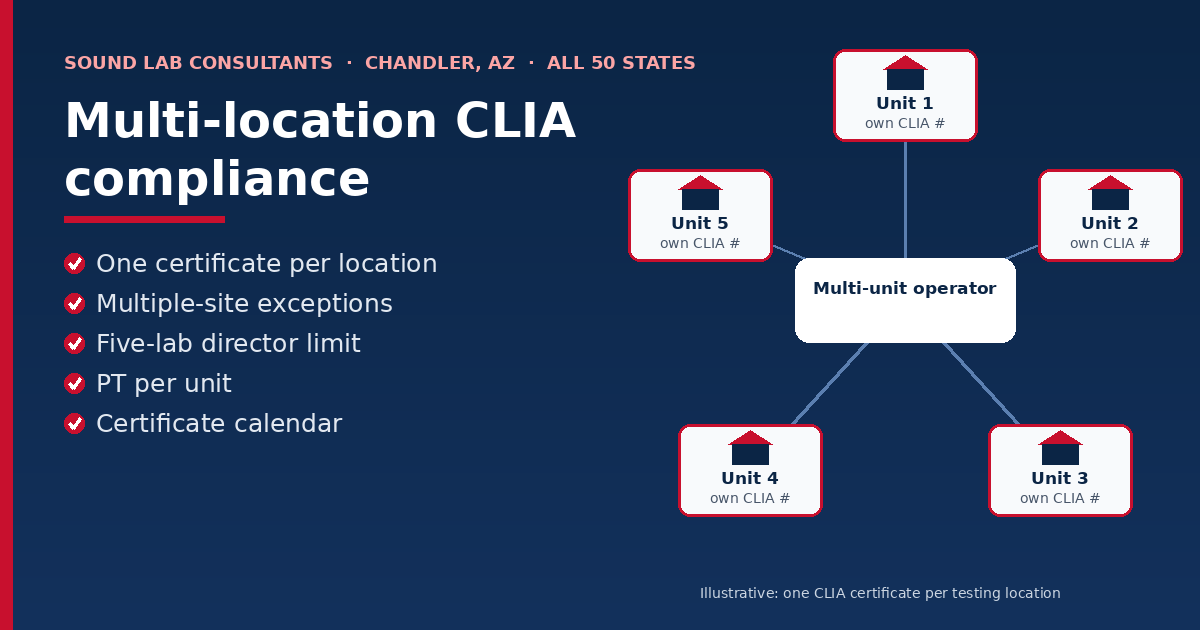
Short answer: Under 42 CFR 493.35, 493.43 and 493.55, each laboratory location must file its own CLIA application unless it is a mobile or temporary site, a not-for-profit or government lab doing limited public health testing, or part of a hospital campus. Franchise clinics at fixed addresses therefore each need their own certificate. A laboratory director may direct no more than five PPM or non-waived labs, moderate and high complexity directors must be on site at least twice a year, and each unit enrolls in proficiency testing and keeps its own records.
Last reviewed November 25, 2026. Primary sources: CMS Clinical Laboratory Improvement Amendments (CLIA) program, CMS Form CMS-116, 42 CFR 493.1407.
One CLIA certificate per location
The CLIA application rules for each certificate type say the same thing: a laboratory must file a separate application for each laboratory location, except in three situations.
| Exception | Who it fits | Fits a typical franchise clinic? |
|---|---|---|
| Not at a fixed location (mobile units, health fairs, temporary sites) | Mobile labs and temporary testing events operating under a home base certificate, with sites listed and changes reported | Only for mobile or event testing tied to a home base |
| Limited public health testing | Not-for-profit or government labs doing no more than a combination of 15 moderate complexity or waived tests per certificate | No, for-profit clinics do not qualify |
| Hospital campus | Hospital labs in contiguous buildings on one campus under common direction | No |
Two clinics in the same shopping center at different suite numbers are two locations. A clinic that relocates needs its certificate updated for the new address before testing there. See CLIA lab relocation.
Director limits and on-site visits
The director rules are what most shape staffing across a franchise group:
- One individual may direct no more than five laboratories with PPM, moderate or high complexity certificates (42 CFR 493.1359(a), 493.1407(d) and 493.1445(d)).
- Moderate and high complexity directors must be on site at least once every 6 months, with at least 4 months between the two minimum visits, and document the visits and the director activities performed.
- Directors must remain accessible for consultation by phone or electronically.
- A director who delegates duties remains responsible for them.
- Each change of director must be reported to the state agency, with qualifications for non-waived labs.
Build a director roster that shows each CLIA number, its certificate type, its director, the visit dates and the next visit due. Waived-only units do not count against the five-lab limit, so many groups keep low-volume units waived and concentrate non-waived testing where the director capacity exists.
Proficiency testing, QC and records belong to each unit
Proficiency testing is enrolled and performed per CLIA number. Each unit tests its own PT samples like patient specimens, and units must not share PT samples or compare results before submission. QC records, temperature logs, maintenance, competency and verification studies are kept for each laboratory for at least two years under 42 CFR 493.1105, longer where accreditors or states require it. A group can standardize forms and review them centrally, but the records must show what happened at that unit.
Planning a franchise lab, or adding units?
Tell us your brand, your test menu and how many locations you are opening. We will map certificates, director coverage and a setup timeline for each unit.
Book a free consultationThe certificate and compliance calendar
Multi-unit operators should keep one calendar covering every unit:
| Item | Frequency |
|---|---|
| CLIA certificate renewal | Every two years per certificate |
| State lab and personnel licenses | Per state schedule |
| Accreditation or state survey window | About every two years for non-waived units |
| Director on-site visits | At least every 6 months per non-waived unit |
| PT events | Typically three events per year per program |
| Calibration verification | At least every 6 months per analyzer |
| Competency assessments | Semiannual first year, then annual per tester |
| Exposure control plan review | At least annually |
| Change notifications (director, ownership, name, location) | Within the CLIA time frame after the change |
See CLIA certificate renewal and CLIA certificate changes.
Operating in more than one state
Franchise groups that cross state lines also cross licensing systems. Some states license laboratories, some license laboratory personnel, New York and Washington run CMS-approved state programs, and state survey agencies differ in how they process applications. Keep a state matrix for every territory and review it before opening a new one. See multi-state laboratory licensing and the state license guide.
Standardize the system, keep the unit accountable
Multi-unit groups get the most value by standardizing everything that does not have to be unit-specific: the approved device list, master SOP templates, QC rules, forms and logs, PT provider, competency checklists, training curriculum and audit scorecard. What must stay unit-specific is the certificate, the director's approval of that unit's procedures, the verification study for that unit's instruments, the competency of that unit's people and the records of what happened there. A regional lab lead or outside consultant who reviews every unit on the same schedule is the bridge between the two.
| Standardize across the group | Keep unit-specific |
|---|---|
| Approved devices and test menu tiers | CLIA certificate and state license |
| SOP and form templates | Director-approved procedure manual |
| QC rules and IQCP framework | QC records and corrective actions |
| Competency checklists | Competency assessments for each tester |
| PT provider | PT enrollment, results and investigations |
| Audit scorecard | Corrective action owned by the unit |
Survey day in a multi-unit group
State agency surveys and accreditation inspections usually arrive unit by unit, and in some programs they are unannounced. Every unit should be able to produce, on the day, its certificate, director qualifications and visit documentation, personnel records and competency, PT results and investigations, QC and temperature logs, verification studies, the approved procedure manual and its quality assessment records. Groups that keep these in the same place in every unit, physically or electronically, spend far less time on survey day. After any survey, share findings across the group so other units can check for the same issue before their own inspection. See the survey-prepared lab checklist.
Acquisitions, resales and new units
When a group buys existing units, each one comes with its own certificate history. Review the certificate, survey reports and plans of correction, PT results, director agreement and personnel files before closing, and file the change of ownership and director changes promptly. For new units, start the lab workstream when the lease is signed so the certificate and director are in place before opening. A single plan for openings, transfers and closures prevents lapses.
Multi-location CLIA checklist
| Control | Owner |
|---|---|
| Master list of every CLIA number, address, certificate type and expiration | Group compliance lead |
| Director roster with five-lab count and visit dates | Group compliance lead and directors |
| PT enrollment per unit | Unit lead, reviewed centrally |
| Standard SOP templates adapted per unit | Technical consultant |
| Competency calendar per tester per unit | Technical consultant or supervisor |
| Change notification log | Group compliance lead |
| Mock survey schedule | Lab consultant |
How an outside consultant supports multi-unit groups
A consultant can keep the master list and calendar, supply directors and technical consultants within the limits, standardize procedures, review records remotely each month, visit units on a schedule, and prepare each unit for surveys. See the franchise lab consulting hub and franchisor lab program standardization.
Get your franchise lab set up right, unit by unit
Sound Lab Consultants helps franchisees, multi-unit operators and franchisors set up in-office labs, obtain CLIA certificates for every location, choose COLA, CAP or Joint Commission accreditation, cover director roles and keep every unit compliant.
Book a free consultationFrequently asked questions
Can a franchise group use one CLIA certificate for all clinics?
No. Each fixed location needs its own certificate unless it fits one of three exceptions: mobile or temporary testing, limited public health testing by not-for-profit or government labs, or hospital campuses.
How many labs can one director oversee?
No more than five laboratories with PPM, moderate or high complexity certificates. Waived-only labs are not subject to that limit.
How often must the lab director visit each franchise unit?
Moderate and high complexity directors must be on site at least once every six months, with at least four months between visits, and document the visits.
Can franchise units share proficiency testing?
No. Each CLIA number enrolls and tests its own PT samples, and units must not share samples or results before submission.
What do we do when we buy an existing franchise unit?
Report the change of ownership to the state agency, confirm or replace the director, and make sure PT, records and procedures continue without a gap.
Franchise lab guides
- Franchise lab consulting (overview)
- Urgent care franchise lab setup
- Physician office franchise labs
- Occupational health franchise labs
- Women's health franchise labs
- Med spa and weight loss franchise labs
- Men's health franchise labs
- Franchisor lab program standardization
Sources
- CMS Clinical Laboratory Improvement Amendments (CLIA) program
- CMS Form CMS-116, CLIA application for certification
- 42 CFR 493.1407, Laboratory director responsibilities (moderate complexity)
- 42 CFR 493.1445, Laboratory director responsibilities (high complexity)
- 42 CFR 493.801, Condition: Enrollment and testing of samples (proficiency testing)
- 42 CFR 493.1105, Retention requirements
- CMS State Operations Manual Appendix C: Survey Procedures and Interpretive Guidelines for Laboratories
- 42 CFR 493.35, 493.43 and 493.55, application per location and multiple-site exceptions (eCFR)
- CMS, How to obtain a CLIA certificate
- CDC, To Test or Not to Test: considerations for waived testing
- 29 CFR 1910.1030, Bloodborne pathogens (OSHA)
- COLA, laboratory accreditation (public site)
- The Joint Commission, laboratory accreditation (public site)
Related pages
Sound Lab Consultants is an independent clinical laboratory consulting company. We are not affiliated with or endorsed by CMS, FDA, CDC, OSHA, DOT, CAP, COLA, The Joint Commission, any state agency, any instrument manufacturer or any franchise brand. This page is general information, not legal, franchise or billing advice; confirm requirements with the agency, accreditor, payer or your counsel. Sound Lab Consultants, 25 Arizona Pl, Chandler, AZ 85225.