
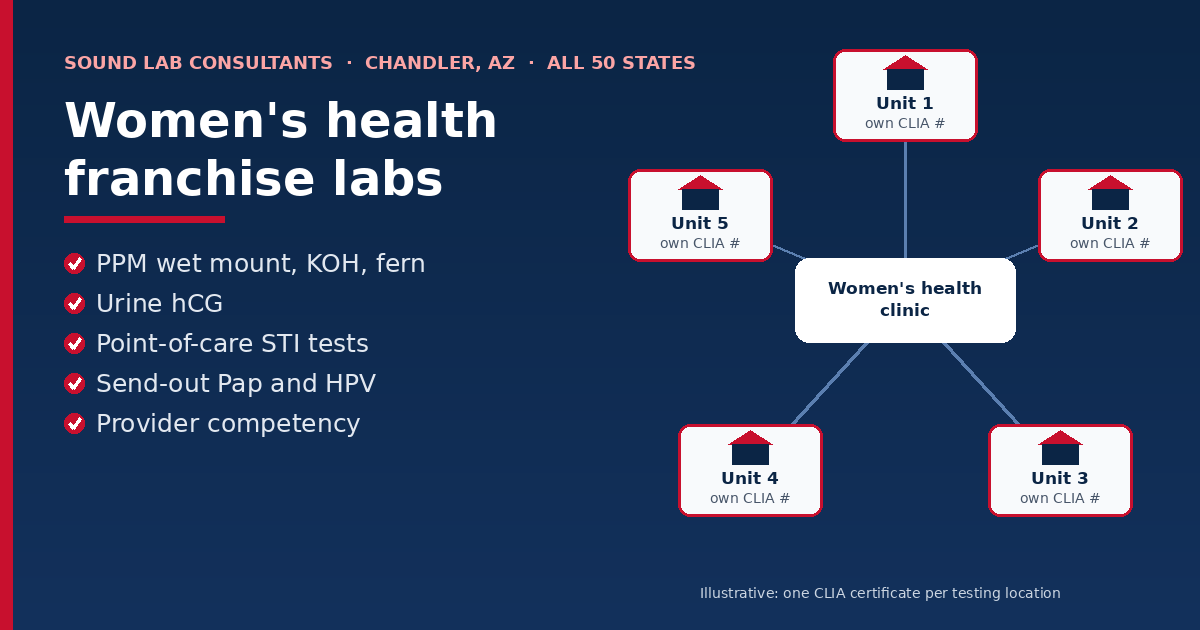
Short answer: Women's health franchise units commonly hold a PPM certificate so providers can perform wet mounts, KOH preparations and fern tests during the visit, alongside waived tests such as urine hCG and urinalysis. Pap and HPV testing are sent to a laboratory certified for cytology and molecular testing. Point-of-care STI tests can be waived or moderate complexity depending on the device. Moderate complexity analyzers require a Certificate of Compliance or Accreditation and a qualified director.
Last reviewed November 25, 2026. Primary sources: CMS Clinical Laboratory Improvement Amendments (CLIA) program, CMS Form CMS-116, FDA CLIA test categorization database.
Typical women's health franchise test menu
| Test | Category | Where it is usually done |
|---|---|---|
| Urine hCG | Waived | In-house, often before procedures or imaging |
| Urine dipstick | Waived | In-house |
| Vaginal wet mount (saline) | PPM | In-house by the provider during the visit |
| KOH preparation | PPM | In-house by the provider |
| Fern test for amniotic fluid | PPM | In-house by the provider in OB settings |
| Vaginal pH and some vaginitis antigen tests | Waived (device dependent) | In-house |
| Chlamydia, gonorrhea, trichomonas NAAT | Waived, moderate or high complexity depending on device | Point-of-care NAAT at some units; most send out |
| HIV and syphilis rapid tests | Some waived | In-house where programs offer rapid screening |
| Pap cytology and HPV | High complexity (cytology); molecular HPV | Always sent to a qualified laboratory |
| Hemoglobin, glucose (prenatal) | Waived | In-house |
| Prenatal panels, blood type and screen, hormone levels | Moderate to high | Usually send-out |
Device categorization changes as new point-of-care STI tests are cleared, so check the FDA database for each device before adding it. CDC's STI treatment guidelines shape which tests clinicians want available; see also our women's health and STI testing page.
Why many women's health units hold a PPM certificate
Provider-performed microscopy is designed for exactly the kind of testing women's health providers do: a quick look at a wet mount or KOH prep during the visit. Under a PPM certificate:
- The procedure must be on CMS's list of PPM procedures and performed by a physician, midlevel practitioner or dentist during the patient's visit, on a specimen from that provider's own patient.
- The laboratory director must be a physician, a midlevel practitioner authorized to practice independently in the state, or a dentist (42 CFR 493.1357), and may direct no more than five PPM or non-waived labs.
- Each provider who performs PPM needs documented training and competency assessment.
- The lab needs procedures, a functioning microscope with maintenance records, and records of results.
- PPM certificates also allow waived tests, so most units need only one certificate.
A medical assistant may prepare a slide but may not perform the PPM examination. Franchise systems that use nurse practitioners or physician assistants should check whether state law allows them to practice independently before naming them as PPM director. See the PPM certificate guide.
Send-out testing: cytology, HPV and prenatal panels
Cervical cytology is high complexity and has its own CLIA cytology requirements, including workload limits and slide review rules, so franchise units send it to a laboratory certified for cytology. HPV testing is usually performed by the same laboratory. Prenatal and hormone panels are typically drawn and sent. For send-outs, the unit's job is specimen collection, labeling, storage, transport and result follow-up. The reference lab agreement should define collection kits, liquid-based cytology vials, pickup schedule, rejection criteria and how abnormal results are communicated. See cytology lab CLIA requirements.
Planning a franchise lab, or adding units?
Tell us your brand, your test menu and how many locations you are opening. We will map certificates, director coverage and a setup timeline for each unit.
Book a free consultationProvider competency and quality in a franchise
Women's health franchises often rely on providers who rotate among units. PPM competency belongs to the person and the lab where they test, so each unit's director should have competency records for each provider who performs PPM there. A practical franchise approach is a standard PPM competency packet (direct observation, slide review challenges, review of results and records, and problem-solving questions) used at every unit, with the unit director signing for their lab. See the six elements of competency assessment.
Specimen handling, privacy and patient communication
Sexual health and pregnancy results are sensitive. Procedures should cover specimen labeling at the point of collection, where results are recorded, who may release them and how patients are notified, consistent with HIPAA and state law on minors' consent and reportable conditions. Several STIs are reportable to public health authorities; the unit should know whether the reference lab, the clinic or both report.
Space and equipment for a women's health unit lab
A women's health unit lab is usually a small room or alcove close to the exam rooms, because wet mounts must be examined promptly while organisms are still motile. Plan for a binocular microscope with a maintenance and cleaning log, slides, coverslips, saline and KOH reagents with labeled open and expiration dates, a centrifuge if urine sediment is examined, a laboratory refrigerator for kits and controls with a temperature log, a sink, and sharps and biohazard containers. Keep a separate area for packaging send-out specimens such as liquid-based cytology vials and NAAT swabs, with the reference lab's requirements posted. Lighting, bench height and a place for the procedure manual at the bench make the difference between procedures that are followed and procedures that are filed away.
| Equipment | Why it matters | Record to keep |
|---|---|---|
| Microscope | PPM wet mount, KOH, fern and sediment exams | Cleaning, maintenance and service log |
| Laboratory refrigerator | hCG kits, controls and STI test kits stored at labeled temperature | Daily temperature log with corrective action |
| Centrifuge | Urine sediment preparation and serum separation for send-outs | Function checks per manufacturer |
| Point-of-care readers | Some hCG, vaginitis and STI tests use readers | QC and lot records |
| Send-out supplies | Cytology vials, NAAT swabs and requisitions | Expiration checks and shipping manifests |
Adding services: prenatal, menopause and fertility-adjacent testing
As women's health franchises grow, brands often add prenatal care, menopause and hormone services, or fertility-adjacent consultations. Most of the added testing (prenatal panels, blood type and antibody screen, hormone levels and genetic screening) is best sent to a reference laboratory. Where a brand wants in-house hormone or CBC testing, the unit moves to moderate complexity with a qualified director, technical consultant, method verification, QC and proficiency testing, as described for hormone testing in men's health units. Semen analysis and other andrology testing carry their own complexity and quality requirements; see andrology and fertility labs before adding them.
Women's health franchise lab checklist
| Item | Notes |
|---|---|
| Certificate | PPM for most units; Waiver if no microscopy; Compliance or Accreditation for analyzers |
| Director | Physician, independent midlevel practitioner or dentist for PPM; five-lab limit checked |
| Microscope | Maintenance, cleaning and function records |
| PPM procedures | Written for wet mount, KOH and fern tests |
| Competency | For each provider who performs PPM |
| Waived devices | hCG, dipstick, pH and any STI tests checked in the FDA database |
| Send-out agreement | Cytology, HPV and prenatal testing |
| Reportable disease process | Who reports and how |
| OSHA program | Exposure control and sharps |
Ongoing oversight for women's health franchise units
A lab consultant tracks PPM competency for each provider, reviews microscope maintenance and result records, keeps procedures current as devices change, checks STI device categorization when vendors change, and prepares units for any survey. For moderate complexity units, the consultant also covers QC, PT and verification. See the franchise lab consulting hub.
Get your franchise lab set up right, unit by unit
Sound Lab Consultants helps franchisees, multi-unit operators and franchisors set up in-office labs, obtain CLIA certificates for every location, choose COLA, CAP or Joint Commission accreditation, cover director roles and keep every unit compliant.
Book a free consultationFrequently asked questions
What CLIA certificate does a women's health franchise clinic need?
Most need a PPM certificate if providers perform wet mounts, KOH or fern tests, which also covers waived tests. A unit with no microscopy can hold a Certificate of Waiver. Analyzers require a Certificate of Compliance or Accreditation.
Can a nurse practitioner be the PPM laboratory director?
A midlevel practitioner can be the PPM director if the state authorizes them to practice independently. Otherwise a physician or dentist must serve.
Can a medical assistant read a wet mount?
No. PPM procedures must be performed by a physician, midlevel practitioner or dentist during the patient's visit.
Can a women's health clinic perform Pap tests in-house?
The clinic collects the specimen, but cytology is high complexity testing with specific CLIA requirements, so it is sent to a qualified laboratory.
Are point-of-care STI tests waived?
Some are and some are not. Categorization depends on the device; check the FDA CLIA database before adding one.
Franchise lab guides
- Franchise lab consulting (overview)
- Urgent care franchise lab setup
- Physician office franchise labs
- Occupational health franchise labs
- Med spa and weight loss franchise labs
- Men's health franchise labs
- Multi-location CLIA compliance
- Franchisor lab program standardization
Sources
- CMS Clinical Laboratory Improvement Amendments (CLIA) program
- CMS Form CMS-116, CLIA application for certification
- FDA CLIA test categorization database
- 42 CFR 493.1235, Personnel competency assessment policies
- 42 CFR 493.1251, Procedure manual
- 42 CFR 493.801, Condition: Enrollment and testing of samples (proficiency testing)
- CDC Sexually Transmitted Infections Treatment Guidelines, 2021
- 42 CFR 493.35, 493.43 and 493.55, application per location and multiple-site exceptions (eCFR)
- CMS, How to obtain a CLIA certificate
- CDC, To Test or Not to Test: considerations for waived testing
- 29 CFR 1910.1030, Bloodborne pathogens (OSHA)
- COLA, laboratory accreditation (public site)
- The Joint Commission, laboratory accreditation (public site)
Related pages
Sound Lab Consultants is an independent clinical laboratory consulting company. We are not affiliated with or endorsed by CMS, FDA, CDC, OSHA, DOT, CAP, COLA, The Joint Commission, any state agency, any instrument manufacturer or any franchise brand. This page is general information, not legal, franchise or billing advice; confirm requirements with the agency, accreditor, payer or your counsel. Sound Lab Consultants, 25 Arizona Pl, Chandler, AZ 85225.