
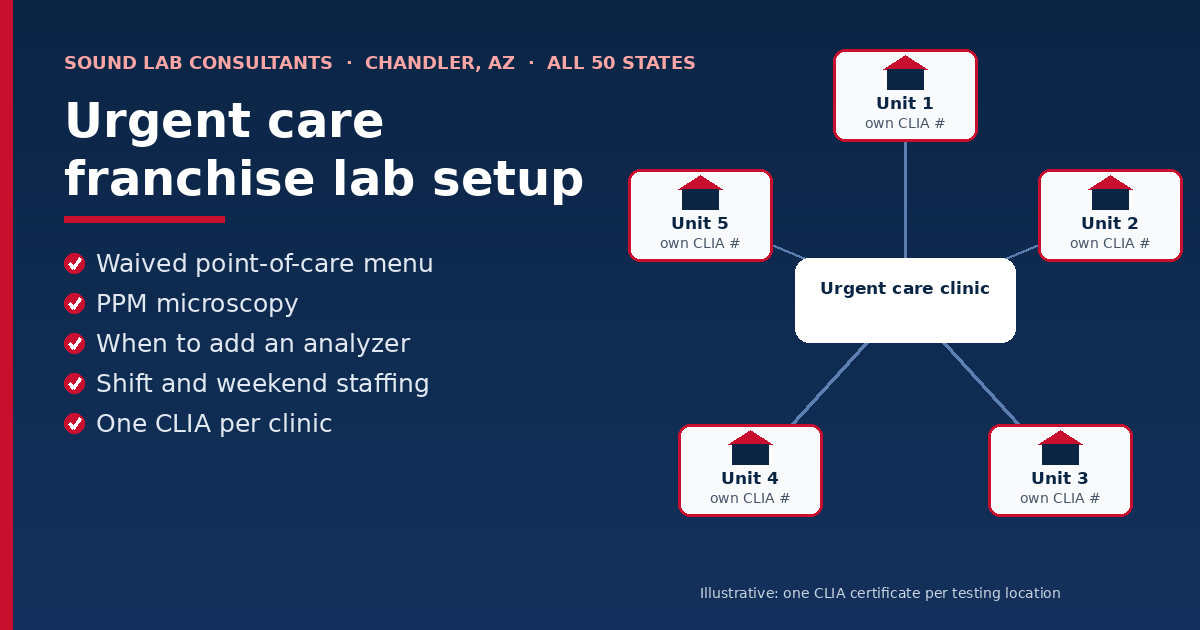
Short answer: Most urgent care franchise clinics start with a Certificate of Waiver covering rapid strep, influenza, COVID-19 and RSV antigen, urine dipstick, urine hCG, glucose and hemoglobin. Clinics where providers perform wet mounts or urine sediment add a PPM certificate. Clinics that add a chemistry or CBC analyzer need a Certificate of Compliance or Accreditation, a qualified laboratory director and technical consultant, method verification, proficiency testing and competency assessment. Each clinic needs its own CLIA certificate.
Last reviewed November 25, 2026. Primary sources: CMS Clinical Laboratory Improvement Amendments (CLIA) program, CMS Form CMS-116, FDA CLIA test categorization database.
The typical urgent care franchise test menu
An urgent care menu is shaped by what walks in the door: sore throats, fevers, coughs, urinary symptoms, minor injuries, pregnancy questions and pre-procedure checks. Most of it can be handled with waived, point-of-care tests that give a result during the visit.
| Test | Usual CLIA category | Notes for franchise clinics |
|---|---|---|
| Rapid strep A antigen | Waived (most devices) | Follow the package insert for negative result confirmation guidance; some molecular strep tests are also waived |
| Influenza A/B, COVID-19, RSV antigen | Waived (most devices) | Combination tests and readers vary by vendor; check categorization for the exact device |
| Rapid molecular respiratory tests | Some waived, some moderate | Waived molecular platforms exist; larger panels are often moderate complexity |
| Urine dipstick (visual or reader) | Waived | Reader-based systems reduce interpretation variation between staff |
| Urine hCG | Waived | Often required before imaging or certain medications |
| Fingerstick glucose, hemoglobin | Waived | Meters need QC per manufacturer and cleaning between patients |
| Mono screen | Waived (most devices) | Common in clinics that see teens and college students |
| Wet mount, KOH, urine sediment | PPM | Only if the provider performs it during the visit |
| CBC with differential | Moderate | Benchtop analyzers; needs director, technical consultant and PT |
| BMP or CMP, troponin, D-dimer | Moderate | Useful for higher-acuity clinics; adds QC, calibration and PT workload |
Each test system must be checked in the FDA CLIA database by manufacturer and model before it goes on the brand's approved list. Complexity follows the device, not the analyte. Our respiratory testing guide covers antigen and molecular respiratory options in more detail.
Choosing the certificate for each clinic
Because every clinic needs its own certificate, the brand can match the certificate to each clinic's menu. A common pattern in urgent care systems is three tiers:
| Tier | Menu | Certificate | What changes |
|---|---|---|---|
| Tier 1 | Waived point-of-care only | Certificate of Waiver | Follow manufacturer instructions; CDC good practice recommendations; no routine survey |
| Tier 2 | Waived plus provider microscopy | PPM certificate | Director must be a physician, midlevel practitioner or dentist; PPM performed by the provider during the visit; competency and records required |
| Tier 3 | Waived, PPM and a CBC or chemistry analyzer | Certificate of Compliance or Accreditation | Full non-waived requirements: qualified director, technical consultant, method verification, QC, calibration verification, PT, competency, surveys |
Moving a clinic from Tier 1 to Tier 3 is a certificate change, not a supply order. The new certificate type must be in place before the analyzer reports a patient result. See CLIA certificate changes and the CMS-116 guide.
When an urgent care clinic should add an analyzer
A CBC or chemistry analyzer can let an urgent care clinic handle more cases without sending patients to an emergency department or waiting on a reference lab. It also commits the clinic to a moderate complexity laboratory. Before adding one, a franchisee should be able to answer yes to most of these:
- Is there enough daily volume to keep reagents in date and run QC economically?
- Is a qualified laboratory director available who is not already directing five PPM or non-waived labs?
- Will a technical consultant verify the method, review QC and PT, and assess competency?
- Do the people who will run the analyzer meet the testing personnel education requirements in 42 CFR 493.1423, and are their records on file?
- Is there bench space, power, temperature control and a service plan for downtime?
- Will results flow into the EHR through a verified interface or a documented entry process?
- Has the revenue cycle team confirmed billing for the added codes under the new certificate?
If the answer to several of these is no, a better choice may be a faster courier and a reference lab arrangement with defined turnaround and critical value calls.
Planning a franchise lab, or adding units?
Tell us your brand, your test menu and how many locations you are opening. We will map certificates, director coverage and a setup timeline for each unit.
Book a free consultationStaffing testing across long hours and weekends
Urgent care clinics are open early, late and on weekends, often with rotating staff and per diem providers. That creates lab problems a primary care office does not have:
- Everyone who tests must be trained and assessed. Per diem providers and float medical assistants still need documented training, and for non-waived tests, competency assessment on the required schedule.
- QC must happen on the shifts that test. For non-waived quantitative tests, the default CLIA rule is two levels of external control each day of testing unless an IQCP is in place. Assign responsibility for each shift, not just the morning crew.
- PPM is personal. Under a PPM certificate, the provider performing the microscopy must be qualified and assessed; a medical assistant cannot read the slide.
- Coverage when a unit is short. Write down which tests stop if no qualified tester is present, rather than letting untrained staff fill in.
A schedule-aware competency calendar is one of the most useful tools an oversight consultant provides. See the six elements of competency assessment.
Workflow, layout and result reporting
Urgent care lab space is usually a small room or alcove. Lay it out so that swabs and urine move one way from collection to testing to disposal, so that reagents and controls are stored at the right temperature away from specimens, and so that the person testing can see the package insert, the procedure and the log at the bench. Read-time matters for antigen tests: a timer at each testing position and a rule against reading early or late prevent many errors.
Results need to reach the chart before the provider makes a treatment decision. Decide whether staff enter results manually with a second check, or whether readers and analyzers send results through an interface that has been verified. Critical value policies matter for clinics that run chemistry or CBC. See EHR result interface verification.
Urgent care franchise lab opening checklist
| Item | Done before first patient test |
|---|---|
| Approved test list checked in FDA database for exact devices | Yes |
| Certificate type chosen for this clinic; CMS-116 filed; state license if required | Yes |
| Laboratory director named; for PPM or non-waived, qualifications documented | Yes |
| Package inserts, SOPs and QC plan at the bench | Yes |
| Training and competency documented for every person who tests | Yes |
| Refrigerator and room temperature logs started | Yes |
| Method verification complete (non-waived only) | Yes |
| PT enrolled for regulated analytes (non-waived only) | Yes |
| Reference lab agreement, supplies and courier schedule | Yes |
| OSHA exposure control plan and sharps program | Yes |
| Result entry or interface verified | Yes |
COLA, CAP or CLIA-only for urgent care
Tier 1 and Tier 2 clinics do not need an accreditor. For Tier 3 clinics, many urgent care groups choose COLA because its standards were built around office and clinic laboratories, while clinics owned by or affiliated with health systems often follow the system's CAP or Joint Commission program. A CLIA-only Certificate of Compliance is also valid. Pick one path for every Tier 3 clinic in the system so that forms, manuals and training stay consistent. See COLA vs CAP vs The Joint Commission.
Ongoing oversight for urgent care franchise clinics
After opening, an outside lab consultant typically reviews QC and temperature logs monthly, keeps the competency calendar for rotating staff, tracks PT events and certificate dates, updates procedures when the brand switches respiratory test vendors, and runs a mock survey before each inspection. For multi-unit operators, the consultant reports a simple status per clinic so the owner can see which units need attention. The franchise lab consulting hub explains how this fits into a franchise-wide program, and our urgent care lab consultant page covers single-clinic work.
Get your franchise lab set up right, unit by unit
Sound Lab Consultants helps franchisees, multi-unit operators and franchisors set up in-office labs, obtain CLIA certificates for every location, choose COLA, CAP or Joint Commission accreditation, cover director roles and keep every unit compliant.
Book a free consultationFrequently asked questions
Does an urgent care franchise clinic need a CLIA certificate for rapid strep and flu tests?
Yes. Any test on a patient specimen, including waived rapid tests, requires a CLIA certificate. A Certificate of Waiver covers waived tests only.
Can a medical assistant perform tests in an urgent care franchise?
Medical assistants can perform waived tests following the manufacturer's instructions. PPM procedures must be performed by the provider. Moderate complexity tests require testing personnel who meet 42 CFR 493.1423.
Do we need a lab director for a waived urgent care clinic?
A director must be named on the CMS-116, but CLIA sets no special qualifications for a waived-only lab director. PPM and non-waived labs require qualified directors.
Can one CLIA certificate cover all of our urgent care clinics?
No. Fixed-location clinics each need their own certificate. The multiple-site exceptions apply to mobile or temporary sites, limited public health testing by not-for-profit or government labs, and hospital campuses.
Is adding a CBC analyzer worth it?
It depends on volume, staffing and director coverage. A CBC analyzer makes the clinic a moderate complexity lab with full CLIA quality requirements, so it makes sense where volume and staff can support it.
Do urgent care labs need proficiency testing?
Non-waived labs must enroll in PT for regulated analytes. Waived labs are not required to, although some accreditors and brands encourage external quality checks.
Franchise lab guides
- Franchise lab consulting (overview)
- Physician office franchise labs
- Occupational health franchise labs
- Women's health franchise labs
- Med spa and weight loss franchise labs
- Men's health franchise labs
- Multi-location CLIA compliance
- Franchisor lab program standardization
Sources
- CMS Clinical Laboratory Improvement Amendments (CLIA) program
- CMS Form CMS-116, CLIA application for certification
- FDA CLIA test categorization database
- 42 CFR 493.1253, Establishment and verification of performance specifications
- 42 CFR 493.1256, Control procedures
- 42 CFR 493.1235, Personnel competency assessment policies
- 42 CFR 493.801, Condition: Enrollment and testing of samples (proficiency testing)
- 42 CFR 493.1405, Laboratory director qualifications (moderate complexity)
- 42 CFR 493.1251, Procedure manual
- 42 CFR 493.35, 493.43 and 493.55, application per location and multiple-site exceptions (eCFR)
- CMS, How to obtain a CLIA certificate
- CDC, To Test or Not to Test: considerations for waived testing
- 29 CFR 1910.1030, Bloodborne pathogens (OSHA)
- COLA, laboratory accreditation (public site)
- The Joint Commission, laboratory accreditation (public site)
Related pages
Sound Lab Consultants is an independent clinical laboratory consulting company. We are not affiliated with or endorsed by CMS, FDA, CDC, OSHA, DOT, CAP, COLA, The Joint Commission, any state agency, any instrument manufacturer or any franchise brand. This page is general information, not legal, franchise or billing advice; confirm requirements with the agency, accreditor, payer or your counsel. Sound Lab Consultants, 25 Arizona Pl, Chandler, AZ 85225.