
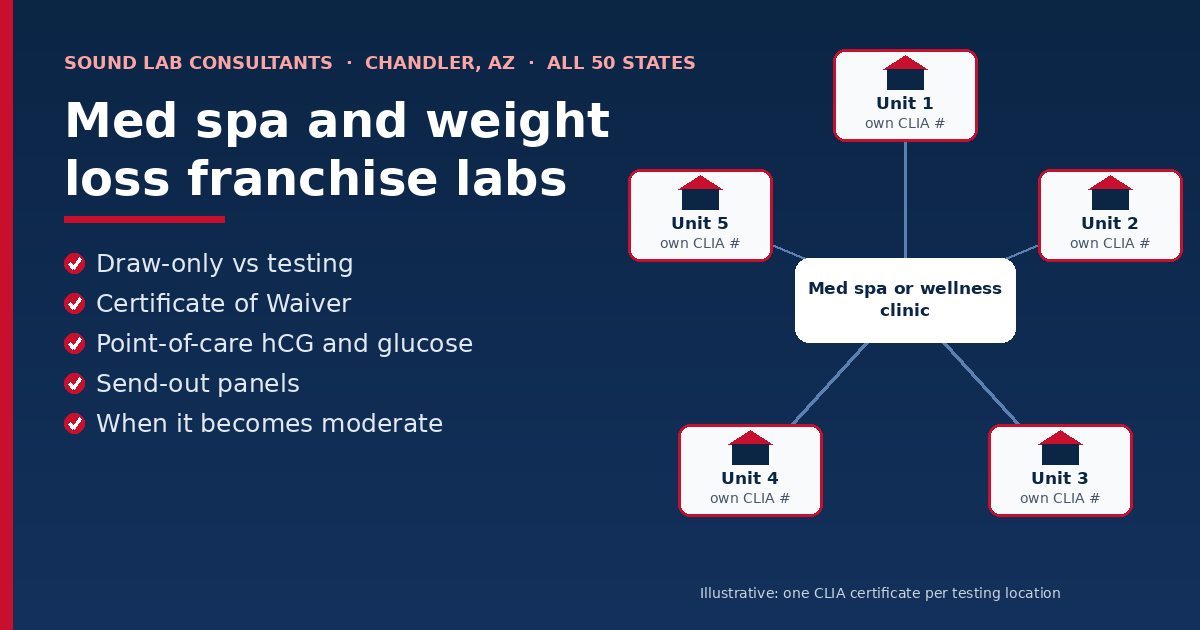
Short answer: A med spa or weight loss franchise unit that only draws blood and sends it to a reference laboratory is not performing testing and does not need a CLIA certificate for that activity, although some states regulate specimen collection stations. A unit that performs any test on site, even a urine pregnancy test or fingerstick glucose, needs a CLIA certificate; waived tests fit a Certificate of Waiver. Running a benchtop analyzer for hormone, A1c or chemistry testing usually means moderate complexity and full CLIA personnel and quality requirements.
Last reviewed November 25, 2026. Primary sources: CMS Clinical Laboratory Improvement Amendments (CLIA) program, CMS Form CMS-116, FDA CLIA test categorization database.
Three lab models for med spa and wellness franchises
| Model | What happens on site | CLIA status |
|---|---|---|
| Draw and send | Phlebotomy, centrifuge, packaging; all testing done by a reference lab | No CLIA certificate needed for collection only; check state rules for collection stations and phlebotomist certification |
| Draw and send plus waived tests | Adds urine hCG, fingerstick glucose, waived A1c, urine dipstick or similar | Certificate of Waiver for the unit |
| In-house analyzer | Benchtop immunoassay or chemistry analyzer for hormones, A1c, lipids or metabolic panels | Usually moderate complexity: Certificate of Compliance or Accreditation with qualified director, technical consultant and testing personnel |
The most common mistake is moving from the second model to the third by accepting a vendor's analyzer offer without changing the certificate, naming a qualified director or verifying the method. Testing beyond the certificate type is a serious finding.
Waived testing realities
Waived does not mean unregulated. A waived test is one the FDA has determined is simple with a low risk of erroneous results when performed correctly. The clinic still has obligations:
- Hold a current Certificate of Waiver for the location before testing.
- Use the device only for the specimen type and purpose in the package insert. Using a waived device outside its labeled use can make the test non-waived.
- Follow the current instructions exactly, including QC, read times, storage temperature and expiration dates.
- Train every person who tests and keep records of who tested, lots, controls and results.
- Expect that CMS or the state agency can visit waived sites, and that complaints can trigger a survey.
CDC's waived testing resources describe good practices such as written procedures, training checklists and result logs. Many errors in waived testing come from not following instructions, not from the device. See waived testing compliance and the Certificate of Waiver requirements.
Weight loss programs: baseline and monitoring labs
Medical weight loss programs commonly order baseline and follow-up labs such as a metabolic panel, A1c, lipids and thyroid testing, depending on the prescriber's protocol and the medication label. For most franchise units these are best drawn and sent: volume per test is modest, the result rarely needs to be available during the same visit, and a reference lab handles the QC, PT and personnel requirements. A waived point-of-care A1c or glucose device can make sense where providers want a same-visit value. Check whether the device is cleared for diagnosis or monitoring only, and use it as labeled.
Planning a franchise lab, or adding units?
Tell us your brand, your test menu and how many locations you are opening. We will map certificates, director coverage and a setup timeline for each unit.
Book a free consultationIV hydration and aesthetic clinics
IV hydration and aesthetic services usually involve little or no laboratory testing, but some protocols call for a pregnancy test before certain treatments or a fingerstick glucose. Either one requires a Certificate of Waiver. Franchise systems should decide brand-wide which tests are offered, so units do not start testing informally without a certificate. Clinical protocols, medical oversight and scope of practice for IV and aesthetic services are governed by state medical and nursing boards; those are outside CLIA and should be reviewed with counsel.
Running a compliant draw-and-send unit
- Use the reference laboratory's specimen requirements for tube type, volume, processing time and storage.
- Label specimens at the patient's side with two identifiers; never pre-label tubes.
- Centrifuge and separate within the stability window, and log refrigerator and freezer temperatures.
- Package specimens to the shipping requirements and hand them off on schedule; keep a manifest.
- Track results so abnormal or critical values reach a provider promptly.
- Check state requirements for phlebotomy certification and collection station licensing; a few states regulate both.
- Maintain an OSHA bloodborne pathogens program, sharps containers and exposure response.
When a wellness unit adds an analyzer
Hormone, A1c and chemistry analyzers marketed to wellness clinics are usually moderate complexity. Before adding one, the unit must change to a Certificate of Compliance or Accreditation, name a laboratory director who meets 42 CFR 493.1405, cover the technical consultant role, confirm that testing personnel meet 42 CFR 493.1423, verify the method under 42 CFR 493.1253, enroll in proficiency testing for regulated analytes under 42 CFR 493.801, and choose an accreditation or survey path. See men's health franchise labs for the same decision in hormone clinics.
Med spa and weight loss franchise lab checklist
| Question | If yes |
|---|---|
| Do we test any specimen on site, even a pregnancy test? | Get a Certificate of Waiver for the unit before testing |
| Do we only draw and send? | No CLIA certificate for collection; follow state collection rules |
| Are all devices waived for our specimen type and use? | Keep the FDA categorization on file for each device |
| Did a vendor offer an analyzer? | Plan moderate complexity requirements before it arrives |
| Are staff trained on each test and is training documented? | Required for good practice and surveys |
| Do we have a reference lab agreement? | Define specimen, courier and result processes |
| Is there an exposure control plan? | Required by OSHA |
How a lab consultant helps wellness franchises
For most med spa and weight loss franchise systems, the lab work is about setting a clear brand standard: which units test, which devices are approved, what certificate each unit holds, and how collection and send-out work. A consultant writes that standard, files certificates for new units, and audits units periodically. See the franchise lab consulting hub.
Get your franchise lab set up right, unit by unit
Sound Lab Consultants helps franchisees, multi-unit operators and franchisors set up in-office labs, obtain CLIA certificates for every location, choose COLA, CAP or Joint Commission accreditation, cover director roles and keep every unit compliant.
Book a free consultationFrequently asked questions
Does a med spa need a CLIA certificate?
Only if it performs a test on a patient specimen. A med spa that only draws blood and sends it to a reference lab does not need a CLIA certificate for that activity. Any on-site test, including a urine pregnancy test, requires one.
Is a urine pregnancy test in a med spa regulated by CLIA?
Yes. It is a waived test, so the unit needs a Certificate of Waiver and must follow the manufacturer's instructions.
Can a weight loss clinic run A1c in-house?
Yes, with the right certificate. Many point-of-care A1c devices are waived; analyzer-based A1c is often moderate complexity. Check whether the device is cleared for diagnosis or monitoring.
Do draw-only franchise sites need a laboratory director?
Not under CLIA for collection only, because no testing is performed. A provider still orders the tests and receives results, and the state may regulate collection stations.
What happens if we run a moderate complexity test under a Certificate of Waiver?
That is testing beyond the certificate and can lead to sanctions and billing problems. Change the certificate and meet non-waived requirements before testing.
Franchise lab guides
- Franchise lab consulting (overview)
- Urgent care franchise lab setup
- Physician office franchise labs
- Occupational health franchise labs
- Women's health franchise labs
- Men's health franchise labs
- Multi-location CLIA compliance
- Franchisor lab program standardization
Sources
- CMS Clinical Laboratory Improvement Amendments (CLIA) program
- CMS Form CMS-116, CLIA application for certification
- FDA CLIA test categorization database
- 42 CFR 493.1405, Laboratory director qualifications (moderate complexity)
- 42 CFR 493.1253, Establishment and verification of performance specifications
- 42 CFR 493.801, Condition: Enrollment and testing of samples (proficiency testing)
- 42 CFR 493.35, 493.43 and 493.55, application per location and multiple-site exceptions (eCFR)
- CMS, How to obtain a CLIA certificate
- CDC, To Test or Not to Test: considerations for waived testing
- 29 CFR 1910.1030, Bloodborne pathogens (OSHA)
- COLA, laboratory accreditation (public site)
- The Joint Commission, laboratory accreditation (public site)
Related pages
Sound Lab Consultants is an independent clinical laboratory consulting company. We are not affiliated with or endorsed by CMS, FDA, CDC, OSHA, DOT, CAP, COLA, The Joint Commission, any state agency, any instrument manufacturer or any franchise brand. This page is general information, not legal, franchise or billing advice; confirm requirements with the agency, accreditor, payer or your counsel. Sound Lab Consultants, 25 Arizona Pl, Chandler, AZ 85225.