
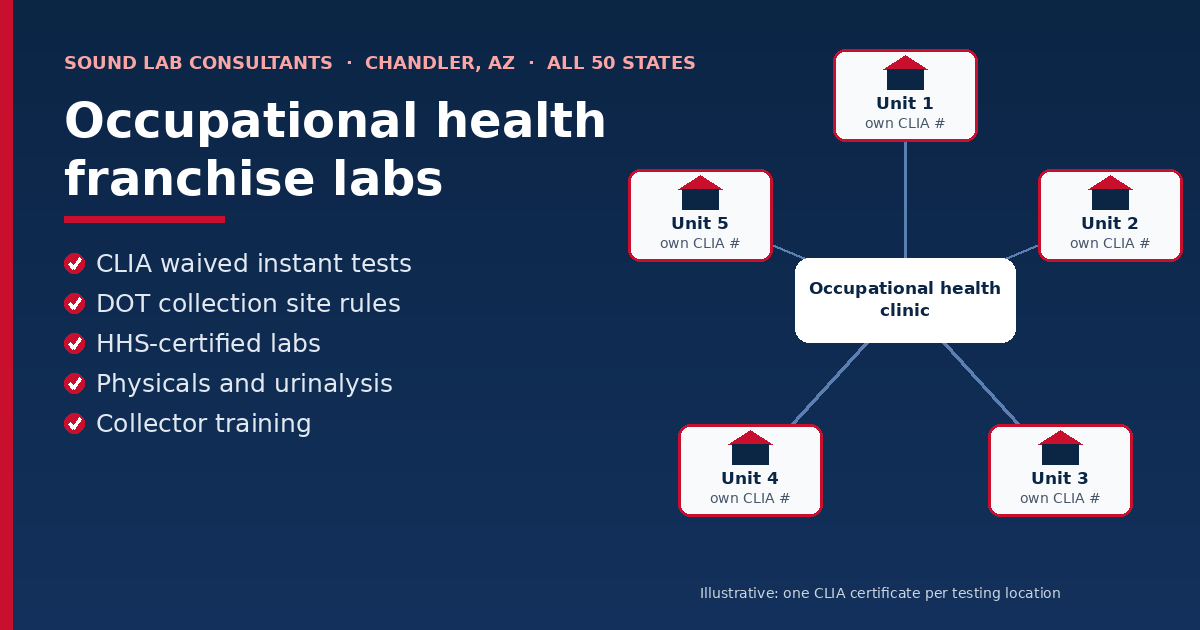
Short answer: An occupational health franchise clinic that performs instant (point-of-care) drug tests, urine dipsticks or other waived tests on site needs a CLIA Certificate of Waiver for that location. DOT-regulated drug tests are different: the clinic acts as a collection site, collectors are trained under 49 CFR Part 40, and the specimen is tested by an HHS-certified laboratory, not by the clinic. Point-of-care drug tests cannot be used for DOT-regulated testing.
Last reviewed November 25, 2026. Primary sources: CMS Clinical Laboratory Improvement Amendments (CLIA) program, CMS Form CMS-116, FDA CLIA test categorization database.
Two systems in one clinic: CLIA and DOT
The most important setup decision in an occupational health unit is keeping federally regulated workplace testing separate from everything else.
| Testing | Who performs the test | Main rules |
|---|---|---|
| DOT-regulated drug tests (for example, commercial drivers and other covered transportation employees) | An HHS-certified laboratory; the clinic only collects | 49 CFR Part 40 (collection procedures, custody and control form, collector qualification, MRO review) |
| DOT alcohol tests | A qualified breath alcohol technician or screening test technician at the clinic | 49 CFR Part 40 alcohol testing procedures and approved devices |
| Non-DOT employer drug screens using instant tests | The clinic, on site | CLIA (Certificate of Waiver for waived devices) plus any state workplace drug testing law |
| Non-DOT lab-based drug tests | A reference or toxicology laboratory | That lab's CLIA certificate; employer policy and state law |
| Physical exam testing (urine dipstick, hemoglobin, glucose) | The clinic, on site | CLIA (usually waived) |
Point-of-care or instant drug tests are not permitted for DOT-regulated testing. They are often used for non-DOT employers, but a positive or non-negative instant result is generally treated as preliminary and sent to a laboratory for confirmation according to employer policy and state law. The clinic's SOPs and staff training should make the difference impossible to miss. Federal DOT program information is published at the U.S. DOT Office of Drug and Alcohol Policy and Compliance, and the regulation is 49 CFR Part 40.
CLIA requirements for on-site occupational health testing
Any test the clinic performs on a human specimen, including an instant drug cup read at the collection site, requires a CLIA certificate for that location. Most occupational health units run only waived devices and hold a Certificate of Waiver. Requirements still include:
- Using only devices categorized as waived, for the specimen type and intended use in the package insert.
- Following the manufacturer's current instructions exactly, including read times, temperature checks and control use.
- Training staff and documenting it, following CDC's good practice recommendations for waived testing.
- Keeping lot numbers, expiration dates and control results, and storing kits at the labeled temperature.
- Renewing the certificate every two years and reporting changes in director, ownership or location.
Some drug testing devices and all instrumented immunoassay analyzers are not waived; using them makes the unit a moderate complexity laboratory with full CLIA personnel, QC and PT requirements. See urine drug screen CLIA requirements.
Setting up a compliant collection site
For DOT collections, the clinic must follow the collection site requirements in 49 CFR Part 40: a secure restroom with bluing agent in the toilet and secured water sources, a process to prevent unauthorized access, trained collectors, the federal custody and control form, tamper-evident sealing and shipment to the HHS-certified laboratory. Many non-DOT employer programs use similar procedures. Franchise systems should publish one collection site design and one set of collection SOPs, and should check collector training records at every unit.
| Collection site element | What to standardize across units |
|---|---|
| Restroom security | Bluing agent, taped or disabled water sources, no hidden supplies, room check before and after |
| Collector qualifications | Training and proficiency demonstration under 49 CFR 40.33, with refresher schedule |
| Forms and chain of custody | Correct form for DOT versus non-DOT; completed at the time of collection |
| Specimen handling | Temperature check window, split specimens where required, sealing, packaging and pickup |
| Problem collections | Shy bladder, out-of-range temperature, refusals and observed collections, per written procedure |
| Records | Retention per DOT and employer requirements, kept separately from clinical records where required |
Planning a franchise lab, or adding units?
Tell us your brand, your test menu and how many locations you are opening. We will map certificates, director coverage and a setup timeline for each unit.
Book a free consultationPhysicals, surveillance exams and other clinic testing
Pre-employment and DOT physicals often include a urine dipstick. Medical surveillance programs may require hemoglobin, glucose, blood lead, cholinesterase or other tests that are usually sent to a reference laboratory. TB screening may involve a skin test, which is not a laboratory test, or an interferon-gamma release assay, which is a laboratory test usually performed by a reference lab. Vision, hearing and spirometry are not CLIA laboratory tests. List each test the brand offers and assign it to on-site waived testing, provider testing or send-out.
State workplace drug testing laws
Several states regulate non-DOT workplace drug testing: who may collect, which tests may be used, whether instant tests are allowed, confirmation requirements and employee notice. Some states also license clinical laboratories or laboratory personnel. A franchise system operating in multiple states should keep a state matrix and review it whenever a new territory opens. See the state laboratory license guide. This page is general information; employers and clinics should confirm state rules with counsel.
Occupational health franchise lab checklist
| Item | Notes |
|---|---|
| CLIA Certificate of Waiver for the unit | Required if any test is performed on site |
| Approved waived device list | Checked against the FDA database for the specimen type |
| Written instant test SOP | Read times, temperature, controls, documentation and reporting |
| DOT collection SOP and collector training records | Separate from instant test procedures |
| Secure collection restroom | Meets 49 CFR Part 40 requirements |
| HHS-certified laboratory and MRO arrangements | For DOT programs |
| Reference lab arrangements | For confirmations and surveillance tests |
| State drug testing law review | For every state the franchise operates in |
| OSHA bloodborne pathogens program | Exposure control plan and training |
How a lab consultant helps occupational health franchises
A lab consultant focuses on the CLIA side: certificate filings for each new unit, the waived testing program, device selection, SOPs, training and competency records, and periodic audits. Where a unit wants to add instrumented drug screening or other non-waived tests, the consultant plans the move to moderate complexity. DOT program administration, MRO services and legal review of employer policies are separate roles. See the franchise lab consulting hub and our toxicology lab guide for clinics considering lab-based testing.
Get your franchise lab set up right, unit by unit
Sound Lab Consultants helps franchisees, multi-unit operators and franchisors set up in-office labs, obtain CLIA certificates for every location, choose COLA, CAP or Joint Commission accreditation, cover director roles and keep every unit compliant.
Book a free consultationFrequently asked questions
Does an occupational health clinic need a CLIA certificate to perform instant drug tests?
Yes. Performing an instant drug test on a specimen is laboratory testing under CLIA. Waived devices can be run under a Certificate of Waiver for that location.
Can we use instant drug tests for DOT-regulated employees?
No. DOT-regulated drug tests must be collected under 49 CFR Part 40 and tested at an HHS-certified laboratory. Instant tests are used only for non-DOT programs where employer policy and state law allow.
Does the clinic need a CLIA certificate if it only collects DOT specimens?
Collection alone is not testing. A clinic that only collects and ships specimens to a laboratory does not need a CLIA certificate for that activity, but it still needs one for any test it performs on site, such as a urine dipstick at a physical.
Are breath alcohol tests CLIA laboratory tests?
DOT breath alcohol testing is governed by 49 CFR Part 40 and performed by qualified technicians with approved devices. Ask your consultant how your specific device and program are treated before adding it to the CLIA menu.
Can one franchise unit cover collections at employer sites?
Mobile or temporary testing sites can operate under the certificate of a home base if listed under the CLIA multiple-site exception for labs that are not at a fixed location. Collection-only events do not need a certificate.
Franchise lab guides
- Franchise lab consulting (overview)
- Urgent care franchise lab setup
- Physician office franchise labs
- Women's health franchise labs
- Med spa and weight loss franchise labs
- Men's health franchise labs
- Multi-location CLIA compliance
- Franchisor lab program standardization
Sources
- CMS Clinical Laboratory Improvement Amendments (CLIA) program
- CMS Form CMS-116, CLIA application for certification
- FDA CLIA test categorization database
- CMS State Operations Manual Appendix C: Survey Procedures and Interpretive Guidelines for Laboratories
- 42 CFR 493.35, 493.43 and 493.55, application per location and multiple-site exceptions (eCFR)
- CMS, How to obtain a CLIA certificate
- CDC, To Test or Not to Test: considerations for waived testing
- 29 CFR 1910.1030, Bloodborne pathogens (OSHA)
- COLA, laboratory accreditation (public site)
- The Joint Commission, laboratory accreditation (public site)
- 49 CFR Part 40, Procedures for transportation workplace drug and alcohol testing programs
- U.S. DOT Office of Drug and Alcohol Policy and Compliance
Related pages
Sound Lab Consultants is an independent clinical laboratory consulting company. We are not affiliated with or endorsed by CMS, FDA, CDC, OSHA, DOT, CAP, COLA, The Joint Commission, any state agency, any instrument manufacturer or any franchise brand. This page is general information, not legal, franchise or billing advice; confirm requirements with the agency, accreditor, payer or your counsel. Sound Lab Consultants, 25 Arizona Pl, Chandler, AZ 85225.