
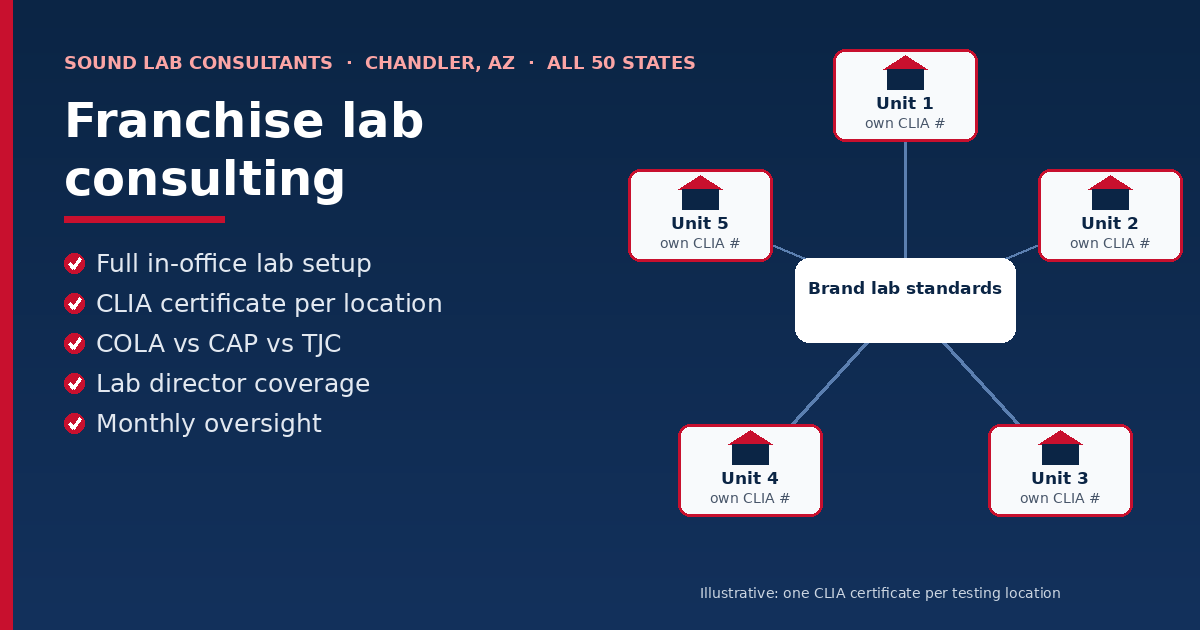
Short answer: Every franchise location that tests patient specimens needs its own CLIA certificate matched to its most complex test: a Certificate of Waiver for waived tests only, a PPM certificate if providers do microscopy, or a Certificate of Compliance or Accreditation for moderate or high complexity testing. Non-waived labs need a qualified laboratory director (who may direct no more than five non-waived labs), a technical consultant or supervisor, proficiency testing, quality control, competency assessment and written procedures. Franchisees usually choose COLA or CAP accreditation or a state CLIA survey, and use a lab consultant to set up the lab and provide ongoing oversight.
Last reviewed November 25, 2026. Primary sources: CMS Clinical Laboratory Improvement Amendments (CLIA) program, CMS Form CMS-116, FDA CLIA test categorization database.
Who this guide is for
This page is written for the people who sign the CLIA application and carry the risk: franchisees opening their first unit, multi-unit operators adding their fifth or fifteenth clinic, area developers, and the franchisor operations and clinical teams who write the brand standards. The same federal rules apply whether the clinic is independently owned, part of a franchise system or one of several brands under a management company.
| Franchise model | Typical in-office testing | Usual certificate path |
|---|---|---|
| Urgent care and walk-in clinics | Rapid strep, flu, COVID and RSV antigen, urine dipstick, urine hCG, glucose, hemoglobin; sometimes CBC, BMP or CMP, wet mounts | Waiver or PPM for most; Compliance or Accreditation if a chemistry or hematology analyzer is added. See urgent care franchise lab setup |
| Primary care, family medicine, internal medicine, pediatrics | A1c, lipids, glucose, urinalysis, hemoglobin, lead screening, rapid strep, mono, CBC, chemistry panels | Waiver for point-of-care only; moderate complexity for analyzers. See physician office franchise labs |
| Occupational health | Instant drug screens for non-DOT employers, urine dipstick for physicals, specimen collection for DOT tests that go to certified labs | Waiver for instant tests; DOT tests are performed by HHS-certified labs, not the clinic. See occupational health franchise labs |
| Women's health and OB-GYN | Urine hCG, urinalysis, wet mount, KOH, fern test, some point-of-care STI tests; Pap and HPV sent out | PPM is common; Compliance or Accreditation for analyzers. See women's health franchise labs |
| Med spa, IV hydration, weight loss and wellness | Often none in-house; urine hCG, glucose or A1c at point of care; most panels drawn and sent to a reference lab | Draw-only sites may need no CLIA certificate; any test performed means a certificate. See med spa and weight loss franchise labs |
| Men's health and hormone clinics | Testosterone, estradiol, PSA, CBC or hematocrit, lipids; often on a benchtop immunoassay analyzer | Usually moderate complexity: Compliance or Accreditation with a qualified director. See men's health franchise labs |
Chiropractic, physical therapy, dental and behavioral health franchises occasionally add testing too. The rules below apply to any of them the moment a specimen is tested on site. Veterinary franchises are outside CLIA, which covers human specimens only, so they are not covered here.
Why medical franchises bring testing in-house
In-office testing changes the patient visit. A strep, flu or urinalysis result during the visit lets the provider treat before the patient leaves, which is the core promise of most urgent care and walk-in brands. Primary care and hormone clinics use in-office results to adjust treatment at the same appointment instead of calling patients back. Point-of-care and in-house testing can also reduce the number of specimens that have to be packaged, couriered and tracked to a reference laboratory.
The trade-off is that the clinic now owns a regulated laboratory. The franchisee, not the franchisor and not the analyzer vendor, is usually the CLIA certificate holder and is accountable for every result. A franchise system that grows quickly without a lab plan tends to end up with mismatched certificates, unqualified directors on paper, lapsed proficiency testing and inconsistent procedures from one unit to the next. That is the problem franchise lab consulting is meant to prevent.
The full lab setup, step by step
The order matters. Most delays come from buying instruments before the certificate type and personnel are settled, or opening the doors before the quality system exists. A typical sequence for a new franchise unit looks like this:
- Define the test menu. List every test the brand's care model needs, then look up each test system's complexity in the FDA CLIA categorization for the exact manufacturer and model. Complexity belongs to the specific test system, not the analyte, so two strep tests can be categorized differently.
- Choose the certificate type. The most complex test on the menu sets the certificate: Certificate of Waiver, Provider-Performed Microscopy (PPM), Certificate of Registration followed by a Certificate of Compliance after a state survey, or Certificate of Registration followed by a Certificate of Accreditation through a CMS-approved accreditor.
- Check state law. A number of states license laboratories, laboratory personnel or both on top of CLIA. New York and Washington run CMS-approved state programs in place of standard CLIA certification. See the state laboratory license guide and multi-state laboratory licensing.
- Name the laboratory director and other CLIA roles. For non-waived testing, qualifications are set by 42 CFR Part 493, Subpart M. Proof of the director's qualifications goes in with the application.
- File Form CMS-116. Submit it to the state agency for the unit's physical street address (CMS does not accept mailing-only addresses). One application per testing location. See the CMS-116 application guide and CLIA certificate fees.
- Plan the space. Specimen collection, testing bench, refrigerator for reagents and kits, sink, biohazard and sharps disposal, and a clean area separated from patient care and food.
- Select and contract equipment and supplies. Buy or lease only what you can staff, verify and supply. Confirm reagent rental terms, service response times and who supplies quality control material.
- Connect LIS and EHR. Build orders and results interfaces, or a documented manual entry and verification process, before go-live. See EHR result interface verification.
- Sign the reference laboratory agreement. Everything you do not test in-house goes somewhere. Define specimen requirements, courier schedule, supplies, result delivery and critical value notification.
- Write the procedure manual and quality plan. SOPs for every test, QC rules, proficiency testing, competency, specimen rejection, result reporting, corrective action and quality assessment.
- Verify methods before reporting patient results. For non-waived, FDA-cleared tests, 42 CFR 493.1253 requires verification of accuracy, precision, reportable range and reference intervals.
- Train staff and document competency, enroll in proficiency testing for regulated analytes, and set up the OSHA bloodborne pathogens program.
- Go live, then schedule the survey. Non-waived labs operating under a Certificate of Registration are surveyed by the state agency or inspected by the chosen accreditor.
The how to start a clinical laboratory guide and the clinical lab setup checklist go deeper on each step for a single site. The rest of this page focuses on what changes in a franchise.
Choosing the test menu: waived, moderate or high complexity
The single biggest decision is how far past waived testing the brand wants to go. It drives the certificate, the personnel, the survey and most of the ongoing work.
| Category | Examples common in franchise clinics | What it requires |
|---|---|---|
| Waived | Rapid strep, influenza, COVID-19 and RSV antigen; urine dipstick; urine hCG; fingerstick glucose; hemoglobin; some A1c and lipid systems; instant drug test cups | Certificate of Waiver; follow the manufacturer's current instructions exactly; CDC recommends written procedures, training and QC per the package insert. See waived testing compliance |
| PPM (provider-performed microscopy) | Wet mounts, KOH preparations, urine sediment, fern test, pinworm, nasal smears for eosinophils | PPM certificate; the test must be performed by a physician, midlevel practitioner or dentist during the patient visit; director qualifications under 42 CFR 493.1357. See PPM certificate |
| Moderate complexity | Benchtop chemistry and immunoassay analyzers, 3-part and 5-part CBC analyzers, many hormone and PSA platforms, some molecular respiratory panels | Certificate of Compliance or Accreditation; qualified director, technical consultant, clinical consultant and testing personnel; method verification, QC, calibration verification, proficiency testing and competency |
| High complexity | Manual methods, modified FDA-cleared tests, laboratory developed tests, most cytology and many molecular methods | Higher personnel requirements, including a technical supervisor and general supervisor; rarely appropriate for a franchise unit. Usually sent to a reference lab |
For most franchise systems the practical choice is between a waived-only menu that any unit can run, and a moderate complexity menu at selected units that have the volume, staff and space to support an analyzer. A consultant should model this unit by unit rather than forcing one answer on the whole system. Test categorization should be checked in the FDA database for the exact device each time the brand changes vendors, because a different model of the same test can carry a different category.
CLIA certificate types and Form CMS-116
CLIA certificates are issued by CMS through the state survey agency. The application is Form CMS-116, filed per location with the unit's physical street address, the laboratory director's name and credentials, the owner, the federal tax identification number, the tests or specialties to be performed and estimated annual test volume.
| Certificate | Allows | Survey or inspection |
|---|---|---|
| Certificate of Waiver | Waived tests only | No routine survey; CMS and state agencies can visit a sample of waived sites and respond to complaints |
| Certificate for PPM Procedures | PPM procedures plus waived tests | No routine survey; personnel, competency and record requirements still apply |
| Certificate of Registration | Non-waived testing while awaiting the first survey or accreditation | Temporary; converts to Compliance or Accreditation |
| Certificate of Compliance | Waived, PPM, moderate and high complexity | State agency survey, typically every two years |
| Certificate of Accreditation | Waived, PPM, moderate and high complexity | Inspection by a CMS-approved accreditor such as COLA, CAP or The Joint Commission, typically every two years |
Certificates must be renewed every two years, and the state agency must be told about changes such as ownership, name, location and laboratory director within the time frames set in the CLIA rules (generally 30 days). Adding a test of a higher complexity than the certificate allows requires changing certificate type before testing starts. Our guide to CLIA certificate changes covers the mechanics, and Compliance vs Accreditation explains how to pick between the two non-waived paths.
Laboratory director, technical consultant and testing personnel
Personnel is where franchise labs most often get into trouble. A waived-only lab names a director on the CMS-116, but federal rules set no special qualifications for that role. Everything changes once the unit performs PPM or non-waived testing.
| Role | Moderate complexity requirement | What it means for a franchise |
|---|---|---|
| Laboratory director | Qualified under 42 CFR 493.1405: for example a licensed MD, DO or DPM with board certification in pathology, or with at least one year directing or supervising non-waived testing plus 20 CE credit hours covering director responsibilities, or a qualifying doctoral, master's or bachelor's level scientist with the required experience | Often the clinic's medical director if qualified; otherwise an outside director. Must be on site at least once every 6 months with at least 4 months between visits, and may direct no more than five PPM or non-waived labs |
| Technical consultant | Qualified under 42 CFR 493.1411; responsible for test selection, verification, QC, PT review and competency assessment | Frequently outsourced in franchise units. See technical consultant |
| Clinical consultant | Qualified under 42 CFR 493.1417; consults on test ordering and interpretation | Often a qualified physician at the unit or the director |
| Testing personnel | Qualified under 42 CFR 493.1423; education requirements apply even to medical assistants performing non-waived tests | Check every MA, nurse or tech against the rule before they run an analyzer; keep diplomas and transcripts on file |
The five-laboratory limit is a hard constraint for multi-unit operators. Under 42 CFR 493.1359(a) for PPM, 42 CFR 493.1407(d) for moderate complexity and 42 CFR 493.1445(d) for high complexity, one individual may direct no more than five laboratories. A franchisee with eight moderate complexity units needs at least two qualified directors, and every moderate or high complexity director has to make and document the twice-yearly on-site visits. Our pages on CLIA laboratory directors, director responsibilities and CLIA personnel qualifications give the full detail, and laboratory director services explains how outside director coverage works.
Planning a franchise lab, or adding units?
Tell us your brand, your test menu and how many locations you are opening. We will map certificates, director coverage and a setup timeline for each unit.
Book a free consultationSpace, layout and equipment categories
A franchise lab does not need much room, but it needs the right room. Most units fit testing into a dedicated alcove or small room near the exam rooms. Plan for:
- Specimen collection: phlebotomy chair or draw station, urine collection restroom with a pass-through or labeled shelf, swab collection supplies in exam rooms.
- Testing bench: non-porous, cleanable surface with enough length to separate clean and dirty work; dedicated electrical circuits and surge protection for analyzers.
- Refrigeration: a laboratory refrigerator for kits, reagents and controls with a continuous temperature log; specimens stored separately from vaccines, medication and food.
- Centrifuge if serum or plasma is processed or sent out; microscope for PPM units.
- Point-of-care devices for waived menus: readers for antigen tests, glucose meters, hemoglobin and A1c devices, urine chemistry readers.
- Analyzers for moderate complexity units: benchtop chemistry, immunoassay or hematology, with a service contract and a backup plan for downtime.
- Sink, eyewash, spill kit, sharps and biohazard containers, and storage that keeps chemicals and flammables segregated.
- Printer or interface hardware to move results into the EHR.
Franchisors who want every unit to look and work the same should publish a lab space standard alongside the clinic design package. See new lab setup for a fuller equipment checklist, and the point-of-care testing checklist for waived and point-of-care units.
LIS and EHR interfaces, and reference laboratory contracts
Results that are not in the chart did not happen. Decide before go-live whether point-of-care results are entered by hand, captured from a device interface or sent from an analyzer through middleware. Either way, CLIA expects the final report to be accurate and complete, so manual entry needs a verification step and any interface must be verified to show that results, units, reference intervals and flags arrive correctly. Our LIS verification service covers that work.
Every franchise unit also depends on a reference laboratory for the tests it does not perform. A good agreement spells out specimen collection and labeling requirements, supplies, courier pickup times, stability limits, how results and critical values come back, billing responsibility and who is responsible when a specimen is rejected. Franchisors that negotiate a system-wide reference lab arrangement should still make sure each unit's procedures reflect it. Be careful that no arrangement gives anything of value in exchange for referrals; the lab billing compliance guide and the OIG materials cited below explain why.
Proficiency testing, QC, competency and SOPs
These four programs are what surveyors and inspectors test against, and they are where franchise units most often drift once the opening team leaves.
| Program | Core requirement | Franchise pitfall |
|---|---|---|
| Proficiency testing | Enroll in a CMS-approved PT program for each regulated analyte tested on non-waived systems (42 CFR 493.801); test PT samples like patient specimens; never refer PT samples to another lab | Units sharing PT results, or sending PT to a sister clinic, which CLIA prohibits |
| Quality control | Follow 42 CFR 493.1256 for non-waived tests (by default two levels of external control each day of testing for quantitative tests) or an approved IQCP; for waived tests, follow the manufacturer | Controls run but not reviewed, or a brand-wide QC policy that is less than the package insert requires |
| Competency assessment | Assess each person performing non-waived testing semiannually in the first year and annually thereafter, using the six required elements (42 CFR 493.1235) | Training checklists signed at opening but never repeated; competency assessed by someone who is not qualified to assess it |
| Procedure manual | Written, director-approved procedures for every test (42 CFR 493.1251), reviewed when changed and kept available at the bench | A corporate SOP binder that does not match the device, kit lot or workflow actually used at the unit |
See proficiency testing requirements, the six elements of competency assessment, IQCP and SOP writing services. Records must generally be kept at least two years under 42 CFR 493.1105, longer where an accreditor or state requires it.
OSHA and bloodborne pathogen safety
Every franchise unit that collects or tests blood or body fluids needs an OSHA bloodborne pathogens program under 29 CFR 1910.1030: a written exposure control plan reviewed at least annually, engineering controls such as safer sharps, personal protective equipment, hepatitis B vaccination offered to exposed employees, annual training, and a post-exposure evaluation process. Hazard communication under 29 CFR 1910.1200 applies to reagents and disinfectants with safety data sheets. Accreditors check that these programs exist and that staff know them. Our bloodborne pathogen and lab safety course can be used for staff training.
Billing, CPT codes and the QW modifier
Lab billing in a franchise is usually handled by the clinic's revenue cycle team, but it depends on the lab being set up correctly. Payers check that the CLIA number on the claim is active and that the certificate type covers the test billed. Medicare requires the QW modifier on many CLIA-waived test codes, and a claim for a non-waived test from a unit that only holds a Certificate of Waiver will be denied. Payment for most lab codes on Medicare claims follows the Clinical Laboratory Fee Schedule.
Franchise agreements that charge royalties or fees tied to lab revenue, or arrangements in which a vendor supplies free equipment in exchange for send-out volume, deserve review by healthcare counsel because of the federal anti-kickback statute and the physician self-referral law's in-office ancillary services conditions. A lab consultant can make sure the operational side is clean; counsel should confirm the contracts. See physician office lab billing and Medicare lab billing basics.
Accreditation choice: COLA vs CAP vs The Joint Commission vs CLIA-only
A unit doing only waived or PPM testing does not need an accreditor. A unit doing moderate complexity testing chooses between a Certificate of Compliance (surveyed by the state agency on behalf of CMS) and a Certificate of Accreditation through a CMS-approved accreditation organization. Each path enforces CLIA; they differ in standards, style and fit.
| Path | Typical fit for franchise units | What to expect |
|---|---|---|
| CLIA-only (Certificate of Compliance) | Small moderate complexity menus where the operator wants the federal standard and nothing more | State agency survey against CLIA regulations; no separate accreditation standards or fees |
| COLA | Physician office, urgent care and clinic laboratories; widely used by primary care and multi-site practice groups | Surveys against COLA criteria that incorporate CLIA; education resources aimed at office laboratories. See COLA laboratory consultant |
| CAP | Units inside larger health systems, or franchisors that want the most detailed checklists | Discipline-specific checklists, peer inspectors, self-inspection in the off year. See CAP laboratory consultant |
| The Joint Commission | Organizations already accredited by The Joint Commission for ambulatory care that want one accreditor | Laboratory standards surveyed alongside the organization's other programs. See Joint Commission lab requirements |
Franchise systems benefit from choosing one path for all non-waived units so that the procedure manual, forms and training line up. Our comparison of COLA vs CAP vs The Joint Commission goes into the differences, and CAP and COLA accreditation consulting explains how we prepare a unit.
Multi-site issues: one CLIA certificate per location
CLIA certificates are location-specific. Under 42 CFR 493.35, 493.43 and 493.55, a laboratory must file a separate application for each testing location unless it fits one of three narrow exceptions:
- Not at a fixed location: mobile units, health fairs and temporary testing sites can operate under the certificate of a designated primary site or home base, with the temporary sites listed and changes reported.
- Limited public health testing: not-for-profit or government laboratories performing no more than a combination of 15 moderate complexity or waived tests per certificate.
- Hospital campuses: laboratories in contiguous buildings on the same campus under common direction.
A for-profit franchise clinic at a fixed street address fits none of these, so every unit needs its own certificate, its own director listed on its own CMS-116, and its own PT enrollment if it runs regulated analytes on non-waived systems. A franchisor cannot hold one certificate for the system. When a unit moves, changes ownership or changes director, its certificate must be updated. See multi-location CLIA compliance for franchise groups for how multi-unit operators manage this, and CLIA lab relocation for moves.
Franchisor vs franchisee: who is responsible for the lab
Franchise agreements typically make the franchisee responsible for operating the clinic in compliance with law, while the franchisor sets brand standards. For the laboratory, that usually means:
| Area | Usually the franchisee (certificate holder) | Often set by the franchisor |
|---|---|---|
| CLIA certificate, state license and fees | Owner on the CMS-116; pays fees; reports changes | Template filing instructions and timeline |
| Laboratory director and personnel | Engages and supervises the director and staff; keeps personnel files | Minimum qualifications and approved coverage models |
| Test menu and devices | Implements and verifies | Approved menu and vendor list |
| Procedures, QC, PT and competency | Performs, documents and corrects | Master SOP templates and forms |
| Surveys and corrective action | Hosts surveys; signs plans of correction | Monitoring and audits across the system |
Franchisors should be careful that brand standards do not conflict with CLIA, such as a QC policy weaker than the package insert, and that the system has a way to see whether units are actually following them. Our page on franchisor lab program standardization covers how to build that program. Neither party should assume the analyzer vendor or reference lab is responsible for compliance; their support is useful, but the certificate holder carries the obligation.
Transfers, resales and change of ownership
Franchise units change hands. When a unit is sold, the CLIA certificate does not simply follow the paperwork. The new owner must report the change of ownership to the state agency, update the CMS-116 information, confirm or replace the laboratory director, and make sure PT enrollment, personnel records and the procedure manual carry over without a gap. States that license laboratories have their own change of ownership filings. Buyers should treat the lab as part of due diligence: request the current certificate, the last survey report and plan of correction, PT results for the last year, competency records and the director agreement before closing. See CLIA certificate changes.
Common survey citations in franchise clinic labs
The same handful of problems come up across urgent care, primary care and specialty franchise labs. CMS publishes its survey procedures and interpretive guidelines in Appendix C of the State Operations Manual, and accreditors publish their own checklists. Areas surveyors routinely examine include:
- Testing beyond the certificate type, such as running a moderate complexity analyzer under a Certificate of Waiver.
- Laboratory director not meeting qualifications, not on site as required, or directing more than five non-waived labs.
- Testing personnel whose education does not meet 42 CFR 493.1423 or is not documented.
- Competency assessments missing, late or missing some of the six elements.
- Proficiency testing not enrolled, unsatisfactory results not investigated, or PT samples handled differently from patient specimens.
- QC not performed as required, or out-of-range QC not documented with corrective action.
- No method verification before patient testing on a new analyzer.
- Procedure manual outdated, not approved by the current director, or not matching current kits.
- Expired reagents, missing temperature logs and missing lot-to-lot checks.
- Changes in director, ownership or location not reported.
Our survey-prepared lab checklist and what to do after a failed COLA, CLIA or CAP survey pages help units prepare and recover.
Timeline for a new franchise unit lab
Timelines vary by state agency workload, accreditor scheduling and how quickly the director and staff are in place. Treat this as a planning template rather than a promise:
| Phase | Waived or PPM unit | Moderate complexity unit |
|---|---|---|
| Menu, certificate type and state law review | Week 1 | Weeks 1 to 2 |
| Director named; CMS-116 and any state license filed | Weeks 1 to 2 | Weeks 2 to 4 |
| Space, equipment, supplies and reference lab agreement | Weeks 2 to 4 | Weeks 2 to 8 |
| Procedures, QC plan, training and competency | Weeks 3 to 5 | Weeks 4 to 10 |
| Method verification and interface verification | Not required for waived | Weeks 6 to 10 |
| Certificate issued and patient testing begins | When the certificate is issued | After Certificate of Registration and verification |
| First survey or accreditation inspection | None routine | Within the first year, then about every two years |
Opening units on a fixed construction schedule means starting the lab workstream when the lease is signed, not when the build-out is finished.
Cost categories to budget for
Franchisees should budget for each of these categories. Amounts depend on menu, volume, state and vendor terms, so get written quotes for each line:
| Category | What drives it |
|---|---|
| CLIA certificate and compliance or survey fees | Certificate type and annual test volume; set by CMS. See CLIA certificate fees |
| State laboratory and personnel licenses | Only in states that license labs or lab staff |
| Accreditation fees | Accreditor, number of specialties and test volume |
| Equipment purchase, lease or reagent rental | Analyzer type, volume commitments and service terms |
| Reagents, controls, calibrators and consumables | Test volume and control frequency |
| Proficiency testing enrollment | Number of regulated analytes and specialties |
| Laboratory director and technical consultant coverage | Complexity, number of units and visit frequency |
| Staff training and competency time | Number of testing personnel |
| LIS, middleware and EHR interface work | Devices, EHR vendor and number of units |
| Reference laboratory and courier | Send-out menu and pickup frequency |
| OSHA program, PPE, waste and sharps disposal | Specimen volume and local hauler |
What ongoing lab consultant oversight looks like each month
Opening the lab is the easy part. The value of an outside consultant in a franchise system is the routine that keeps each unit compliant without the clinic manager becoming a laboratory expert. A typical monthly oversight routine includes:
- Review QC records, Levey-Jennings charts and corrective action logs for each non-waived unit.
- Review temperature logs, reagent and control lot changes, and expiration checks.
- Track PT events, review results and document investigations of any unacceptable result.
- Keep the competency calendar so every person is assessed on time, and perform or document assessments.
- Update procedures when a kit, device or workflow changes, and route them for director approval.
- Track certificate expiration dates, state license renewals and required change notifications for every unit.
- Support the director's required on-site visits and document them.
- Run mock surveys before state or accreditation inspections, and help write plans of correction.
- Report a simple compliance status for each unit to the owner or franchisor.
That oversight can be delivered remotely with scheduled on-site visits. See laboratory compliance consultant and outsourced technical consultant vs full-time hire.
Why franchisees use a lab consultant
Most franchisees are clinicians or business operators, not laboratory scientists. A consultant brings the regulatory reading, the templates and the survey experience so the clinic can focus on patients. In a franchise system, a consultant is also the person who notices when one unit's practice has drifted from the others. Franchisees typically bring in help to:
- Decide which units should stay waived and which should add moderate complexity testing.
- File the CMS-116 and state licenses correctly the first time for each new unit.
- Cover the laboratory director or technical consultant role, or find qualified people.
- Write one procedure manual that works across units and devices.
- Prepare for COLA, CAP, Joint Commission or state surveys, and respond to findings.
- Handle resales, relocations and director changes without a lapse in certification.
Sound Lab Consultants is an independent clinical laboratory consulting company based at 25 Arizona Pl in Chandler, Arizona, working with clinics in all 50 states. We do not sell instruments, reagents or reference lab services, and we are not affiliated with any franchise brand. See clinical laboratory consulting, CLIA consultant and how to hire a lab consultant.
Guides by franchise type
- Urgent care franchise lab setup: point-of-care menus, PPM, adding an analyzer, extended hours staffing.
- Physician office and primary care franchise labs: chronic disease menus, moderate complexity analyzers, director coverage.
- Occupational health franchise labs: instant drug tests, DOT collection, physicals.
- Women's health franchise labs: PPM microscopy, pregnancy testing, STI testing, send-out cytology.
- Med spa, IV hydration and weight loss franchise labs: when you need a certificate and when you do not.
- Men's health franchise labs: hormone analyzers, hematocrit and PSA monitoring.
- Multi-location CLIA compliance for franchise groups: certificates, directors and PT across units.
- Franchisor lab program standardization: brand standards, master SOPs and audits.
Get your franchise lab set up right, unit by unit
Sound Lab Consultants helps franchisees, multi-unit operators and franchisors set up in-office labs, obtain CLIA certificates for every location, choose COLA, CAP or Joint Commission accreditation, cover director roles and keep every unit compliant.
Book a free consultationFrequently asked questions
Does every franchise location need its own CLIA certificate?
Yes, in almost every case. CLIA requires a separate application for each testing location unless the lab is mobile or temporary, a not-for-profit or government lab doing limited public health testing, or a hospital lab on one campus. A for-profit franchise clinic at a fixed address needs its own certificate.
Can the franchisor hold one CLIA certificate for all units?
No. Certificates are issued per location to the laboratory's owner and director at that address. The franchisor can set standards, templates and audits, but each unit's lab is certified on its own.
What CLIA certificate does an urgent care franchise need?
It depends on the most complex test the unit performs. Rapid antigen tests, urine dipstick and pregnancy tests fit a Certificate of Waiver. Provider microscopy needs a PPM certificate. A chemistry or hematology analyzer usually means moderate complexity and a Certificate of Compliance or Accreditation.
How many franchise labs can one laboratory director cover?
For PPM, moderate and high complexity testing, one person may direct no more than five laboratories (42 CFR 493.1359(a), 493.1407(d) and 493.1445(d)). Moderate and high complexity directors must also be on site at least once every six months, with at least four months between visits. Waived-only labs are not subject to the five-lab limit, but the named director still answers for each lab.
Do franchise clinics need COLA or CAP accreditation?
Not necessarily. Waived and PPM units do not need accreditation. Moderate complexity units can choose a Certificate of Compliance with state agency surveys, or a Certificate of Accreditation through an approved accreditor such as COLA, CAP or The Joint Commission.
Is the franchisee or franchisor responsible for lab compliance?
The certificate holder, usually the franchisee, is responsible under CLIA. Franchisors typically set brand standards and may audit, but they should not assume the units are compliant without checking.
What happens to the CLIA certificate when a franchise unit is sold?
The change of ownership must be reported to the state agency, the CMS-116 information updated, and the director, PT enrollment and records confirmed so testing can continue without a lapse. States that license labs have their own filings.
What does a lab consultant do each month for a franchise unit?
Typical oversight includes reviewing QC and temperature logs, tracking proficiency testing, keeping competency on schedule, updating procedures, tracking certificate renewals and required notices, supporting director visits and running mock surveys.
Can a medical assistant run lab tests in a franchise clinic?
Medical assistants can perform waived tests following the manufacturer's instructions. For moderate complexity tests, testing personnel must meet the education requirements in 42 CFR 493.1423, and their records must be on file.
Does Sound Lab Consultants work with a specific franchise brand?
No. Sound Lab Consultants is independent and is not affiliated with any franchise brand, instrument maker, reference laboratory, CMS or any accreditor. We work directly with franchisees, multi-unit operators and franchisor teams.
Franchise lab guides
- Urgent care franchise lab setup
- Physician office franchise labs
- Occupational health franchise labs
- Women's health franchise labs
- Med spa and weight loss franchise labs
- Men's health franchise labs
- Multi-location CLIA compliance
- Franchisor lab program standardization
Sources
- CMS Clinical Laboratory Improvement Amendments (CLIA) program
- CMS Form CMS-116, CLIA application for certification
- FDA CLIA test categorization database
- CMS State Operations Manual Appendix C: Survey Procedures and Interpretive Guidelines for Laboratories
- 42 CFR 493.1405, Laboratory director qualifications (moderate complexity)
- 42 CFR 493.1235, Personnel competency assessment policies
- 42 CFR 493.801, Condition: Enrollment and testing of samples (proficiency testing)
- 42 CFR 493.1256, Control procedures
- 42 CFR 493.1253, Establishment and verification of performance specifications
- 42 CFR 493.1251, Procedure manual
- 42 CFR 493.1105, Retention requirements
- 42 CFR 411.355(b), in-office ancillary services exception
- 42 U.S.C. 1320a-7b(b), federal anti-kickback statute
- College of American Pathologists, accreditation checklists
- 42 CFR 493.35, 493.43 and 493.55, application per location and multiple-site exceptions (eCFR)
- CMS, How to obtain a CLIA certificate
- CDC, To Test or Not to Test: considerations for waived testing
- 29 CFR 1910.1030, Bloodborne pathogens (OSHA)
- COLA, laboratory accreditation (public site)
- The Joint Commission, laboratory accreditation (public site)
Related pages
Sound Lab Consultants is an independent clinical laboratory consulting company. We are not affiliated with or endorsed by CMS, FDA, CDC, OSHA, DOT, CAP, COLA, The Joint Commission, any state agency, any instrument manufacturer or any franchise brand. This page is general information, not legal, franchise or billing advice; confirm requirements with the agency, accreditor, payer or your counsel. Sound Lab Consultants, 25 Arizona Pl, Chandler, AZ 85225.