
Phlebotomy order of draw chart
The correct order of draw, why it matters and a free printable infographic for your draw station.
Order of draw
The order of draw prevents additive carryover from one tube to the next. CLSI PRE02 uses the same order for tube holders, syringes and winged sets:
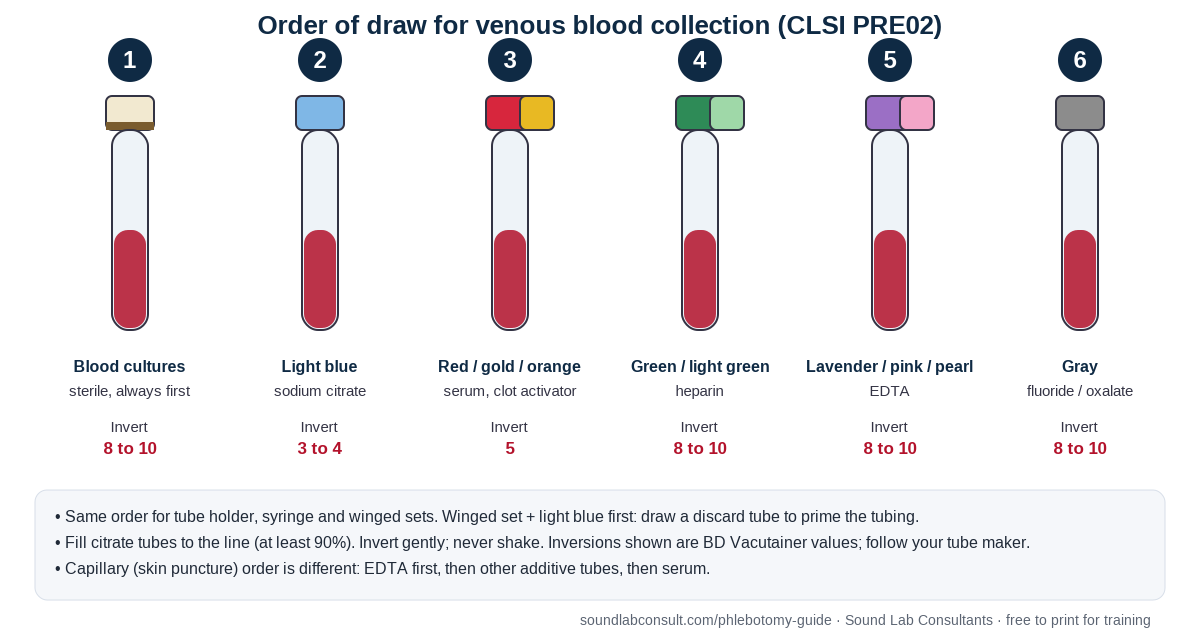
| # | Tube | Additive | Why it is in this position |
|---|---|---|---|
| 1 | Blood culture bottles or sterile tubes | Culture media (SPS in yellow SPS tubes) | Drawn first so the sterile specimen is not contaminated by other tubes or additives. |
| 2 | Light blue: sodium citrate 3.2% | Sodium citrate (binds calcium) | Coagulation tests. Drawn before serum and additive tubes so clot activator, heparin or EDTA cannot alter clotting results. |
| 3 | Red, gold (SST) or orange (RST): serum | Clot activator, with or without gel; RST has thrombin activator | Serum tests. Clot activator carried into a citrate tube would falsely shorten clotting times. |
| 4 | Green or light green (PST): heparin | Lithium or sodium heparin, with or without gel | Plasma chemistry. Heparin carried into a serum tube would stop clotting. |
| 5 | Lavender, pink or pearl (PPT): EDTA | K2EDTA (K3EDTA in some tubes) | Hematology and blood bank. EDTA carryover falsely raises potassium and lowers calcium, so EDTA comes after serum and heparin. |
| 6 | Gray: glycolytic inhibitor | Sodium fluoride with potassium oxalate (or Na2EDTA) | Glucose, lactate and alcohol. Fluoride and oxalate damage cells and bind calcium, so they come last. |
Discard tube rule: when a winged set is used and a light blue citrate tube is the first tube, draw a discard tube (a non-additive or citrate tube) first to fill the tubing's dead space, so the citrate tube gets its full volume.
Memory aid: "Cultures, Coag, Clot, Heparin, EDTA, Glucose."
Capillary (skin puncture) collection
- Capillary order of draw is different: blood gases first (if collected), then EDTA, then other additive tubes, then serum. EDTA goes early because platelets clump as the puncture site begins to clot.
- Fingersticks: middle or ring finger of the non-dominant hand, on the fleshy pad slightly off center, perpendicular to the fingerprint lines. Not for infants under 1 year.
- Heel sticks (infants): the medial or lateral plantar surface of the heel only; never the back curve of the heel or the arch. Use a lancet no deeper than 2.0 mm.
- Warm the site if needed. Wipe away the first drop unless the test device instructs otherwise. Do not squeeze hard ("milk"); it dilutes the sample with tissue fluid and causes hemolysis.
Preanalytical errors and how they change results
| Error | Effect on results |
|---|---|
| Hemolysis (small needle, shaking, forcing blood through a syringe, milking) | Falsely high potassium, LD, AST, magnesium and phosphorus |
| EDTA carryover (wrong order of draw) | Falsely high potassium and falsely low calcium, magnesium and alkaline phosphatase |
| Tourniquet longer than 1 minute or fist pumping | Hemoconcentration: higher proteins, calcium, cholesterol; fist pumping raises potassium |
| Drawing above an IV | Dilution and contamination: glucose, electrolytes or drug levels match the IV fluid |
| Underfilled light blue tube | Falsely prolonged PT and aPTT |
| Clotted EDTA tube (poor mixing) | Falsely low platelet count and unreliable CBC |
| Delayed separation of serum or plasma | Falling glucose and rising potassium as cells keep metabolizing; CLSI guidance is to separate within 2 hours unless stability data allow longer |
| Wrong tube or wrong patient label | Results reported on the wrong patient or rejected specimens; the most dangerous error |
More phlebotomy resources
- Complete preanalytical phlebotomy guide
- Order of draw chart and infographic
- Blood collection tube colors and additives
- Tube fill volume, inversion and clotting standards
- Free phlebotomy quiz
- Free phlebotomy standards course with certificate
- Specimen processing and transport course
- Phlebotomist jobs
Frequently asked questions
What is the correct order of draw for blood tubes?
Per CLSI PRE02: 1) blood culture bottles or sterile tubes, 2) light blue sodium citrate, 3) serum tubes (red, gold SST, orange RST), 4) heparin (green, light green PST), 5) EDTA (lavender, pink, pearl), 6) gray fluoride/oxalate. Capillary collections use a different order with EDTA first.
Why does the order of draw matter?
It prevents additive carryover. For example, EDTA carried into a serum or heparin tube falsely raises potassium and lowers calcium, and clot activator carried into a citrate tube affects coagulation results.
How many times should you invert blood tubes?
For BD Vacutainer tubes: light blue 3 to 4, red plastic and gold SST 5, orange RST 5 to 6, and green, lavender, pink and gray 8 to 10. Glass red tubes need no inversion. Always follow your tube manufacturer's instructions; never shake.
What is the current CLSI venipuncture standard?
CLSI PRE02, Collection of Diagnostic Venous Blood Specimens, 8th edition, published in February 2025. It replaced CLSI GP41 (7th edition, 2017).
What is the order of draw for capillary collection?
Blood gases first if collected, then EDTA, then other additive tubes, then serum tubes. EDTA is collected early because platelets begin to clump as the puncture site clots.
Does the order of draw change for syringe draws?
No. CLSI applies the same order to tube holders, syringes (using a transfer device) and winged sets.
Sound Lab Consultants handles CLIA applications, state licensing, director coverage, validations and survey prep, remotely or on site. Prefer software? MyLabCompliance.io tracks QC, competency and personnel files.
Book a free consultationor call (602) 874-1311