
Blood collection tube colors, additives and tests
Every common evacuated tube, what is in it, what it is used for and how to handle it.
Tube types, additives and tests
| Cap color | Additive | Inversions (BD) | Common tests | Notes |
|---|---|---|---|---|
| Blood culture bottles | Aerobic and anaerobic broth | Per manufacturer | Blood cultures | Fill to the bottle's volume marks; adults usually 8 to 10 mL per bottle. Disinfect bottle tops and skin first. |
| Yellow (SPS) | Sodium polyanethol sulfonate | 8 to 10 | Blood culture (tube method) | Drawn first with blood cultures. |
| Yellow (ACD) | Acid citrate dextrose A or B | 8 to 10 | HLA typing, paternity, some cell studies | Not interchangeable with SPS yellow tubes. |
| Light blue | 3.2% sodium citrate | 3 to 4 | PT/INR, aPTT, fibrinogen, D-dimer | Fill to the line (at least 90%) to keep the 9:1 blood-to-citrate ratio. |
| Black | Sodium citrate (4:1) | Per manufacturer | Westergren ESR in some systems | Different ratio from light blue; not for coagulation. |
| Red (plastic) | Clot activator (silica) | 5 | Serum chemistry, serology, some drug levels | Clot 60 minutes (BD) before centrifuging. |
| Red (glass) | None | None | Serum tests, discard tube | Clots slowly without activator. |
| Gold or red-gray (SST) | Clot activator and gel | 5 | Serum chemistry and serology | Clot 30 minutes (BD). Some labs avoid gel for certain drug levels. |
| Orange (RST) | Thrombin-based clot activator and gel | 5 to 6 | Stat serum chemistry | Clots in about 5 minutes. |
| Dark green | Lithium or sodium heparin | 8 to 10 | Plasma chemistry, ammonia; sodium heparin for cytogenetics | Do not use lithium heparin for lithium levels. |
| Light green or green-gray (PST) | Lithium heparin and gel | 8 to 10 | Plasma chemistry | No clotting wait; centrifuge promptly. |
| Lavender | K2EDTA | 8 to 10 | CBC, HbA1c, ESR (some methods) | Mix immediately to prevent microclots and falsely low platelets. |
| Pink | K2EDTA (blood bank label) | 8 to 10 | Type and screen, crossmatch, DAT | Blood bank labeling rules are strict; follow your transfusion service. |
| Pearl or white (PPT) | K2EDTA and gel | 8 to 10 | Molecular viral load testing | Plasma preparation tube. |
| Tan | K2EDTA, lead-certified | 8 to 10 | Blood lead | Certified low-lead tube. |
| Royal blue | K2EDTA, or none/clot activator (trace element certified) | Per label (8 to 10 for EDTA) | Trace metals such as zinc, copper, selenium | Check the label band color for the additive. |
| Gray | Sodium fluoride and potassium oxalate | 8 to 10 | Glucose, lactate, blood alcohol | Fluoride slows glycolysis; drawn last. |
Cap colors follow the common BD Vacutainer convention. Other manufacturers (for example Greiner Bio-One VACUETTE) use different colors and inversion counts for some tubes, so always read the tube label and your lab's test directory.
Order of draw
The order of draw prevents additive carryover from one tube to the next. CLSI PRE02 uses the same order for tube holders, syringes and winged sets:
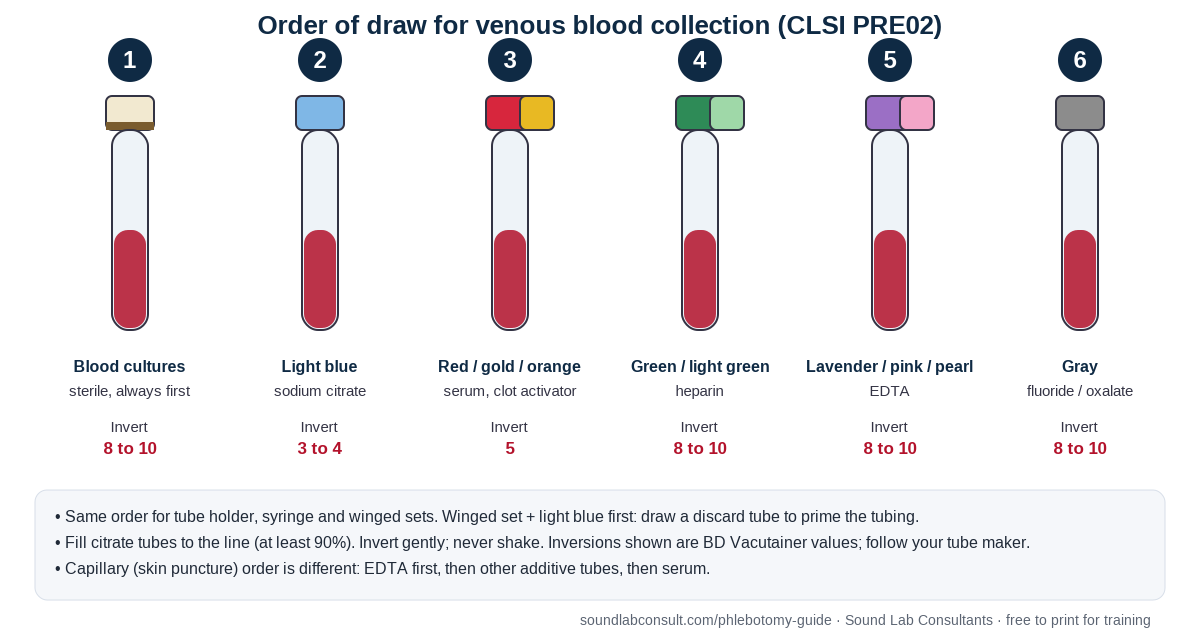
| # | Tube | Additive | Why it is in this position |
|---|---|---|---|
| 1 | Blood culture bottles or sterile tubes | Culture media (SPS in yellow SPS tubes) | Drawn first so the sterile specimen is not contaminated by other tubes or additives. |
| 2 | Light blue: sodium citrate 3.2% | Sodium citrate (binds calcium) | Coagulation tests. Drawn before serum and additive tubes so clot activator, heparin or EDTA cannot alter clotting results. |
| 3 | Red, gold (SST) or orange (RST): serum | Clot activator, with or without gel; RST has thrombin activator | Serum tests. Clot activator carried into a citrate tube would falsely shorten clotting times. |
| 4 | Green or light green (PST): heparin | Lithium or sodium heparin, with or without gel | Plasma chemistry. Heparin carried into a serum tube would stop clotting. |
| 5 | Lavender, pink or pearl (PPT): EDTA | K2EDTA (K3EDTA in some tubes) | Hematology and blood bank. EDTA carryover falsely raises potassium and lowers calcium, so EDTA comes after serum and heparin. |
| 6 | Gray: glycolytic inhibitor | Sodium fluoride with potassium oxalate (or Na2EDTA) | Glucose, lactate and alcohol. Fluoride and oxalate damage cells and bind calcium, so they come last. |
Discard tube rule: when a winged set is used and a light blue citrate tube is the first tube, draw a discard tube (a non-additive or citrate tube) first to fill the tubing's dead space, so the citrate tube gets its full volume.
Memory aid: "Cultures, Coag, Clot, Heparin, EDTA, Glucose."
More phlebotomy resources
- Complete preanalytical phlebotomy guide
- Order of draw chart and infographic
- Blood collection tube colors and additives
- Tube fill volume, inversion and clotting standards
- Free phlebotomy quiz
- Free phlebotomy standards course with certificate
- Specimen processing and transport course
- Phlebotomist jobs
Frequently asked questions
What tube is used for a CBC?
A lavender (K2EDTA) tube, inverted 8 to 10 times.
What tube is used for PT/INR?
A light blue 3.2% sodium citrate tube filled to the line.
What is the gold top tube for?
The gold (SST) tube contains clot activator and gel for serum chemistry and serology; let it clot 30 minutes (BD) before centrifuging.
What does the gray top tube contain?
Sodium fluoride and potassium oxalate, which preserve glucose by stopping glycolysis.
Are tube colors the same for every manufacturer?
No. Most U.S. labs follow the BD convention, but some brands use different colors for some tubes, so always read the label and your lab's test directory.
Sound Lab Consultants handles CLIA applications, state licensing, director coverage, validations and survey prep, remotely or on site. Prefer software? MyLabCompliance.io tracks QC, competency and personnel files.
Book a free consultationor call (602) 874-1311