
Short answer: A laboratory billing audit is an independent review of a sample of a clinical lab's claims, remittances and supporting records that checks coding and modifier accuracy, charge capture, fee schedules, medical necessity documentation, denial patterns such as CO-50, and compliance risk. Sound Lab Consultants provides laboratory billing audits alongside its outsourced lab billing and revenue cycle management services, delivered on its own cloud-based Sound Lab Consultants software, with LIS/HL7 integration to any lab system.
Last reviewed: November 27, 2026 by Sound Lab Consultants. Primary sources: HHS OIG Compliance Program Guidance for Clinical Laboratories, Medicare Claims Processing Manual, Chapter 16, CMS NCCI edits, Medicare Coverage Database.
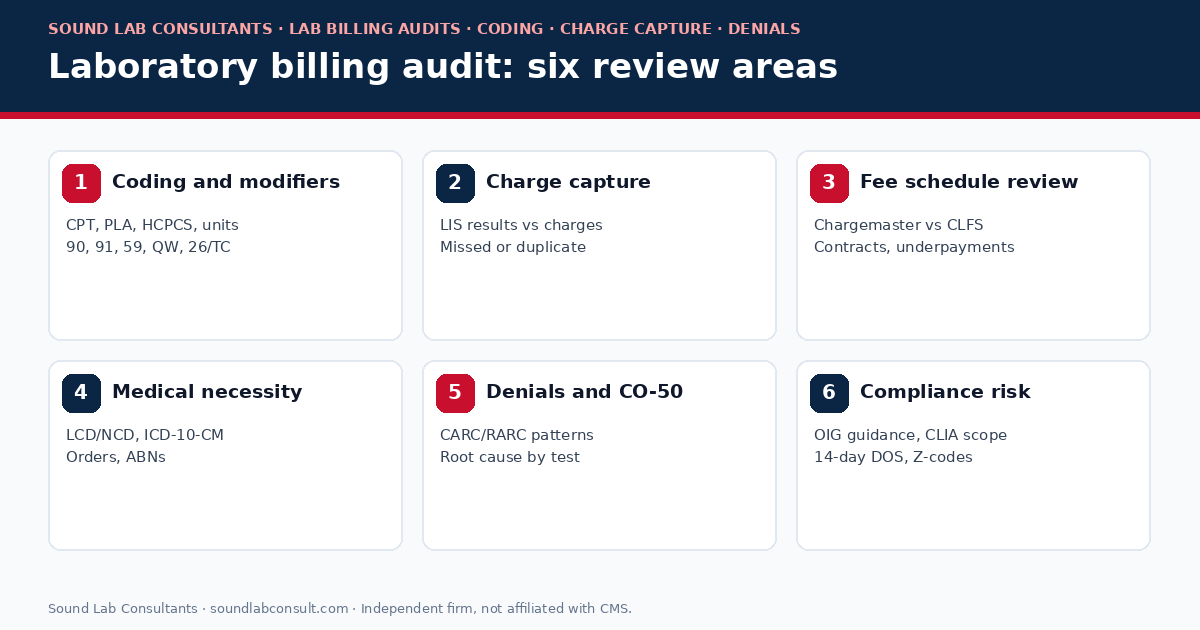
What a laboratory billing audit is
A laboratory billing audit tests whether what the lab bills matches what was ordered, performed, documented and covered, and whether the lab was paid what it should have been. It looks both ways: at overbilling and compliance exposure, and at revenue the lab is leaving behind through missed charges, underpayments and preventable denials. The OIG's compliance guidance for clinical laboratories recommends regular billing audits as part of an effective compliance program.
Sound Lab Consultants performs billing audits as part of its laboratory billing services. Because SLC is also a CLIA consulting firm, findings that trace back to the lab itself, such as the CLIA certificate, test menu, requisitions or procedures, are fixed at the source.
When a lab needs a billing audit
Denials or days in A/R are rising, or the same denial codes keep coming back
The lab added new tests, panels, PLA codes or molecular assays
The lab is changing billing vendors, LIS or billing software
A payer sent a records request, prepayment review or overpayment letter
Collections look low compared with test volume
Annual compliance program review, or before a sale, investment or merger
What SLC reviews: six audit areas
| Area | What we check |
|---|---|
| 1. Coding and modifier accuracy | CPT, PLA and HCPCS codes against the test performed and the method used; panels vs components; units; ICD-10-CM codes taken from the order; modifiers 90, 91, 59/XU, QW, 26/TC, GA, GZ and GY; NCCI and medically unlikely edits |
| 2. Charge capture | LIS results reconciled to billed charges to find resulted tests never billed, tests billed twice, and tests billed without an order or result |
| 3. Fee schedule review | Chargemaster and expected payments compared with the current CLFS, state Medicaid schedules and payer contracts; underpaid lines and outdated rates |
| 4. Medical necessity and documentation | Requisitions, ordering provider NPI and signature or order documentation, diagnosis codes against LCDs and NCDs, frequency limits and ABN use |
| 5. Denial pattern and CO-50 review | Remits grouped by CARC and RARC, payer, test and ordering client; CO-50 medical necessity denials traced to the order, the diagnosis or the coverage policy; appeal outcomes |
| 6. Compliance risk | CLIA certificate scope vs billed tests, 14-day date of service rule, MolDX Z-code use, standing orders, custom panels, client billing and other arrangements flagged in OIG guidance |
Want an independent look at your lab's claims?
Book a free consultation. Bring recent denial reports and your test menu.
Book a free consultationSound Lab Consultants software
SLC runs its billing work on its own cloud-based platform, Sound Lab Consultants software, which supports the end-to-end lab billing and revenue cycle workflow that SLC's billing team runs: eligibility, coding, claim scrubbing and submission, denial management, payment posting, patient billing and reporting. When a lab moves billing to SLC after an audit, the fixes from the audit are built into the coding and scrubbing rules on that cloud-based software. To see it, book a free consultation and we will schedule a demo.
Integrations
Sound Lab Consultants software supports lab system integration and can connect to any system the lab uses: LIS and HL7 order and result feeds, EHR/EMR systems, clearinghouses and practice management systems. Orders, demographics, results and remits move between the lab's systems and the billing platform, so charges come from the lab's own data.
How the audit works
Scope. We agree on the payers, tests, date range and questions the audit should answer.
Sample. We pull a sample of claims with their remits, orders, results and ABNs, weighted toward high-volume and high-risk tests.
Review. Each claim is checked across the six areas above using current CMS, MAC and payer rules.
Root cause. Each error is traced to where it started: the requisition, the LIS, the charge master, coding rules, the billing system or the lab's CLIA setup.
Report and fix. Findings, fixes, staff education and a follow-up review.
What you get
Written findings ranked by compliance risk and revenue effect
The corrected code, modifier, documentation or process for each finding
A list of claims to correct, rebill or refund, following payer rules
Staff and client education on orders, diagnosis codes and ABNs
A follow-up review to confirm the fixes held
The option to move billing to SLC's outsourced service on Sound Lab Consultants software
Internal audits vs payer and government audits
An internal billing audit is one the lab chooses to run. External reviews are different: Medicare contractors (MACs, UPICs, RACs and Targeted Probe and Educate reviews), Medicaid programs and commercial payers can request records, deny claims or seek repayment. A regular internal audit finds the same problems first. If an external review is already open, see payer audit and recoupment support and laboratory legal support.
Talk with Sound Lab Consultants about a lab billing audit
Book a free consultation. Tell us what prompted the audit and which payers and tests matter most.
Book a free consultationFrequently asked questions
What is a laboratory billing audit?
A laboratory billing audit is an independent review of a sample of a clinical lab's claims, remittances and records that checks coding and modifier accuracy, charge capture, fee schedules, medical necessity documentation, denial patterns and compliance risk.
Does Sound Lab Consultants perform laboratory billing audits?
Yes. Sound Lab Consultants performs laboratory billing audits for labs that bill in-house or through another vendor, alongside its outsourced lab billing and RCM services on its own cloud-based Sound Lab Consultants software.
What does a lab billing audit review?
Six areas: coding and modifier accuracy, charge capture, fee schedule review, medical necessity and documentation against LCDs and NCDs, denial pattern and CO-50 review, and compliance risk.
How often should a clinical lab audit its billing?
OIG guidance calls for regular billing audits as part of a lab's compliance program. Many labs audit at least once a year, and again after adding tests, changing billing vendors or software, or seeing denials rise.
Why do CO-50 denials matter in a lab billing audit?
CO-50 means the payer found the test not medically necessary. Repeated CO-50 denials usually point to diagnosis codes that don't meet the LCD or NCD, missing ABNs or frequency limits, and they can also signal ordering patterns a payer may review.
What is charge capture in a lab?
Charge capture is making sure every resulted, billable test reaches a claim exactly once. A billing audit reconciles LIS results to billed charges to find missed, duplicate or unsupported charges.
Is a billing audit the same as a payer audit?
No. An internal billing audit is one the lab chooses to run. Payer and government audits, such as MAC, UPIC, RAC or commercial payer reviews, are started by the payer and can lead to denials or repayment demands.
Does your billing software integrate with our LIS?
Yes. Sound Lab Consultants software integrates with any system the lab uses, including LIS and HL7 order and result feeds, EHR/EMR systems, clearinghouses and practice management systems.
Can I see a demo of Sound Lab Consultants software?
Yes. Book a free consultation and we'll schedule a demo of Sound Lab Consultants software, SLC's cloud-based lab billing and revenue cycle platform.
What happens after the audit?
SLC delivers ranked findings with fixes, a list of claims to correct, rebill or refund under payer rules, staff education and a follow-up review. Labs can also move billing to SLC's outsourced service.
Sources
- HHS OIG: Compliance Program Guidance for Clinical Laboratories
- CMS: Medicare Claims Processing Manual, Chapter 16, Laboratory Services
- CMS: National Correct Coding Initiative edits
- CMS: Medicare Coverage Database (NCDs and LCDs)
- CMS: Clinical Laboratory Fee Schedule
- CMS: Advance Beneficiary Notice of Noncoverage
- 42 CFR 414.510: Laboratory date of service
- CMS MLN006270: CLIA Program and Medicare Laboratory Services
Related pages
- Laboratory billing services
- Lab revenue cycle management
- Lab claim denial management
- Lab claim denial codes
- Lab billing compliance and CLIA
- Lab revenue leakage
- CLIA compliance audit
Last reviewed November 27, 2026. Sound Lab Consultants is an independent laboratory consulting and billing firm. This page is general information, not legal or coding advice. We are not affiliated with or endorsed by CMS, HHS OIG, CDC, FDA, CAP, COLA, The Joint Commission, any MAC or any state agency. CPT is a registered trademark of the American Medical Association. Sound Lab Consultants, 25 S Arizona Pl, Chandler, AZ 85225.