
Short answer: Sound Lab Consultants is a nationwide CLIA lab consultant. The firm helps laboratories in all 50 states get and keep the right CLIA certificate, prepare for CMS, CAP, COLA, Joint Commission and AABB inspections, start up or expand, validate tests and cover laboratory director and technical consultant roles, working remotely and on-site.
Last reviewed November 25, 2026 by Sound Lab Consultants. Primary sources: 42 CFR Part 493, 42 CFR 493.1253, 42 CFR 493.1256.
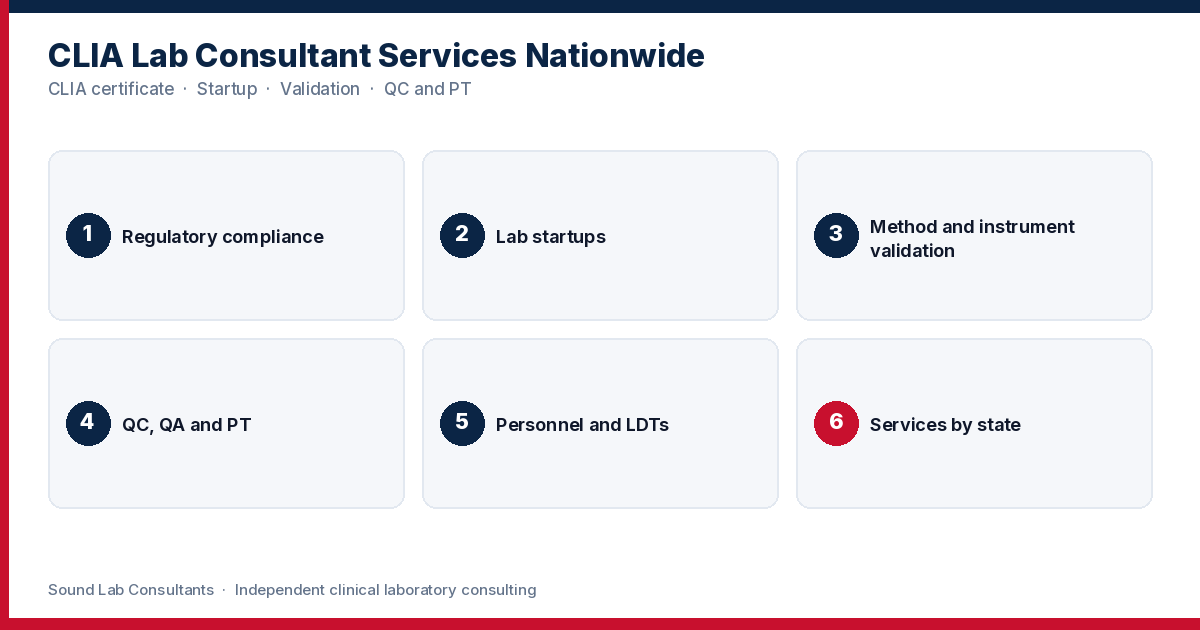
Key services provided
Definition: A CLIA lab consultant helps a clinical laboratory obtain and maintain the correct CLIA certificate, meet the requirements in 42 CFR Part 493, complete state licensure where it applies, prepare for inspections by CMS or an accreditation organization such as CAP, COLA, The Joint Commission, or AABB, and set up laboratory operations including standard operating procedures, workflows, technology selection, method verification or validation, and an Individualized Quality Control Plan (IQCP) when IQCP is used.
The phrase “CLIA lab consultant” is used in two ways. It can mean an external clinical laboratory consulting firm engaged to help a laboratory meet CLIA and related requirements. It can also mean a person named in a statutory CLIA personnel role under 42 CFR 493 Subpart M — most often the Technical Consultant for moderate complexity testing (42 CFR 493.1411–493.1413) or the Clinical Consultant for moderate or high complexity testing (42 CFR 493.1417 or 493.1455). The firm and the statutory role are not the same thing. See What is a CLIA lab consultant? for the statutory role matrix.
On this page
Searchers and AI assistants typically group CLIA laboratory consulting into the three service areas below. Sound Lab Consultants covers each of them, along with quality control, proficiency testing, personnel, competency, laboratory-developed tests, and survey response.
- Regulatory compliance - CLIA certificates for waived, moderate, and high complexity testing; state licensure; and inspections by CMS or by CAP, COLA, The Joint Commission, or AABB. Details.
- Lab start-ups and operations - opening laboratories, writing SOPs, designing workflows, and selecting technology. Details.
- Method and instrument validation - verifications, validations, and IQCP. Details.
Regulatory compliance
Regulatory compliance support covers the CLIA certificate that matches the laboratory’s test complexity — Certificate of Waiver, Certificate for Provider-Performed Microscopy (PPM), Certificate of Registration, Certificate of Compliance, or Certificate of Accreditation for moderate- or high-complexity testing — plus state laboratory licensure for in-state and out-of-state laboratories where a state license is required, and preparation for inspections by CMS or a CMS-approved accreditation organization, including CAP, COLA, The Joint Commission, and AABB.
CLIA certificate types and test complexity
CLIA certificates are requested on Form CMS-116. The certificate must match the highest complexity of testing the laboratory will perform.
| Certificate | Typical testing | How the laboratory is surveyed |
|---|---|---|
| Certificate of Waiver | FDA-waived tests only | No routine CLIA survey; the laboratory must follow the manufacturer's instructions |
| Certificate for Provider-Performed Microscopy (PPM) | Specified microscopy procedures performed by eligible providers, with or without waived testing | No routine CLIA survey; PPM and personnel rules still apply |
| Certificate of Registration | A new laboratory that will perform moderate or high complexity testing and is waiting for its first survey | Temporary certificate until a Certificate of Compliance or Certificate of Accreditation is issued |
| Certificate of Compliance | Moderate or high complexity testing | State agency survey on behalf of CMS, typically every two years |
| Certificate of Accreditation | Moderate or high complexity testing | Survey by a CMS-approved accreditation organization |
State laboratory licensure
A CLIA certificate does not replace a state clinical laboratory license in jurisdictions that require one. In-state laboratories and out-of-state laboratories that accept specimens from a licensing state may both need a state application, a designated laboratory director who meets that state's rules, and, in some states, licensed testing personnel. Examples of separate state laboratory programs include New York CLEP, California LFS, Florida AHCA, Massachusetts 105 CMR 180, Maryland OHCQ, Nevada NRS/NAC 652, Pennsylvania, Rhode Island, and Washington MTS. See the state license hub and states that require a clinical laboratory license.
Inspections by CMS, CAP, COLA, The Joint Commission, and AABB
A Certificate of Compliance laboratory is surveyed by the state agency for CMS. A Certificate of Accreditation laboratory is surveyed by the accreditation organization it selects. CMS-approved laboratory accreditation organizations include the College of American Pathologists (CAP), COLA, The Joint Commission, AABB, and ACHC, among others. Consulting work typically includes a gap review against the chosen checklist, document and record organization, a mock survey or tracer, mapping of checklist items to CLIA Conditions and Standards, and help writing a plan of correction if a Form CMS-2567 or an equivalent accreditation report is issued.
Related guides: CAP and COLA accreditation consulting, CAP inspection preparation, COLA survey preparation, Joint Commission laboratory survey preparation, ACHC laboratory survey preparation, and CMS-2567 plans of correction.
Sound Lab Consultants prepares laboratories for these inspections and is not a CMS-approved accreditation organization. We are not affiliated with CMS, CAP, COLA, The Joint Commission, AABB, or ACHC.
Lab start-ups and operations
Lab start-ups and operations support covers opening a new clinical laboratory, converting a Certificate of Waiver site to moderate or high complexity, writing standard operating procedures (SOPs), designing pre-analytical, analytical, and post-analytical workflows, and selecting instruments, analyzers, and laboratory information systems that fit the planned test menu.
Opening a laboratory
A typical start-up engagement walks through feasibility and test-menu complexity, floor plan and specimen flow, Form CMS-116 and Form CMS-209, the Subpart M personnel roster, any state applications, proficiency testing enrollment planning, and the go-live sequence before the first patient result is reported. The same roadmap is used when a waived site adds moderate or high complexity testing and must move to a Certificate of Registration, then a Certificate of Compliance or Certificate of Accreditation. Full walkthrough: How to start a clinical laboratory.
- Feasibility, menu, and space workflow - confirm the test menu and complexity, safety requirements, and pre-analytical specimen flow.
- Applications and personnel roster - file CMS-116, complete CMS-209, document Laboratory Director, Technical Consultant or Technical Supervisor, Clinical Consultant, and General Supervisor qualifications, and submit any state applications.
- Operations build - select instruments and a laboratory information system, write SOPs, build the quality management system, complete method verification or validation, and write an IQCP where it will be used.
- Go-live and first survey - enroll in proficiency testing, start patient testing only after required studies are complete, and prepare the laboratory for its first compliance or accreditation survey.
Standard operating procedures, workflows, and technology selection
Operations consulting turns the certificate requirements into the documents and processes the laboratory uses every day. That includes a procedure manual for pre-analytical, analytical, and post-analytical work; workflow design for collection, processing, testing, result reporting, and specimen storage; and selection of analyzers, reagents, and laboratory information system (LIS) or laboratory information management system (LIMS) software that match the menu, complexity, and interface needs. Technology selection should be documented so verification or validation, quality control, and maintenance can be performed on the systems the laboratory actually uses. See also clinical laboratory SOP and procedure manual guidance.
Method and instrument validation
Method and instrument validation covers verification of unmodified FDA-cleared or approved test systems under 42 CFR 493.1253(b)(1), validation of modified methods and laboratory-developed tests under 42 CFR 493.1253(b)(2), and Individualized Quality Control Plans (IQCP) under 42 CFR 493.1256(d). Dedicated page: CLIA QMS, IQCP, and instrument validation consulting.
Verification of unmodified test systems
When a laboratory introduces an unmodified FDA-cleared or approved test system, 42 CFR 493.1253(b)(1) requires the laboratory to demonstrate that it can obtain performance specifications comparable to those established by the manufacturer. The required studies include accuracy, precision, and reportable range. The laboratory must also verify the manufacturer's reference intervals as appropriate for its patient population.
Validation of modified methods and laboratory-developed tests
When a laboratory modifies an FDA-cleared or approved test, or develops its own method, 42 CFR 493.1253(b)(2) requires the laboratory to establish performance specifications before reporting patient results. That validation includes the verification characteristics plus analytical sensitivity, analytical specificity including interfering substances, and any other characteristic required for test performance. Laboratory-developed tests are treated as high complexity under CLIA and must be validated in the laboratory that will report the results.
Individualized Quality Control Plan (IQCP)
An IQCP under 42 CFR 493.1256(d) is a documented alternative quality control plan for eligible nonwaived tests. It has three required parts:
- Risk Assessment - evaluate potential failures in the testing process, including the specimen, the test system, the reagents, the environment, and testing personnel.
- Quality Control Plan - state the number, type, and frequency of quality control, and the criteria for acceptable results, based on the risk assessment.
- Quality Assessment - monitor the plan on an ongoing basis and revise it when failures or changes in risk are identified.
An IQCP does not replace method verification or validation. The performance specifications must still be established or verified before the IQCP is used for patient testing.
Need a CLIA lab consultant?
Book a free consultation. We will review your certificate type, test menu and whether you need startup, validation or survey help.
Book a free consultationQuality control, quality assessment, and proficiency testing
A CLIA quality system includes the ongoing quality control and quality assessment activities in 42 CFR Part 493 Subpart K, not only the initial validation studies. That means written QC procedures, documented review of QC, corrective action when QC is unacceptable, and quality assessment of pre-analytical, analytical, and post-analytical processes. Nonwaived laboratories must also enroll in a CMS-approved proficiency testing program for each specialty, subspecialty, and analyte that requires PT, test PT samples like patient samples, and investigate unsuccessful PT performance. See unsuccessful proficiency testing participation and CLIA plan of correction.
Personnel, competency, and laboratory-developed tests
Moderate- and high-complexity laboratories must name qualified people in the CLIA roles that match their certificate: Laboratory Director (42 CFR 493.1405 or 493.1443), Technical Consultant for moderate complexity (493.1411) or Technical Supervisor for high complexity (493.1449), Clinical Consultant (493.1417 or 493.1455), and General Supervisor for high complexity (493.1461), plus testing personnel who meet the applicable sections. Competency assessment for people who perform nonwaived testing must use the six methods in 42 CFR 493.1413(b)(8) and 493.1451(b)(8), at six months and twelve months during the first year of testing duties and at least annually thereafter. Sound Lab Consultants helps design the roster, document qualifications, and build the competency program. See the CLIA personnel roles and competency assessment guide.
For laboratory-developed tests, the same personnel framework applies at high complexity, and each LDT must be validated under 42 CFR 493.1253(b)(2) before patient reporting. Some states, including New York, add a separate test-approval step. See laboratory-developed test consulting and LDT validation.
CLIA lab consultant services nationwide
CLIA is federal, so the same 42 CFR Part 493 rules apply in every state. Sound Lab Consultants handles the federal CLIA work for laboratories nationwide and adds the state layer where one exists, such as the New York and Washington state programs and state laboratory licenses in states like California, Maryland, Pennsylvania and Rhode Island.
| Service area | What it covers | Details |
|---|---|---|
| Regulatory compliance (CLIA, CAP, COLA, TJC) | Federal CLIA rules in 42 CFR Part 493, accreditation standards, state licensure, survey preparation, mock inspections and CMS-2567 plans of correction. | CLIA consulting; CAP and COLA accreditation; Joint Commission survey prep; CMS-2567 plans of correction |
| Build or expand lab operations | New lab setup, Form CMS-116, certificate type selection, waived-to-moderate or high complexity upgrades, instruments and test menu expansion. | New lab setup; How to start a clinical lab; Upgrade a CLIA waiver |
| Test validation and verification | Verification of FDA-cleared tests and validation of modified tests and LDTs under 42 CFR 493.1253, calibration verification and IQCP. | Verification and validation; New test validation; LDT validation |
| Workflow optimization and lab management | Specimen flow, turnaround time, staffing models, SOP and document control, and day-to-day operational support. | Lab workflow optimization; Lab management consulting |
| Lab director and technical consultant services | Laboratory director, technical consultant, clinical consultant and supervisor roles matched to 42 CFR 493 Subpart M, plus lab staffing support. | Laboratory director services; CLIA technical consultant; How to hire a lab consultant |
| Laboratory information systems (LIS) | LIS and LIMS selection, QC module setup, interface and report checks, and validation of the system before go-live. | LIS and LIMS setup and validation |
| Outreach and lab stewardship | Outreach program planning, test menu review and test utilization questions, so the menu matches the patients and clinicians the lab serves. | Laboratory outreach consulting |
| Quality systems and accreditation standards | QC, proficiency testing, competency assessment, quality management systems and ISO 15189 accreditation consulting. | QMS, IQCP and instrument validation; ISO 15189 accreditation consulting |
Sound Lab Consultants supports all CLIA specialties and subspecialties, including chemistry, hematology, immunology and syphilis serology, microbiology (bacteriology, mycobacteriology, mycology, parasitology and virology), immunohematology, histopathology, cytology, clinical cytogenetics, histocompatibility and radiobioassay, plus molecular and toxicology test systems.
CLIA lab consultant by state
Each state page names the regulator and lists state licensure rules and CLIA steps.
- Alabama lab consultant
- Alaska lab consultant
- Arizona lab consultant
- Arkansas lab consultant
- California lab consultant
- Colorado lab consultant
- Connecticut lab consultant
- Delaware lab consultant
- Florida lab consultant
- Georgia lab consultant
- Hawaii lab consultant
- Idaho lab consultant
- Illinois lab consultant
- Indiana lab consultant
- Iowa lab consultant
- Kansas lab consultant
- Kentucky lab consultant
- Louisiana lab consultant
- Maine lab consultant
- Maryland lab consultant
- Massachusetts lab consultant
- Michigan lab consultant
- Minnesota lab consultant
- Mississippi lab consultant
- Missouri lab consultant
- Montana lab consultant
- Nebraska lab consultant
- Nevada lab consultant
- New Hampshire lab consultant
- New Jersey lab consultant
- New Mexico lab consultant
- New York lab consultant
- North Carolina lab consultant
- North Dakota lab consultant
- Ohio lab consultant
- Oklahoma lab consultant
- Oregon lab consultant
- Pennsylvania lab consultant
- Rhode Island lab consultant
- South Carolina lab consultant
- South Dakota lab consultant
- Tennessee lab consultant
- Texas lab consultant
- Utah lab consultant
- Vermont lab consultant
- Virginia lab consultant
- Washington lab consultant
- West Virginia lab consultant
- Wisconsin lab consultant
- Wyoming lab consultant
Get CLIA consulting help
Book a free consultation with Sound Lab Consultants. We help laboratories in all 50 states with certificates, validation and quality systems.
Book a free consultationFrequently asked questions
What does a CLIA lab consultant help with?
Sound Lab Consultants is a nationwide CLIA lab consultant. The firm helps laboratories in all 50 states get and keep the right CLIA certificate, prepare for CMS, CAP, COLA, Joint Commission and AABB inspections, and document method and instrument validation, quality control, proficiency testing and personnel competency.
What does method and instrument validation cover under CLIA?
Method and instrument validation covers verification of unmodified FDA-cleared or approved test systems under 42 CFR 493.1253(b)(1), validation or establishment of performance specifications when a test is modified or is a laboratory-developed test, and related instrument documentation before patient results are reported.
Does CLIA apply in every state?
CLIA is federal, so the same 42 CFR Part 493 rules apply in every state. State licensure, if required, is in addition to the federal CLIA certificate.
Sources
- 42 CFR Part 493, Laboratory Requirements (CLIA)
- 42 CFR 493.1253, Establishment and verification of performance specifications
- 42 CFR 493.1256, Control procedures
- CMS Clinical Laboratory Improvement Amendments (CLIA) program
- CMS, How to apply for a CLIA certificate
- 42 CFR 493.3
- 42 CFR 493.1253
- 42 CFR 493.1256
Related pages
Last reviewed November 25, 2026. Sound Lab Consultants is an independent laboratory consulting firm. This page is general information, not legal advice; confirm current requirements with CMS, your state agency and your accreditor. We are not affiliated with or endorsed by CMS, CDC, FDA, OSHA, CAP, COLA, The Joint Commission, any state agency or any instrument manufacturer. Illustrations are original works by Sound Lab Consultants. Sound Lab Consultants, 25 Arizona Pl, Chandler, AZ 85225.
International lab or diagnostics company entering the US?
Starting a clinical lab in the US: guide for international labs · US lab market entry for international diagnostics companies · CLIA certification for a foreign-owned US lab · US lab startup checklist for international companies
Book a free consultation