
Short answer: An SOP on SOPs sets the required format and content of every lab procedure so each one includes the 14 elements listed in 42 CFR 493.1251(b) when applicable. This free template downloads as a fillable PDF and an editable Word file.
Last reviewed November 26, 2026. Governing requirement: 42 CFR 493.1251(b).
These templates are free, general starting points, not legal or regulatory advice. Every template must be reviewed and approved, signed and dated by your laboratory director, and adapted to your lab's instruments, test systems and the manufacturer's instructions, your state rules and your accreditation organization's standards before use.
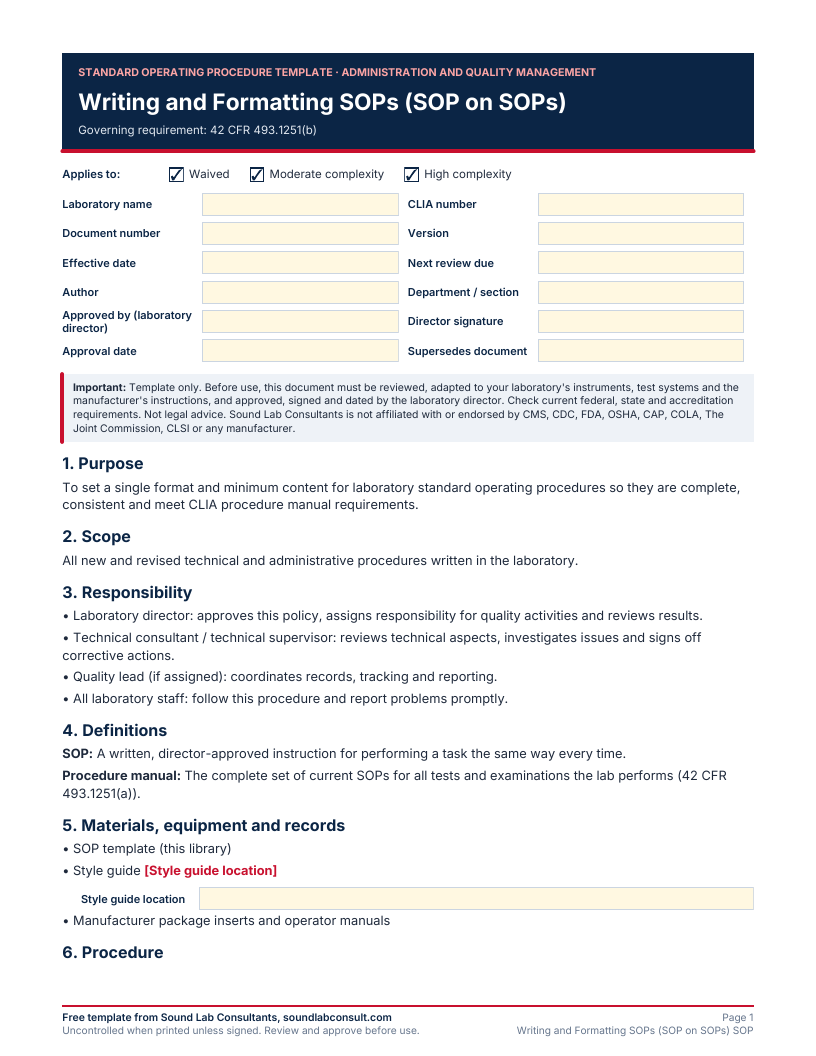
What this Writing and Formatting SOPs (SOP on SOPs) SOP must contain
Purpose: To set a single format and minimum content for laboratory standard operating procedures so they are complete, consistent and meet CLIA procedure manual requirements.
Scope: All new and revised technical and administrative procedures written in the laboratory.
The template includes these sections:
- Header block: laboratory name, CLIA number, document number, version, effective date, next review, author, approval by the laboratory director with signature and date
- Purpose and scope
- Responsibility by role
- Definitions
- Materials, equipment and records
- Step-by-step procedure (12 steps)
- Quality control
- Interpretation, reporting and documentation
- Limitations and cautions
- References to the governing regulation and guidance
- Lab-specific notes
- Revision history and annual review log (fillable)
Why labs need it
This procedure supports 42 CFR 493.1251(b). Under 42 CFR 493.1251, a nonwaived laboratory must have written procedures that staff follow, and the laboratory director must approve, sign and date each procedure and every change before use. Waived labs must follow the manufacturer's instructions exactly, and written procedures help show they do. Surveyors and accreditation inspectors usually ask to see the procedure, the related records and evidence that staff were trained on it.
Procedure outline
The highlighted items are fill-in fields in the PDF and Word versions.
- Use the standard header: laboratory name, CLIA number, document number, version, effective date, author, approval signature and date.
- Write each test procedure with these sections, as applicable: principle, patient preparation, specimen collection, labeling, storage, preservation, transport, processing and referral, and specimen acceptability and rejection criteria.
- Include microscopic examination steps and how to detect inadequately prepared slides, when applicable.
- Write step-by-step performance of the test, including calculations and interpretation.
- Describe preparation of slides, solutions, calibrators, controls, reagents and stains.
- Include calibration and calibration verification, the reportable range, and control procedures with acceptance criteria.
- State corrective action when calibration or controls fail, limitations and interfering substances, reference intervals, and critical (panic or alert) values.
- Describe how results are entered and reported, including critical value reporting, and what to do if the test system becomes inoperable.
- List pertinent literature references.
- You may reference the manufacturer's package insert or operator manual for items it covers; add anything it does not cover (42 CFR 493.1251(c)). Record the insert version: [Package insert version tracking method].
- Use numbered steps, one action per step, active voice, and units for every value. Put lab-specific values in the template's fill-in fields.
- Submit the draft through document control for review and director approval before use.
Quality control and documentation
- Reviewers check each draft against the 493.1251(b) checklist before approval.
- A procedure is incomplete if any applicable 493.1251(b) element is missing.
Limitations
- Textbooks may supplement but not replace written procedures (42 CFR 493.1251(a)).
- This is a generic template. Adapt it to your instruments, test systems, manufacturer instructions, state law and accreditation standards before use.
Key definitions
- SOP: A written, director-approved instruction for performing a task the same way every time.
- Procedure manual: The complete set of current SOPs for all tests and examinations the lab performs (42 CFR 493.1251(a)).
Fields you fill in
Besides the header block, revision history and annual review log, this template has 2 lab-specific fields:
- Style guide location
- Package insert version tracking method
How to adopt this template
- Download the PDF or Word version above.
- Fill in the header block and every highlighted field. Where a field says "per manufacturer", copy the value from your current package insert or operator manual.
- Delete steps that do not apply and add any steps your test system or state requires.
- Have the technical consultant or technical supervisor review it, then have the laboratory director sign and date it before use.
- Train staff, document their review, and add the SOP to your document control master list.
Need procedures written for your lab?
Sound Lab Consultants writes and reviews complete procedure manuals that match your instruments, test menu and certificate type. Book a free consultation to talk through what your lab needs.
Book a free consultationFrequently asked questions
Is this Writing and Formatting SOPs (SOP on SOPs) SOP template free?
Yes. The Writing and Formatting SOPs (SOP on SOPs) SOP template is a free download as a fillable PDF and an editable Word (.docx) file. There is no email gate or sign-up.
What regulation does a writing and formatting sops (sop on sops) procedure address?
This template is built around 42 CFR 493.1251(b). Read the current text at the official source linked on this page, and check your state and accreditation organization for added requirements.
Can our lab use this SOP as-is?
No. Use it as a starting point. Fill in the highlighted fields, adapt the steps to your instruments and the manufacturer's instructions, and have the laboratory director approve, sign and date it before use (42 CFR 493.1251(d)).
Which labs is this template for?
It is written for waived, moderate and high complexity laboratories, as marked in the template's 'Applies to' boxes. Uncheck any that do not apply to your lab.
How do I fill in the PDF?
Open the PDF in a PDF reader that supports forms, click the shaded fields and type. Save a copy. In the Word version, click each highlighted field (a content control) and type over it.
Official sources
- eCFR, 42 CFR 493.1251(b)
- eCFR, 42 CFR Part 493 Laboratory Requirements (CLIA)
- CMS, State Operations Manual Appendix C: Survey procedures and interpretive guidelines for laboratories
- eCFR, 42 CFR 493.1251
Related SOP templates
These templates are free, general starting points, not legal or regulatory advice. Every template must be reviewed and approved, signed and dated by your laboratory director, and adapted to your lab's instruments, test systems and the manufacturer's instructions, your state rules and your accreditation organization's standards before use. Sound Lab Consultants is not affiliated with or endorsed by CMS, CDC, FDA, OSHA, HHS, CAP, COLA, The Joint Commission, CLSI, any state agency, or any instrument or reagent manufacturer. CLSI and other standards are referenced by name only. Sound Lab Consultants, 25 Arizona Pl, Chandler, AZ 85225.