
Short answer: CLIA sanctions defense support is the work a laboratory does when CMS proposes or imposes sanctions under 42 CFR 493 Subpart R: correcting the deficiencies, documenting compliance, and, with an attorney, responding to or appealing the sanction. CMS can impose principal sanctions (suspension, limitation or revocation of the CLIA certificate) and alternative sanctions (directed plan of correction, state onsite monitoring, civil money penalties). Sound Lab Consultants fixes and documents the laboratory problems; an independent health care attorney handles appeals under 42 CFR Part 498.
Last reviewed November 25, 2026. Primary sources: CLIA enforcement and sanctions, CLIA statute, Appeals procedures.
Not a law firm. Sound Lab Consultants is a laboratory consulting firm. We do not give legal advice or represent anyone. When a matter needs a lawyer, we introduce you to an independent health care attorney, and you engage that attorney directly.
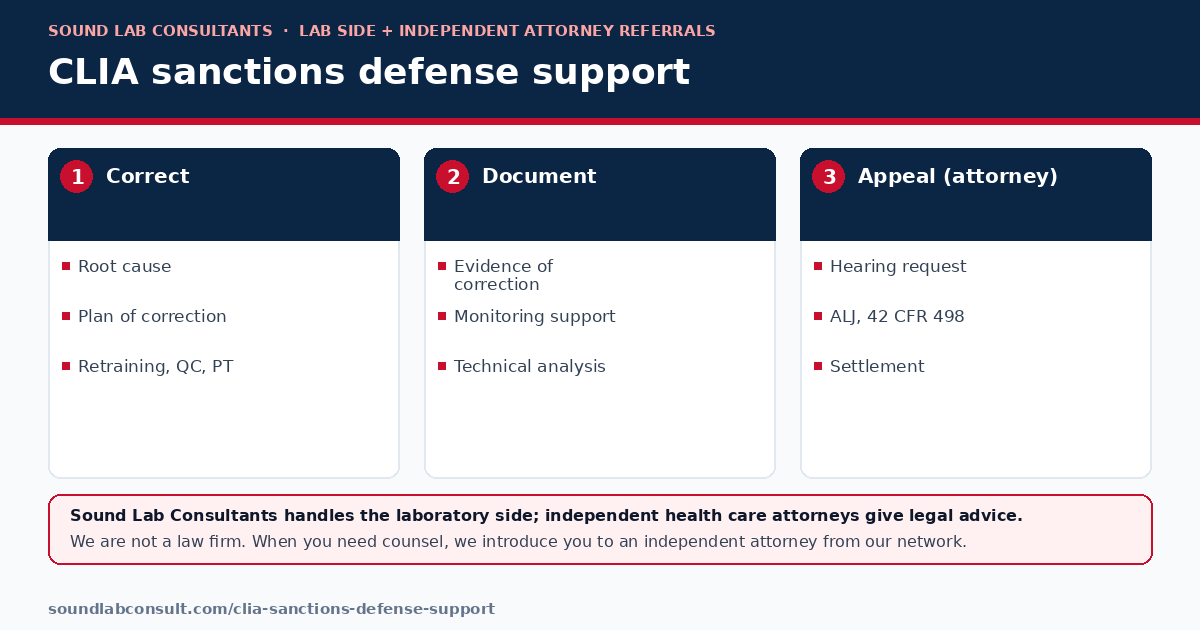
What is CLIA sanctions defense support?
CLIA sanctions defense support is the work a laboratory does when CMS proposes or imposes sanctions under 42 CFR 493 Subpart R: correcting the deficiencies, documenting compliance, and, with an attorney, responding to or appealing the sanction.
Types of CLIA sanctions
| Sanction | What it means | Lab-side priority |
|---|---|---|
| Directed plan of correction | CMS directs specific corrective actions and timelines | Complete and document every action on time |
| State onsite monitoring | The state agency monitors the lab, at the lab's cost | Clean records and visible correction |
| Civil money penalty (CMP) | Daily or per-violation penalties until correction | Correct fast; penalties can accrue until compliance |
| Suspension or limitation | Testing stops, fully or for specific specialties | Correct, document and support any appeal |
| Revocation | Certificate is revoked; owners and operators can be barred for two years | Call an attorney immediately |
The rules are in CLIA enforcement and sanctions, 42 CFR 493 Subpart R and the CLIA statute. Condition-level deficiencies are what usually trigger sanctions; see condition-level deficiencies and sanctions, alternative sanctions and civil money penalties and cease-testing letters.
What to do in the first 10 days
- Read the letter for deadlines. A CMS-2567 plan of correction is generally due within 10 calendar days; hearing requests have their own short deadline.
- Call an attorney if sanctions are proposed or revocation is possible.
- Stop or limit testing where results may be unreliable, and document the decision.
- Write the plan of correction (see CMS-2567 plan of correction and CLIA plan of correction guide).
- Collect evidence of correction as you go, not at the end.
Talk to us before the deadline
Book a free consultation. We review the lab side now and, if you need counsel, introduce you to an independent health care attorney.
Book a free consultationLab-side work vs attorney work
Sound Lab Consultants is not a law firm. We do the laboratory work; an independent health care attorney gives legal advice and represents you.
| Lab-side work (Sound Lab Consultants) | Attorney work (independent health care attorney) |
|---|---|
|
|
How the referral works
- Book a free consultation. Tell us what happened and any deadline. Keep privileged or confidential details for the call.
- We review the lab issue. We look at what the rules require, what records exist, what can be fixed now and which parts need a lawyer.
- We introduce you to an independent attorney. When legal counsel is needed, we connect you with an independent health care attorney from our network. You engage and pay the attorney directly, and the attorney decides the legal strategy.
- We stay on for the lab-side work. Corrective action, records, SOPs, billing process fixes, training and monitoring, coordinated with your attorney.
When to get a lawyer now
Call a lawyer now, then call us, if you have
- A CMS letter proposing CLIA sanctions (civil money penalty, suspension, limitation or revocation), or a cease-testing letter
- A subpoena, civil investigative demand (CID), search warrant, or agents asking to interview staff
- A payer recoupment, extrapolated overpayment demand or prepayment review notice
- An HHS-OIG letter, exclusion notice or request for information
- A suspected breach of patient data, ransomware or a lost or stolen device
- A signing or closing deadline on a lab acquisition, sale or joint venture
Deadlines in these matters are short and some cannot be extended. An attorney should handle the legal response; we handle the laboratory side in parallel.
Related laboratory legal support
This page is part of our laboratory legal support hub, which covers all five core areas: licensure and regulatory compliance, fraud, abuse and reimbursement, data privacy and cybersecurity, transactions and operations, and litigation and investigations.
- Laboratory payer audit and recoupment support
- Laboratory Anti-Kickback, Stark and EKRA compliance
- Laboratory HIPAA breach response
- Laboratory acquisition due diligence
- Laboratory government investigation support
Start with a free consultation
Tell us what happened and your deadline. We triage the laboratory side, connect you with an independent health care attorney when you need one, and stay on for the lab work.
Book a free consultationFrequently asked questions
What sanctions can CMS impose on a CLIA laboratory?
Principal sanctions are suspension, limitation or revocation of the CLIA certificate. Alternative sanctions are a directed plan of correction, state onsite monitoring and civil money penalties. CMS can also cancel Medicare payment for laboratory services.
Can a CLIA sanction be appealed?
Many can. Appeals go through the process in 42 CFR Part 498, starting with a hearing request before an administrative law judge within a short deadline. An attorney should handle the appeal.
What happens if a CLIA certificate is revoked?
The laboratory cannot test, and under the CLIA statute the owner and operator can be barred from owning or operating a CLIA laboratory for two years.
How fast do I need to respond to a CMS-2567?
A plan of correction is generally due within 10 calendar days of receiving the CMS-2567. Read your letter for the exact date.
What do you do in a CLIA sanctions case?
We fix and document the laboratory deficiencies, write the plan of correction, support directed plans and monitoring, and give your attorney the technical analysis for the response.
Is Sound Lab Consultants a law firm?
No. We are a laboratory consulting firm and do not give legal advice or represent anyone. We handle the lab side and introduce you to independent health care attorneys, whom you engage directly.
Sources
- CLIA enforcement and sanctions, 42 CFR 493 Subpart R (eCFR)
- CLIA statute, 42 U.S.C. 263a (govinfo.gov)
- Appeals procedures, 42 CFR Part 498 (eCFR)
- CLIA regulations, 42 CFR Part 493 (eCFR)
- CMS, Clinical Laboratory Improvement Amendments (CLIA)
Related pages
Sound Lab Consultants is an independent laboratory consulting firm, not a law firm. This page is general information, not legal advice, and reading it or booking a consultation does not create an attorney-client relationship. Attorneys we introduce are independent; you engage them directly. We are not affiliated with or endorsed by CMS, FDA, CDC, HHS, OIG, DOJ, CAP, COLA, The Joint Commission or any state agency. Sound Lab Consultants, 25 Arizona Pl, Chandler, AZ 85225.