
Short answer: Laboratory HIPAA breach response is the set of steps a lab takes after protected health information may have been exposed: contain the incident, assess the risk, decide on notification under the HIPAA Breach Notification Rule and state law, and fix the cause. Under 45 CFR Part 164, a breach of unsecured protected health information generally requires notice to affected individuals without unreasonable delay and no later than 60 days after discovery, plus notice to HHS and, for 500 or more residents of a state, the media. Sound Lab Consultants handles the lab-side facts and fixes; an independent attorney decides on notification.
Last reviewed November 25, 2026. Primary sources: HHS, HIPAA security and privacy, HIPAA general administrative requirements.
Not a law firm. Sound Lab Consultants is a laboratory consulting firm. We do not give legal advice or represent anyone. When a matter needs a lawyer, we introduce you to an independent health care attorney, and you engage that attorney directly.
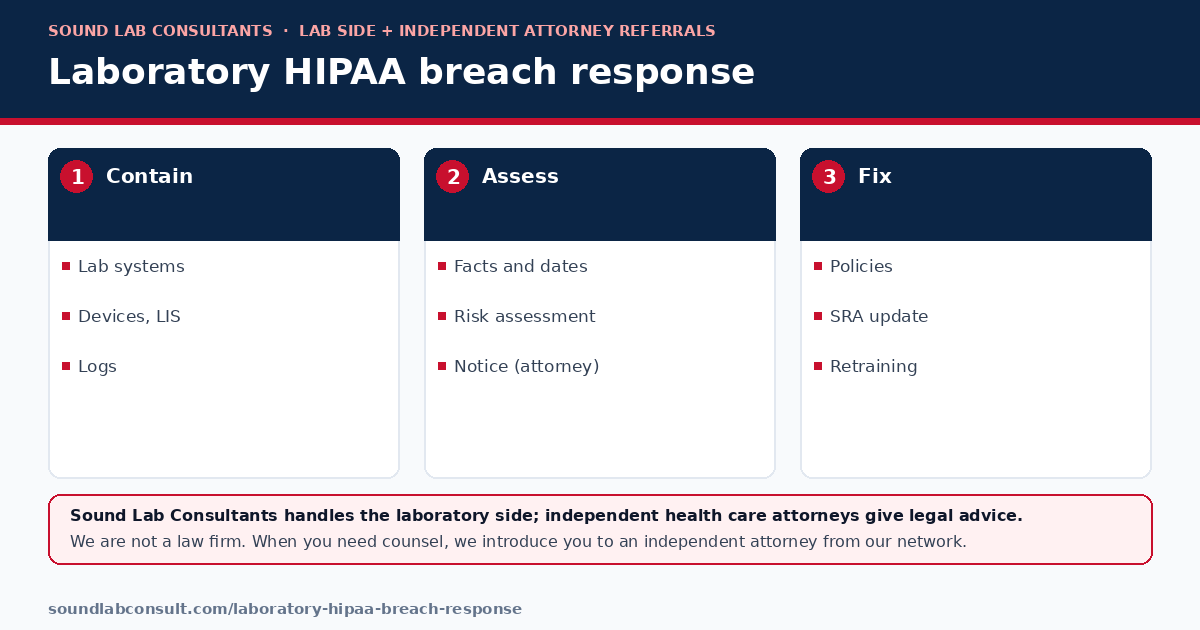
What is Laboratory HIPAA breach response?
Laboratory HIPAA breach response is the set of steps a lab takes after protected health information may have been exposed: contain the incident, assess the risk, decide on notification under the HIPAA Breach Notification Rule and state law, and fix the cause.
HIPAA breach notification deadlines
| Who to notify | When |
|---|---|
| Affected individuals | Without unreasonable delay, no later than 60 days after discovery |
| HHS, 500 or more individuals | At the same time as individual notice (within 60 days) |
| Media, more than 500 residents of a state or jurisdiction | Within 60 days |
| HHS, fewer than 500 individuals | Within 60 days after the end of the calendar year |
| Covered entity, when a business associate has the breach | Without unreasonable delay, no later than 60 days |
Source: HHS, HIPAA Breach Notification Rule and 45 CFR Part 164 Subpart D. State laws can add shorter deadlines.
Common laboratory breach scenarios
- Results faxed or emailed to the wrong office
- Ransomware on the LIS or a connected instrument PC
- Lost or stolen courier bag, laptop or phone
- Patient portal or interface misrouting results
- Staff looking up records without a job need
Prevention starts with a security risk assessment (HealthIT.gov, Security Risk Assessment Tool) and HIPAA privacy and security training.
Talk to us before the deadline
Book a free consultation. We review the lab side now and, if you need counsel, introduce you to an independent health care attorney.
Book a free consultationLab-side work vs attorney work
Sound Lab Consultants is not a law firm. We do the laboratory work; an independent health care attorney gives legal advice and represents you.
| Lab-side work (Sound Lab Consultants) | Attorney work (independent health care attorney) |
|---|---|
|
|
How the referral works
- Book a free consultation. Tell us what happened and any deadline. Keep privileged or confidential details for the call.
- We review the lab issue. We look at what the rules require, what records exist, what can be fixed now and which parts need a lawyer.
- We introduce you to an independent attorney. When legal counsel is needed, we connect you with an independent health care attorney from our network. You engage and pay the attorney directly, and the attorney decides the legal strategy.
- We stay on for the lab-side work. Corrective action, records, SOPs, billing process fixes, training and monitoring, coordinated with your attorney.
When to get a lawyer now
Call a lawyer now, then call us, if you have
- A CMS letter proposing CLIA sanctions (civil money penalty, suspension, limitation or revocation), or a cease-testing letter
- A subpoena, civil investigative demand (CID), search warrant, or agents asking to interview staff
- A payer recoupment, extrapolated overpayment demand or prepayment review notice
- An HHS-OIG letter, exclusion notice or request for information
- A suspected breach of patient data, ransomware or a lost or stolen device
- A signing or closing deadline on a lab acquisition, sale or joint venture
Deadlines in these matters are short and some cannot be extended. An attorney should handle the legal response; we handle the laboratory side in parallel.
Related laboratory legal support
This page is part of our laboratory legal support hub, which covers all five core areas: licensure and regulatory compliance, fraud, abuse and reimbursement, data privacy and cybersecurity, transactions and operations, and litigation and investigations.
- CLIA sanctions defense support
- Laboratory payer audit and recoupment support
- Laboratory Anti-Kickback, Stark and EKRA compliance
- Laboratory acquisition due diligence
- Laboratory government investigation support
Start with a free consultation
Tell us what happened and your deadline. We triage the laboratory side, connect you with an independent health care attorney when you need one, and stay on for the lab work.
Book a free consultationFrequently asked questions
Is every lab data incident a HIPAA breach?
An impermissible use or disclosure of protected health information is presumed to be a breach unless a risk assessment shows a low probability that the information was compromised. Counsel should make the final call.
How long does a lab have to notify patients of a breach?
Without unreasonable delay and no later than 60 days after discovery under HIPAA. State laws may be shorter.
Is a laboratory a HIPAA covered entity?
Most clinical laboratories that bill electronically are covered entities. A lab working for another provider may be a business associate. An attorney should confirm your status.
Do labs need a security risk assessment?
Yes. The HIPAA Security Rule requires covered entities and business associates to assess risks to electronic protected health information and manage them.
What do you do after a lab breach?
We document facts, help contain lab systems, support the risk assessment, fix policies and workflows and retrain staff. Notification decisions are attorney work.
Is Sound Lab Consultants a law firm?
No. We are a laboratory consulting firm and do not give legal advice or represent anyone. We handle the lab side and introduce you to independent health care attorneys, whom you engage directly.
Sources
- HHS, HIPAA Breach Notification Rule
- HIPAA security and privacy, 45 CFR Part 164 (eCFR)
- HIPAA general administrative requirements, 45 CFR Part 160 (eCFR)
- HHS, HIPAA Security Rule
- HHS, Sample business associate agreement provisions
- HealthIT.gov, Security Risk Assessment Tool
Related pages
Sound Lab Consultants is an independent laboratory consulting firm, not a law firm. This page is general information, not legal advice, and reading it or booking a consultation does not create an attorney-client relationship. Attorneys we introduce are independent; you engage them directly. We are not affiliated with or endorsed by CMS, FDA, CDC, HHS, OIG, DOJ, CAP, COLA, The Joint Commission or any state agency. Sound Lab Consultants, 25 Arizona Pl, Chandler, AZ 85225.