
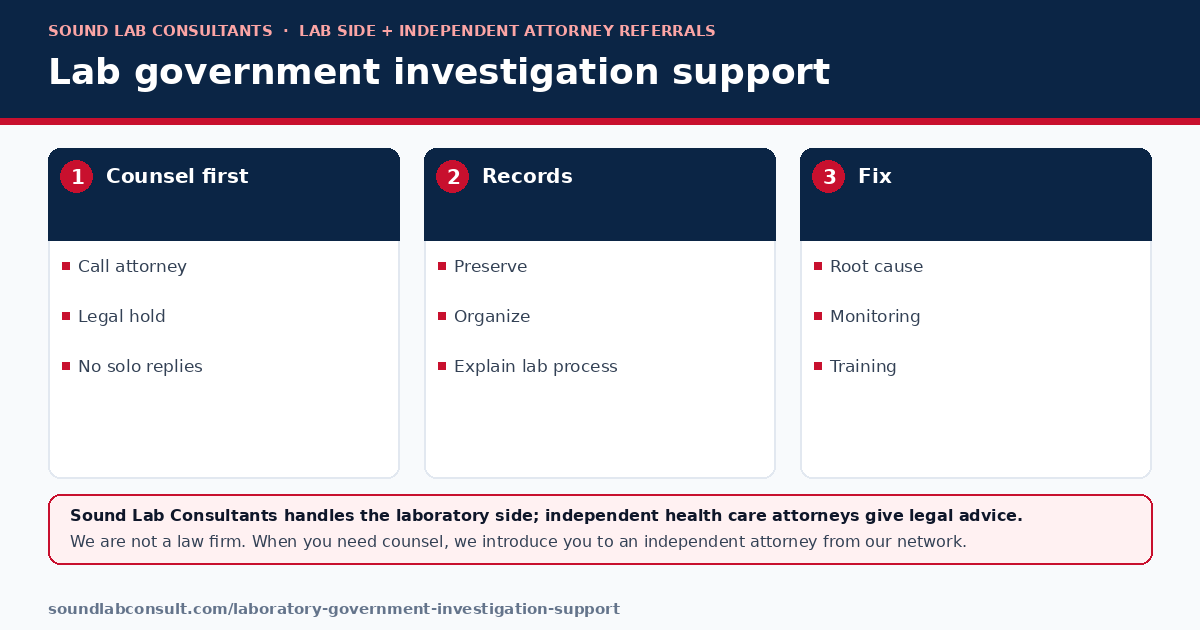
Short answer: Laboratory government investigation support is the lab-side help a laboratory and its attorney need during a government investigation, subpoena, civil investigative demand or False Claims Act matter: preserving and organizing records, explaining laboratory processes and fixing what went wrong. Investigations of labs often involve HHS-OIG, the Department of Justice, state Medicaid fraud units or payers, and can follow audits or whistleblower (qui tam) complaints under 31 U.S.C. 3729. Call an attorney first; Sound Lab Consultants works with your counsel on the laboratory side.
Last reviewed November 25, 2026. Primary sources: False Claims Act, U.S. Department of Justice, HHS-OIG.
Not a law firm. Sound Lab Consultants is a laboratory consulting firm. We do not give legal advice or represent anyone. When a matter needs a lawyer, we introduce you to an independent health care attorney, and you engage that attorney directly.
What is Laboratory government investigation support?
Laboratory government investigation support is the lab-side help a laboratory and its attorney need during a government investigation, subpoena, civil investigative demand or False Claims Act matter: preserving and organizing records, explaining laboratory processes and fixing what went wrong.
Types of government inquiries
| Inquiry | From | First step |
|---|---|---|
| Subpoena | DOJ, HHS-OIG, grand jury or state | Call counsel; preserve records |
| Civil investigative demand (CID) | DOJ under the False Claims Act | Call counsel; do not respond alone |
| Search warrant | Federal or state agents | Call counsel immediately; do not obstruct |
| OIG letter or request for information | HHS-OIG | Call counsel before responding |
| Qui tam (whistleblower) suit | Filed by a relator under the FCA | Counsel handles; we support on lab facts |
Background: U.S. Department of Justice, The False Claims Act and HHS-OIG, Fraud and abuse laws.
Preserving laboratory records
- Suspend routine deletion of LIS data, emails and instrument files once counsel issues a hold
- Keep requisitions, results, QC, PT, maintenance and validation records intact
- Keep personnel and competency files, and sales and marketing records
- Do not change, back-date or annotate old records
For expert analysis through counsel, see CLIA expert witness.
Talk to us before the deadline
Book a free consultation. We review the lab side now and, if you need counsel, introduce you to an independent health care attorney.
Book a free consultationLab-side work vs attorney work
Sound Lab Consultants is not a law firm. We do the laboratory work; an independent health care attorney gives legal advice and represents you.
| Lab-side work (Sound Lab Consultants) | Attorney work (independent health care attorney) |
|---|---|
|
|
How the referral works
- Book a free consultation. Tell us what happened and any deadline. Keep privileged or confidential details for the call.
- We review the lab issue. We look at what the rules require, what records exist, what can be fixed now and which parts need a lawyer.
- We introduce you to an independent attorney. When legal counsel is needed, we connect you with an independent health care attorney from our network. You engage and pay the attorney directly, and the attorney decides the legal strategy.
- We stay on for the lab-side work. Corrective action, records, SOPs, billing process fixes, training and monitoring, coordinated with your attorney.
When to get a lawyer now
Call a lawyer now, then call us, if you have
- A CMS letter proposing CLIA sanctions (civil money penalty, suspension, limitation or revocation), or a cease-testing letter
- A subpoena, civil investigative demand (CID), search warrant, or agents asking to interview staff
- A payer recoupment, extrapolated overpayment demand or prepayment review notice
- An HHS-OIG letter, exclusion notice or request for information
- A suspected breach of patient data, ransomware or a lost or stolen device
- A signing or closing deadline on a lab acquisition, sale or joint venture
Deadlines in these matters are short and some cannot be extended. An attorney should handle the legal response; we handle the laboratory side in parallel.
Related laboratory legal support
This page is part of our laboratory legal support hub, which covers all five core areas: licensure and regulatory compliance, fraud, abuse and reimbursement, data privacy and cybersecurity, transactions and operations, and litigation and investigations.
- CLIA sanctions defense support
- Laboratory payer audit and recoupment support
- Laboratory Anti-Kickback, Stark and EKRA compliance
- Laboratory HIPAA breach response
- Laboratory acquisition due diligence
Start with a free consultation
Tell us what happened and your deadline. We triage the laboratory side, connect you with an independent health care attorney when you need one, and stay on for the lab work.
Book a free consultationFrequently asked questions
What should a lab do after receiving a subpoena or CID?
Call an attorney before responding or letting staff talk to investigators. Then preserve all potentially relevant records. We help counsel locate and organize lab records.
Can you talk to investigators for us?
No. Communication with investigators is attorney work. We support your attorney on the laboratory side.
What is a qui tam case?
A False Claims Act lawsuit filed by a private whistleblower (relator) on behalf of the government. The government can join the case. It is attorney work from the start.
What penalties apply under the False Claims Act?
Treble damages plus a civil penalty per false claim, adjusted for inflation each year. Your attorney can explain your exposure.
How do you help after an investigation?
We fix the lab processes involved, build monitoring, train staff and can stay on for ongoing compliance oversight.
Is Sound Lab Consultants a law firm?
No. We are a laboratory consulting firm and do not give legal advice or represent anyone. We handle the lab side and introduce you to independent health care attorneys, whom you engage directly.
Sources
- False Claims Act, 31 U.S.C. 3729 (govinfo.gov)
- U.S. Department of Justice, The False Claims Act
- HHS-OIG, Fraud and abuse laws
- Anti-Kickback Statute, 42 U.S.C. 1320a-7b(b) (govinfo.gov)
- Eliminating Kickbacks in Recovery Act (EKRA), 18 U.S.C. 220 (govinfo.gov)
- CLIA regulations, 42 CFR Part 493 (eCFR)
Related pages
Sound Lab Consultants is an independent laboratory consulting firm, not a law firm. This page is general information, not legal advice, and reading it or booking a consultation does not create an attorney-client relationship. Attorneys we introduce are independent; you engage them directly. We are not affiliated with or endorsed by CMS, FDA, CDC, HHS, OIG, DOJ, CAP, COLA, The Joint Commission or any state agency. Sound Lab Consultants, 25 Arizona Pl, Chandler, AZ 85225.