
Short answer: A chain of custody SOP documents every person who handles a specimen for legal or employment drug testing so its integrity can be defended. This free template downloads as a fillable PDF and an editable Word file.
Last reviewed November 26, 2026. Governing requirement: 49 CFR Part 40 (DOT) / SAMHSA guidelines; forensic practice.
These templates are free, general starting points, not legal or regulatory advice. Every template must be reviewed and approved, signed and dated by your laboratory director, and adapted to your lab's instruments, test systems and the manufacturer's instructions, your state rules and your accreditation organization's standards before use.
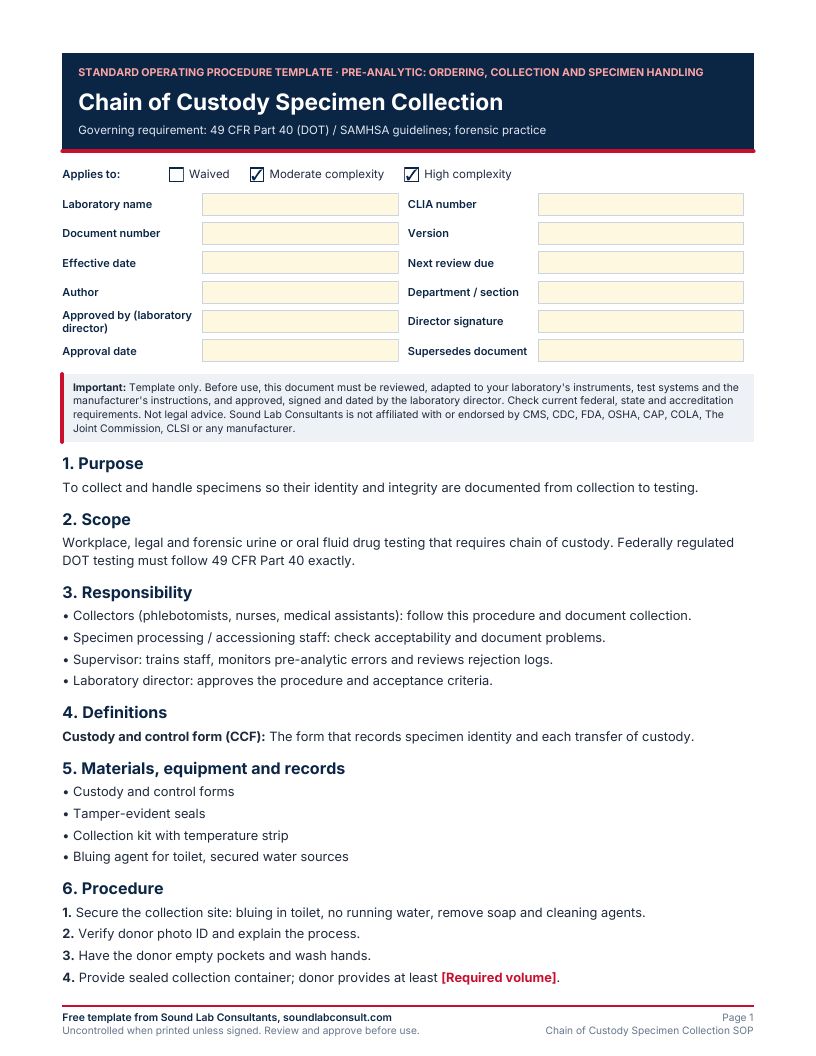
What this Chain of Custody Specimen Collection SOP must contain
Purpose: To collect and handle specimens so their identity and integrity are documented from collection to testing.
Scope: Workplace, legal and forensic urine or oral fluid drug testing that requires chain of custody. Federally regulated DOT testing must follow 49 CFR Part 40 exactly.
The template includes these sections:
- Header block: laboratory name, CLIA number, document number, version, effective date, next review, author, approval by the laboratory director with signature and date
- Purpose and scope
- Responsibility by role
- Definitions
- Materials, equipment and records
- Step-by-step procedure (9 steps)
- Quality control
- Interpretation, reporting and documentation
- Limitations and cautions
- References to the governing regulation and guidance
- Lab-specific notes
- Revision history and annual review log (fillable)
Why labs need it
This procedure supports 49 CFR Part 40 (DOT) / SAMHSA guidelines; forensic practice. Under 42 CFR 493.1251, a nonwaived laboratory must have written procedures that staff follow, and the laboratory director must approve, sign and date each procedure and every change before use. Waived labs must follow the manufacturer's instructions exactly, and written procedures help show they do. Surveyors and accreditation inspectors usually ask to see the procedure, the related records and evidence that staff were trained on it.
Procedure outline
The highlighted items are fill-in fields in the PDF and Word versions.
- Secure the collection site: bluing in toilet, no running water, remove soap and cleaning agents.
- Verify donor photo ID and explain the process.
- Have the donor empty pockets and wash hands.
- Provide sealed collection container; donor provides at least [Required volume].
- Read the temperature strip within 4 minutes; acceptable range 32-38 °C (90-100 °F).
- Inspect for signs of tampering.
- Split if required, seal bottles in front of the donor, donor initials seals.
- Complete the CCF; every transfer is signed, dated and timed.
- Package and ship to the testing lab in sealed bags.
Quality control and documentation
- Follow the laboratory's QC policy and the manufacturer's instructions; record QC before reporting patient results.
- Stop patient testing and take corrective action when QC or acceptance criteria are not met.
- Any break in custody documentation must be recorded and may invalidate the specimen for legal use.
Limitations
- Non-regulated testing may use a simplified chain of custody approved by the director.
- This is a generic template. Adapt it to your instruments, test systems, manufacturer instructions, state law and accreditation standards before use.
Key definitions
- Custody and control form (CCF): The form that records specimen identity and each transfer of custody.
Fields you fill in
Besides the header block, revision history and annual review log, this template has 1 lab-specific field:
- Required volume
How to adopt this template
- Download the PDF or Word version above.
- Fill in the header block and every highlighted field. Where a field says "per manufacturer", copy the value from your current package insert or operator manual.
- Delete steps that do not apply and add any steps your test system or state requires.
- Have the technical consultant or technical supervisor review it, then have the laboratory director sign and date it before use.
- Train staff, document their review, and add the SOP to your document control master list.
Need procedures written for your lab?
Sound Lab Consultants writes and reviews complete procedure manuals that match your instruments, test menu and certificate type. Book a free consultation to talk through what your lab needs.
Book a free consultationFrequently asked questions
Is this Chain of Custody Specimen Collection SOP template free?
Yes. The Chain of Custody Specimen Collection SOP template is a free download as a fillable PDF and an editable Word (.docx) file. There is no email gate or sign-up.
What regulation does a chain of custody specimen collection procedure address?
This template is built around 49 CFR Part 40 (DOT) / SAMHSA guidelines; forensic practice. Read the current text at the official source linked on this page, and check your state and accreditation organization for added requirements.
Can our lab use this SOP as-is?
No. Use it as a starting point. Fill in the highlighted fields, adapt the steps to your instruments and the manufacturer's instructions, and have the laboratory director approve, sign and date it before use (42 CFR 493.1251(d)).
Which labs is this template for?
It is written for moderate and high complexity laboratories, as marked in the template's 'Applies to' boxes. Uncheck any that do not apply to your lab.
How do I fill in the PDF?
Open the PDF in a PDF reader that supports forms, click the shaded fields and type. Save a copy. In the Word version, click each highlighted field (a content control) and type over it.
Official sources
- eCFR, 49 CFR Part 40 (DOT) / SAMHSA guidelines; forensic practice
- eCFR, 49 CFR Part 40 Procedures for transportation workplace drug and alcohol testing
- HHS Mandatory Guidelines for Federal Workplace Drug Testing Programs (referenced by name)
- CMS, State Operations Manual Appendix C: Survey procedures and interpretive guidelines for laboratories
Related SOP templates
These templates are free, general starting points, not legal or regulatory advice. Every template must be reviewed and approved, signed and dated by your laboratory director, and adapted to your lab's instruments, test systems and the manufacturer's instructions, your state rules and your accreditation organization's standards before use. Sound Lab Consultants is not affiliated with or endorsed by CMS, CDC, FDA, OSHA, HHS, CAP, COLA, The Joint Commission, CLSI, any state agency, or any instrument or reagent manufacturer. CLSI and other standards are referenced by name only. Sound Lab Consultants, 25 Arizona Pl, Chandler, AZ 85225.