
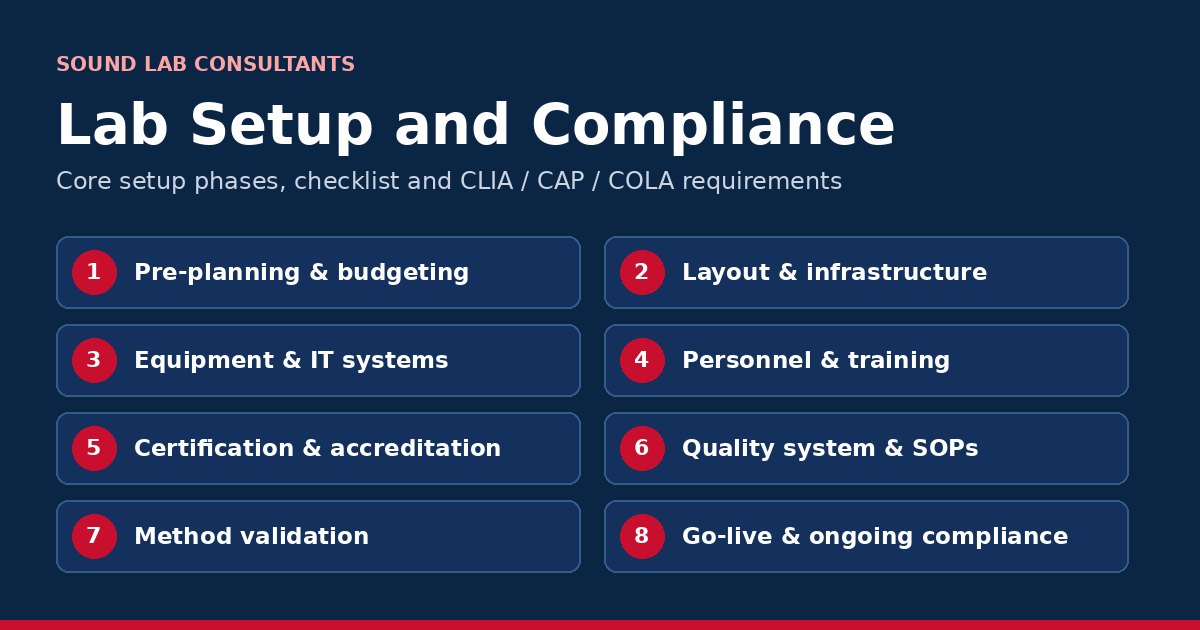
Short answer: Lab setup and compliance runs in eight phases: (1) pre-planning and budgeting on a 6 to 12 month timeline with a 10–15% contingency reserve; (2) layout and infrastructure with a unidirectional workflow, physical barriers, chemical segregation, eyewash stations, safety showers and fume hoods; (3) equipment and IT systems with IQ/OQ/PQ and a LIS or LIMS; (4) qualified personnel and documented training; (5) certification and accreditation (CLIA certificate via form CMS-116, state license where required, optional CAP, COLA or Joint Commission accreditation, GLP under 21 CFR Part 58 for nonclinical research labs, and OSHA programs); (6) a quality system and SOPs; (7) method verification or validation under 42 CFR 493.1253; and (8) go-live with QC, proficiency testing and competency running from day one. Sound Lab Consultants runs this whole process for new clinical labs nationwide.
Last reviewed November 25, 2026 by Sound Lab Consultants. Primary sources: 42 CFR Part 493, CMS CLIA, OSHA 29 CFR 1910.1450.
What lab setup and compliance means
Setting up a compliant laboratory requires aligning facility design, equipment and software controls, personnel qualifications, and regulatory frameworks with the lab's specific testing or research purpose. In a clinical laboratory, "compliant" means the lab meets the Clinical Laboratory Improvement Amendments (CLIA) rules in 42 CFR Part 493, any state laboratory license, the checklist of an accreditor if the lab chooses one, and OSHA worker-safety standards. In a research or nonclinical lab, it can also mean Good Laboratory Practice under 21 CFR Part 58 and the wider GxP expectations a sponsor sets.
The mistake most new labs make is treating setup and compliance as two projects: build first, then "get compliant." Surveyors and accreditors look at what you built. The room layout decides whether molecular testing can meet 42 CFR 493.1101. The LIS build decides whether reports meet 42 CFR 493.1291. The people you hire decide which tests you can legally run under Subpart M. Lab setup and compliance work best as one plan, and that is how this guide is organized.
This page is the setup-and-compliance companion to our main how to start a clinical laboratory guide, which covers the business side: ownership, payers, billing and growth. Use this page for the build and the rules; use the hub for the business plan.
Core lab setup phases
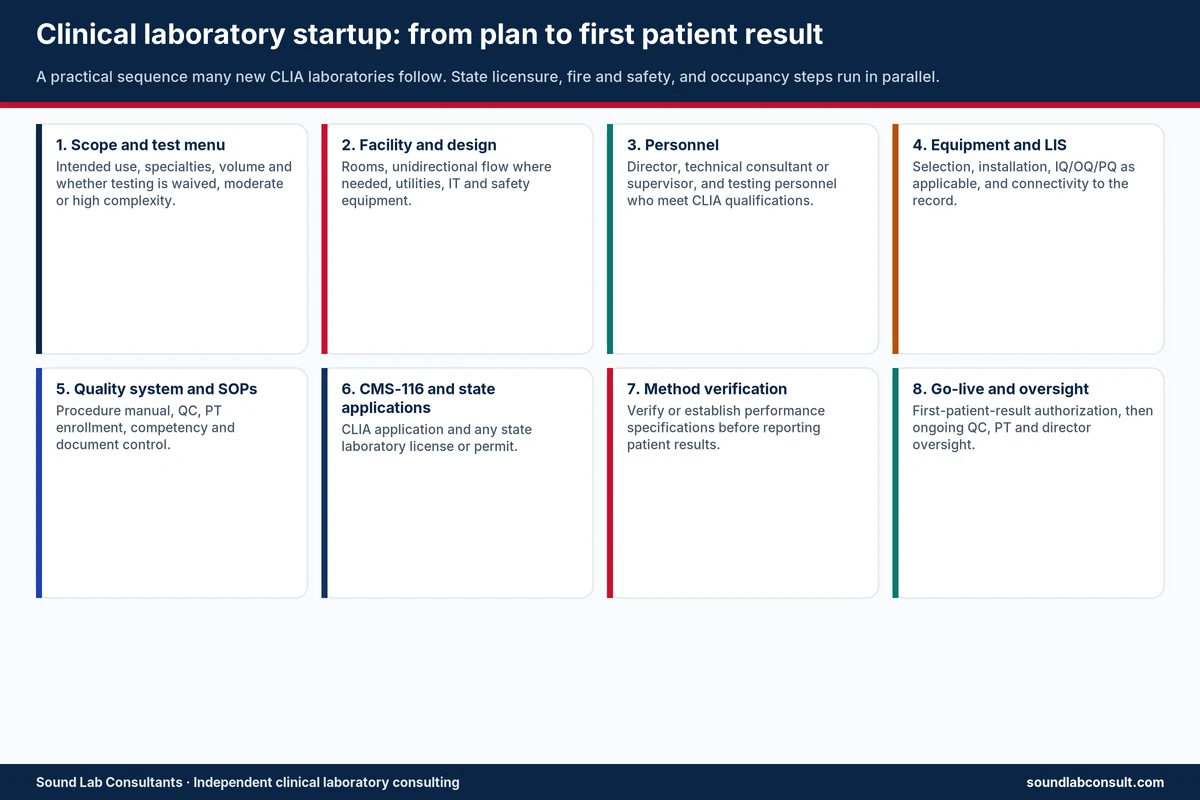
Every lab, from a physician office lab running moderate-complexity chemistry to a high-complexity molecular or toxicology lab, moves through the same eight core setup phases. They overlap, and several run in parallel, but each one has a clear output a surveyor can check.
| Phase | What you decide or build | Compliance output |
|---|---|---|
| 1. Pre-Planning & Budgeting | Test menu, complexity, volume, timeline, team, budget and contingency | Complexity map that drives certificate type and personnel |
| 2. Layout & Infrastructure | Floor plan, workflow, barriers, utilities, safety equipment | Space and utilities that meet 493.1101 and OSHA |
| 3. Equipment & IT Systems | Instruments, service, LIS/LIMS, interfaces | IQ/OQ/PQ records; verified report and interface |
| 4. Personnel & Training | Director, supervisors, testing staff | Qualification files, training and competency records |
| 5. Regulatory Certification & Accreditation | CLIA certificate, state license, accreditor, OSHA programs | CLIA number, license, accreditation plan, exposure control plan |
| 6. Quality System & SOPs | Procedure manual, QC, PT, quality assessment | Director-approved procedures and quality plan |
| 7. Method Validation & Verification | Verification or validation studies per test | Signed 493.1253 performance specifications |
| 8. Go-live & Ongoing Compliance | Launch, monitoring, survey preparation | QC, PT, competency and QA records from day one |
Pre-Planning & Budgeting
Pre-planning sets every later decision, so it deserves real time. Start with the test menu, because the menu sets the CLIA complexity of each test (waived, moderate or high), and complexity sets the certificate type, the personnel you must hire and the validation work ahead.
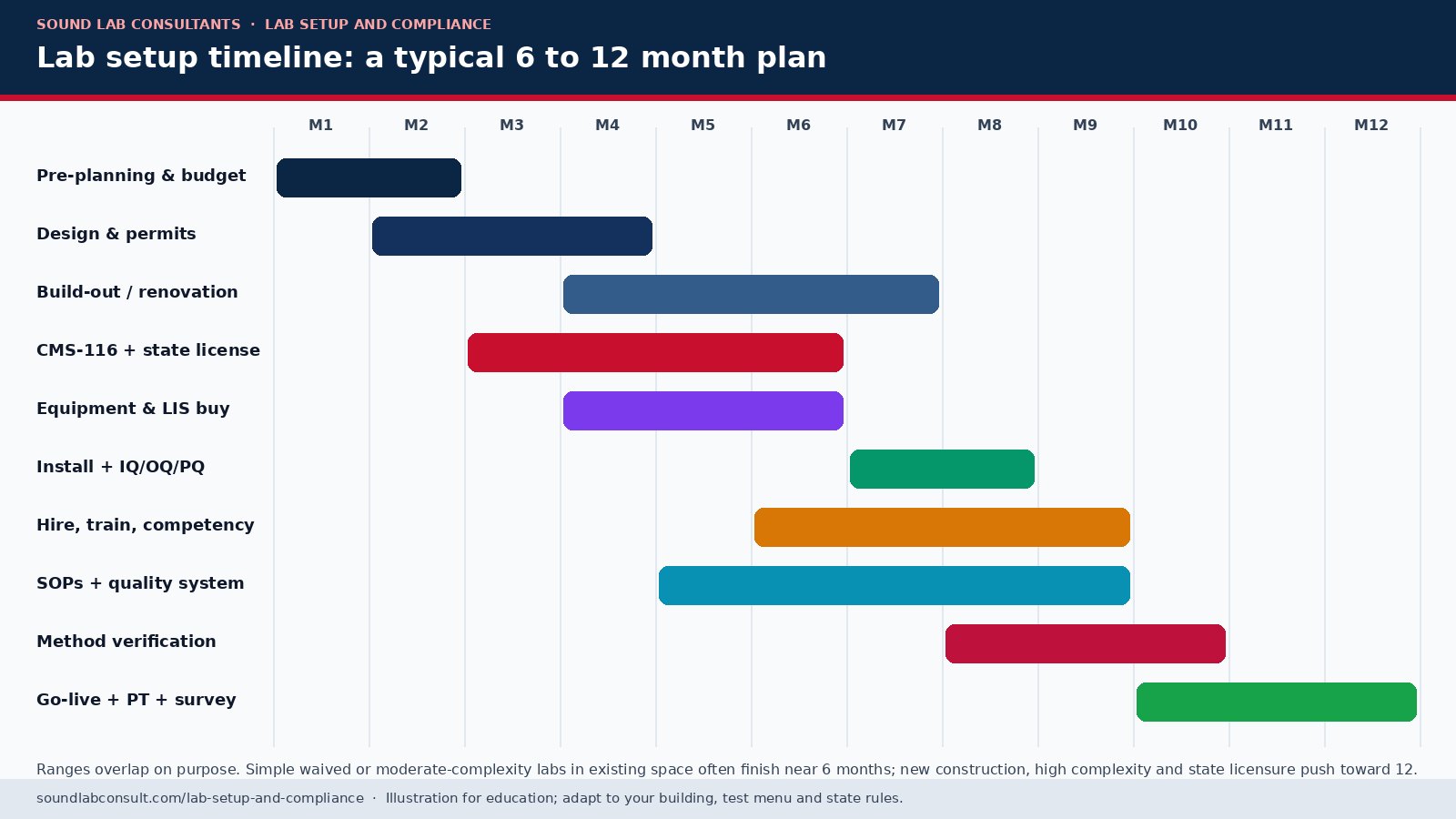
- Map a 6 to 12 month timeline. A waived or moderate-complexity lab in existing space can open near the short end. New construction, high-complexity testing, molecular work or a state that licenses labs pushes toward 12 months. Build the schedule backward from the date you need to bill.
- Define the project team. Name owners for lab leadership (the future laboratory director and supervisor), facilities and construction, environmental health and safety (EHS), IT and the LIS, purchasing, and finance. One person should own the master schedule.
- Budget by category. Plan for construction or renovation, casework and benches, HVAC and electrical upgrades, water purification, safety equipment, instruments (purchase, lease or reagent rental), the LIS or LIMS and interfaces, initial reagents and QC material, proficiency testing enrollment, CLIA and state fees, accreditation fees, staffing before revenue, and training.
- Hold a 10–15% contingency reserve. Construction surprises, instrument delays and extra validation runs are common. Many planners carry a 10–15% reserve on top of the categorized budget.
- Check state rules first. Some states license clinical labs or lab personnel on top of CLIA. See states that require a clinical laboratory license before you sign a lease.
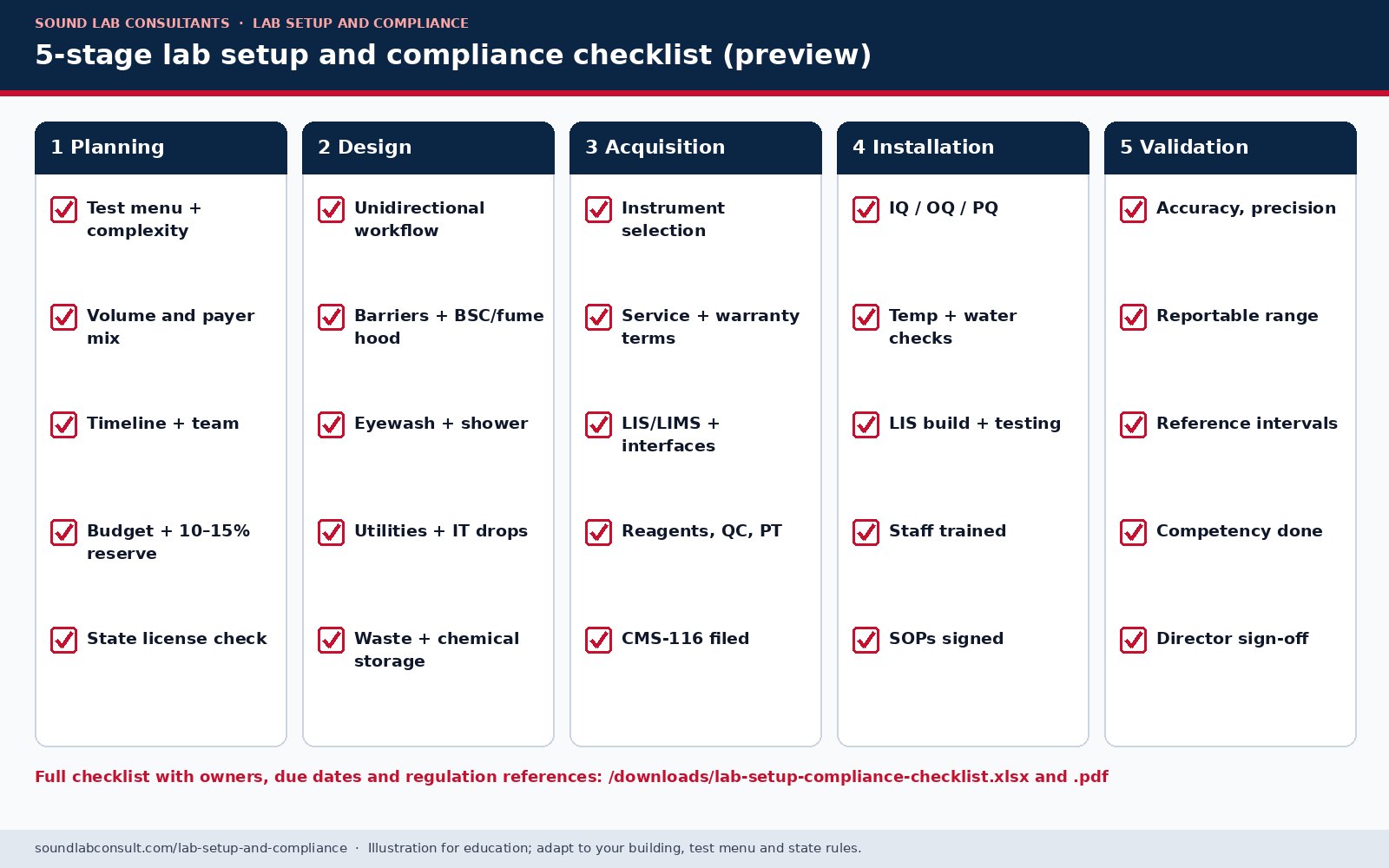
Use a 5-stage planning checklist to keep the work in order: planning, design, acquisition, installation and validation. The full checklist is below and in the free download.
Layout & Infrastructure
CLIA's facility rule, 42 CFR 493.1101, requires a lab to be built, arranged and maintained so that space, ventilation and utilities support every phase of testing, and so contamination of patient specimens, equipment, instruments, reagents and materials is minimized. For molecular amplification that is not in a closed system, the same rule requires a unidirectional workflow with separate areas for specimen preparation, amplification and product detection, and reagent preparation where applicable.
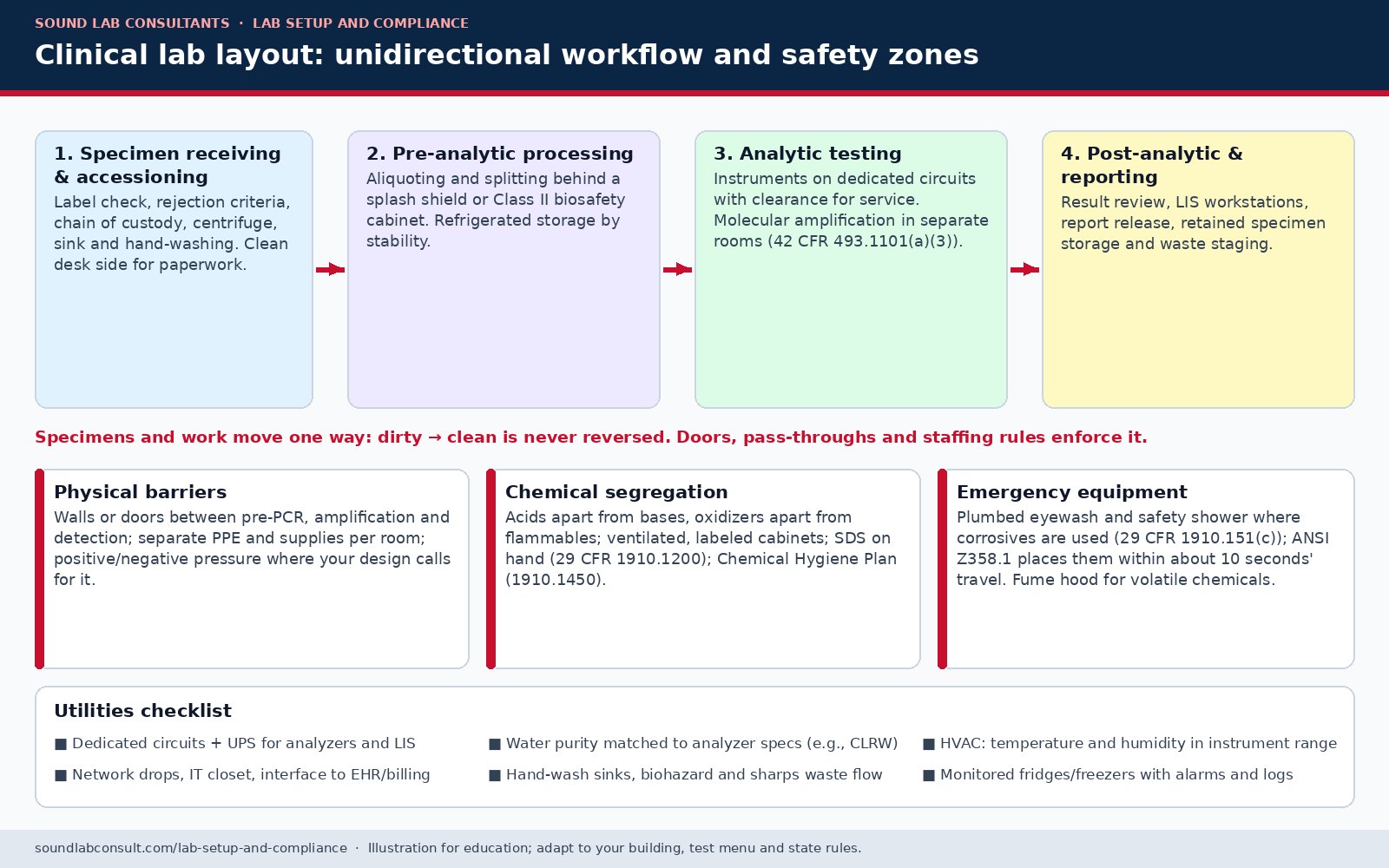
- Unidirectional workflow. Specimens move one way: receiving and accessioning, pre-analytic processing, analytic testing, then post-analytic review and storage. Molecular rooms add a strict clean-to-dirty sequence. Our unidirectional workflow guide and PCR lab floor plan show room-by-room examples.
- Physical barriers. Walls and doors between incompatible areas, dedicated PPE and supplies per room, splash shields at open-tube work, and Class II biosafety cabinets for aerosol-generating steps, following the CDC/NIH Biosafety in Microbiological and Biomedical Laboratories (BMBL) risk assessment approach.
- Chemical segregation. Store incompatible chemicals apart, such as acids away from bases and oxidizers away from flammables, in labeled, ventilated cabinets, with Safety Data Sheets on hand under the OSHA Hazard Communication standard (29 CFR 1910.1200).
- Eyewash stations and safety showers. OSHA 29 CFR 1910.151(c) requires suitable facilities for quick drenching or flushing where corrosive materials can reach the eyes or body. The ANSI/ISEA Z358.1 consensus standard is the usual design reference for placement and weekly activation.
- Fume hoods. Use chemical fume hoods for volatile or toxic chemicals (for example fixatives and some extraction reagents) under your Chemical Hygiene Plan. A biosafety cabinet is not a fume hood; size and specify each for its job.
- Utilities. Dedicated electrical circuits and UPS for analyzers and the LIS, water purity that meets each analyzer's specification, temperature and humidity inside instrument ranges, network drops, monitored refrigerators and freezers, hand-wash sinks and a clear biohazard waste path.
For specialty builds, see molecular lab design, NGS lab design, BSL-2 molecular lab design and histology lab setup and compliance.
Equipment & IT Systems
Pick instruments on reliability, uptime, service response, warranty terms, reagent supply and test menu fit, not only on price. Ask each vendor for service coverage in your area, the expected preventive maintenance schedule and the FDA status of each assay you plan to run, because an FDA-cleared or approved test run without modification needs verification, while a modified test or laboratory-developed test needs full validation.
- Installation Qualification (IQ): the instrument is delivered and installed as specified: model and serial numbers, utilities, environment, software version, and manufacturer installation checks.
- Operational Qualification (OQ): the instrument operates within the manufacturer's specifications across its intended ranges: temperature, pipetting, optics, alarms and calibration.
- Performance Qualification (PQ): the instrument performs consistently in your lab, with your staff, reagents and samples. In a CLIA lab, PQ connects directly to the 493.1253 verification study.
- LIS or LIMS. A laboratory information system (clinical) or laboratory information management system (research and manufacturing) tracks samples from order to report, manages reagent lots and expiry, captures QC, and sends results. Validate every instrument and EHR interface before go-live. Our LIS/LIMS QC module setup and validation page covers this step.
- Reports. Build the test report to contain every element required by 42 CFR 493.1291, then test it end to end.
Labs under GLP or other GxP frameworks should also confirm that computerized systems meet 21 CFR Part 11 expectations for electronic records and signatures where those rules apply. See our instrument validation and verification guide for more detail.
Personnel & Training
CLIA personnel rules sit in 42 CFR Part 493 Subpart M and depend on test complexity. CMS updated many qualification requirements in a final rule effective December 28, 2024, so check current text, not old job descriptions.
| Complexity | Required roles | Regulation |
|---|---|---|
| Moderate | Laboratory director, technical consultant, clinical consultant, testing personnel | 493.1403 to 493.1425 |
| High | Laboratory director, technical supervisor, clinical consultant, general supervisor, testing personnel (plus cytology roles where applicable) | 493.1441 to 493.1495 |
| Waived | No CLIA personnel standards; follow manufacturer instructions and good laboratory practice | Certificate of Waiver |
- Qualification files: diplomas, transcripts or equivalency evaluations, licenses where the state requires them, and job descriptions that list each person's CLIA duties.
- Training: documented training on each test, instrument, the LIS, safety and specimen handling before the person tests patients.
- Competency: six-element competency assessment for each test system, twice in the first year of testing and annually after that, for moderate- and high-complexity testing. See the six elements of CLIA competency assessment.
- Safety training: OSHA bloodborne pathogens training at hire and annually, and Laboratory Standard and hazard communication training.
If you need a qualified director, see CLIA laboratory director coverage and the CLIA personnel roles guide.
Planning a new lab?
Book a free consultation. We will map your test menu, complexity, licenses, layout and timeline, and show you where the compliance risks are before you build.
Book a free consultationRegulatory Certification & Accreditation
Every U.S. lab that tests human specimens for diagnosis, prevention or treatment needs a CLIA certificate, unless it is in a CLIA-exempt state program (New York and Washington run their own CMS-approved programs). The pieces are:
- CLIA certificate (form CMS-116). Apply through your state survey agency, or online where CMS's portal is available. The certificate type follows your highest-complexity test: Certificate of Waiver, Provider-Performed Microscopy, or a registration certificate leading to a Certificate of Compliance (state survey) or Certificate of Accreditation (accreditor survey). See the CMS-116 CLIA application guide.
- State licensure. Several states license clinical labs, out-of-state labs that test their residents, or lab personnel. Check our CLIA laboratory state license pages for your state.
- Accreditation (optional, by choice). CAP, COLA and The Joint Commission are CMS-approved accreditation organizations. A lab can choose one for deemed status instead of routine state surveys. Compare them in COLA vs. CAP vs. Joint Commission and certificate of compliance vs. accreditation.
- GxP and GLP for research labs. Nonclinical laboratory studies that support FDA applications follow GLP under 21 CFR Part 58: a study director, a quality assurance unit, SOPs, equipment records and archived raw data. A research-only lab that reports no patient results does not need CLIA, but the moment results go to a patient or provider, CLIA applies.
- OSHA programs. The Bloodborne Pathogens standard (29 CFR 1910.1030) requires a written exposure control plan reviewed at least annually, engineering and work practice controls, PPE, hepatitis B vaccination offered to exposed staff, and training. The Laboratory Standard (29 CFR 1910.1450) requires a Chemical Hygiene Plan and a designated Chemical Hygiene Officer.
- Other permits. Local building and occupancy permits, medical waste registration, radiation or controlled substance registrations where applicable, and business licenses.
Quality System & SOPs
The quality system is what turns a well-built room into a compliant lab. Under CLIA it spans general requirements, pre-analytic, analytic and post-analytic systems (493.1200 to 493.1299), with quality assessment built into each.
- Procedure manual for every test, written to 42 CFR 493.1251 and approved, signed and dated by the laboratory director before use.
- QC plan under 42 CFR 493.1256: at least two levels of control each day of testing for quantitative tests unless an approved alternative such as an Individualized Quality Control Plan applies. See IQCP requirements.
- Proficiency testing enrollment for regulated analytes under Subpart H, with PT samples tested like patient samples and never referred out. See proficiency testing and QC consulting.
- Document control and records that follow 42 CFR 493.1105 retention periods.
- Specimen management: requisitions, labeling, rejection criteria, transport and stability.
- Corrective and preventive action, complaints and quality assessment reviews on a set schedule.
- Safety manual: exposure control plan, Chemical Hygiene Plan, waste handling and emergency response.
Method Validation & Verification
Before reporting patient results, the lab must establish or verify performance specifications under 42 CFR 493.1253.
| Test type | What 493.1253 requires | Typical study design |
|---|---|---|
| Unmodified FDA-cleared or approved (moderate or high complexity) | Verify accuracy, precision and reportable range, and verify that the manufacturer's reference intervals fit your patient population | Comparison with a reference method or known samples, replicate runs over days, linearity or calibration verification samples, reference interval transference |
| Modified FDA test or laboratory-developed test (LDT) | Establish accuracy, precision, analytical sensitivity, analytical specificity including interfering substances, reportable range, reference intervals and any other characteristic needed | Full validation plan with acceptance criteria approved by the director before data collection |
| Waived test | Follow the manufacturer's instructions; no 493.1253 study is required | Many labs still run a short accuracy check as good practice |
The laboratory director signs the final report. Calibration and calibration verification under 42 CFR 493.1255 then continue on schedule. For assay-specific help, see our instrument validation and verification page and the clinical lab setup checklist.
Go-live & Ongoing Compliance
Go live only when the director has signed the procedures and validation reports, the CLIA certificate (or registration certificate) is in hand, the state license is issued where required, staff training and initial competency are complete, PT is enrolled, and the LIS has passed end-to-end testing. Then make compliance the routine:
- Daily QC review, weekly maintenance and temperature logs, and monthly QC trend review.
- PT events tested, reviewed and investigated on time.
- Competency at six months and twelve months for new staff, then annually.
- Calibration verification at least every six months where required.
- Quality assessment meetings with documented actions.
- Mock surveys before your first state or accreditor survey and before each two-year cycle. See the CLIA compliance checklist.
5-stage lab setup planning checklist
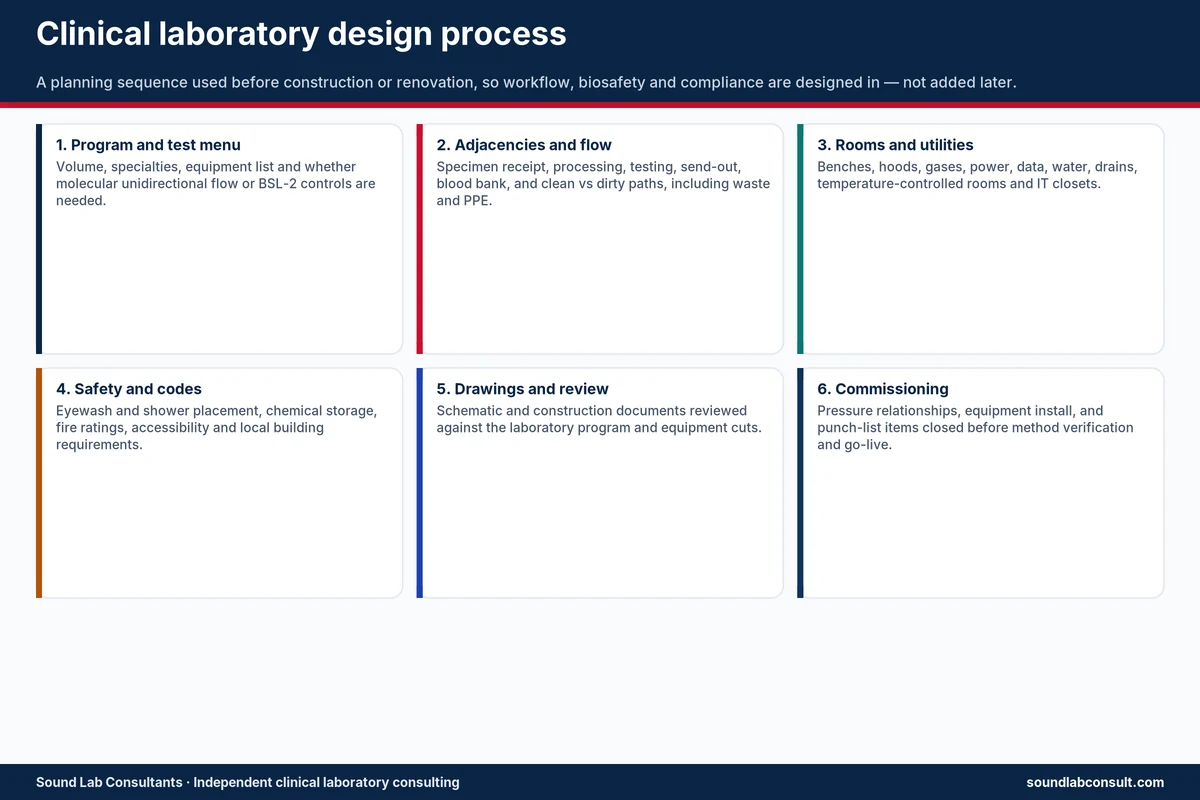
This 5-stage planning checklist follows the order most lab projects actually run: planning, design, acquisition, installation and validation. Download the full version with owner, due date and status columns and the regulation behind each item:
Download the checklist (Excel .xlsx) Download the checklist (PDF)
| Stage | Key tasks | Deliverable | Reference |
|---|---|---|---|
| 1. Planning | Test menu and complexity; volume forecast; payer and referral plan; timeline; project team; budget by category with 10–15% contingency; state license check; space search | Project charter, budget, schedule | 42 CFR 493 Subpart A; state law |
| 2. Design | Floor plan with unidirectional workflow; barriers; biosafety cabinets and fume hoods; eyewash and shower placement; chemical storage; HVAC, power, water, data; waste path | Approved drawings and equipment list | 493.1101; 29 CFR 1910.151, 1910.1450; BMBL |
| 3. Acquisition | Instrument selection and service terms; LIS/LIMS and interfaces; reagents, controls and calibrators; PT enrollment; CMS-116 filing; accreditor application | Purchase orders, CLIA application, PT enrollment | 493.1253; Subpart H; CMS-116 |
| 4. Installation | Construction close-out; IQ and OQ; utilities and temperature checks; LIS build and interface testing; hiring; training; SOP writing; safety plans | IQ/OQ records, training files, signed SOPs | 493.1251; Subpart M; 29 CFR 1910.1030 |
| 5. Validation | PQ and 493.1253 verification or validation; reference intervals; initial competency; mock survey; director sign-off; go-live | Signed validation reports, go-live approval | 493.1253, 493.1255, 493.1451/1413 |
Want a stage-by-stage list for a specific instrument platform? See our vendor-specific setup checklists linked from the clinical lab setup checklist.
Lab setup timeline (6 to 12 months)
Most clinical labs take 6 to 12 months from decision to first patient result. The ranges below are typical planning ranges, not promises; state agency processing, construction and instrument delivery drive most of the variation.
| Months | Work underway | Milestone |
|---|---|---|
| Month 1–2 | Test menu and complexity, budget, team, site selection, state license research | Project charter and budget approved |
| Month 2–4 | Design, permits, instrument and LIS selection, director identified | Drawings approved; instruments chosen |
| Month 3–6 | Build-out; CMS-116 and state license applications; PT enrollment; hiring | CLIA number or certificate issued; license pending or issued |
| Month 6–8 | Instrument delivery, IQ/OQ, LIS build and interfaces, SOP writing, training | Installation complete; SOPs drafted |
| Month 7–10 | PQ and method verification or validation, competency, mock survey | Director sign-off on each test |
| Month 9–12 | Go-live, first PT events, accreditor or state survey scheduling | Patient testing; first survey |
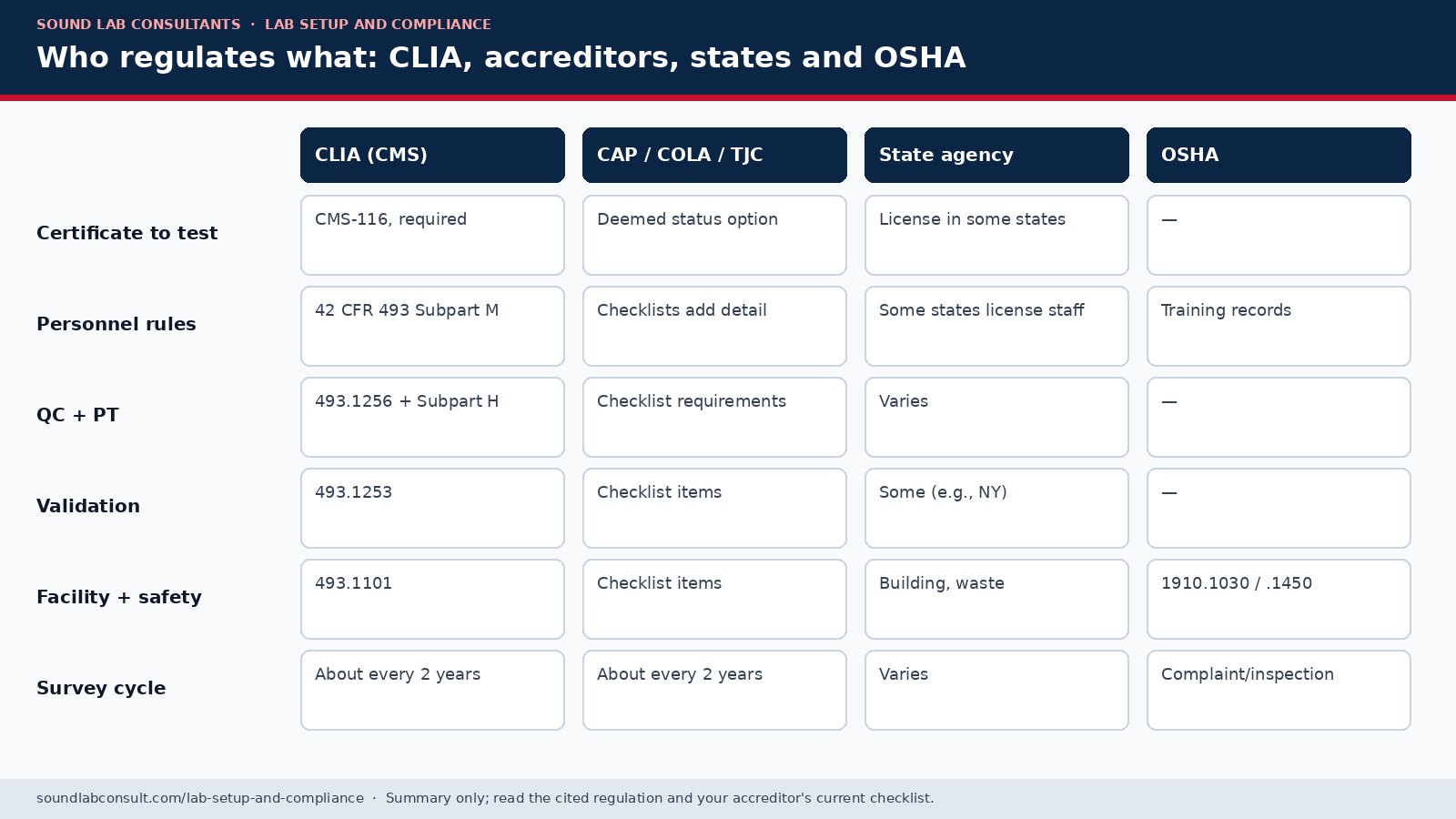
Compliance requirements matrix: CLIA vs CAP vs COLA vs state vs OSHA
Different bodies regulate different parts of the same lab. This matrix shows who checks what. Accreditors' checklists change often, so confirm the current edition with your accreditor before you build to it.
| Area | CLIA (CMS) | CAP | COLA | State agency | OSHA |
|---|---|---|---|---|---|
| Authority to test | CLIA certificate required (CMS-116) | Accreditation gives deemed status for CLIA | Accreditation gives deemed status for CLIA | License required in some states | Not applicable |
| Facility and safety | 493.1101 space, ventilation, utilities, contamination control | Checklist items for facilities and safety | Criteria for facilities and safety | Building, waste and some lab rules | 1910.1030, 1910.1450, 1910.1200, 1910.151 |
| Personnel | Subpart M qualifications and duties | Checklist items; follows CLIA minimums at least | Criteria follow CLIA minimums at least | Personnel licensure in some states | Training records for safety standards |
| Validation | 493.1253 | Checklist items on method performance | Criteria on method performance | Some states review (for example New York for LDTs) | Not applicable |
| QC and PT | 493.1256; Subpart H | Checklist items; PT through approved programs | Criteria; PT through approved programs | Varies | Not applicable |
| Survey cycle | Routine survey about every 2 years (Certificate of Compliance) | On-site inspection about every 2 years | Survey about every 2 years | Varies by state | Inspection on complaint, referral or program |
For a deeper side-by-side, read CLIA, CAP, COLA and TJC regulations and lab CLIA compliance by test complexity.
Want this checklist run for you?
Sound Lab Consultants plans, licenses, validates and opens compliant labs nationwide, then stays on for oversight. Book a free consultation.
Book a free consultationHow Sound Lab Consultants runs lab setup and oversight
Sound Lab Consultants is an independent clinical laboratory consulting firm based at 25 Arizona Pl, Chandler, Arizona, serving labs nationwide. We run lab setup and compliance as one project, then stay on to oversee the lab after go-live if you want us to. Typical work includes:
- Planning: test menu and complexity map, timeline, team roles and budget categories, and a state-by-state license check.
- Design review: workflow, barriers, safety equipment and utilities reviewed against CLIA 493.1101, OSHA and the lab's specialties, alongside your architect or contractor.
- Equipment and LIS: instrument selection criteria, service and warranty questions, IQ/OQ/PQ plans and LIS or LIMS interface validation.
- Licensing and accreditation: CMS-116, state license applications and accreditor applications prepared and tracked.
- People: laboratory director and technical consultant or supervisor coverage where qualified, job descriptions, training plans and competency programs.
- Quality system: procedure manual, QC plan, IQCP where appropriate, PT plan, quality assessment and safety manuals.
- Validation: verification and validation plans, data review and reports for director sign-off.
- Ongoing oversight: scheduled QC and PT review, competency tracking, mock surveys, and help with deficiency reports and plans of correction.
We also build specialty labs: microbiology, molecular and PCR, toxicology and NGS. If you are comparing firms, our lab consultant and laboratory startup consultants pages explain what a consultant should cover.
Common lab setup and compliance mistakes
- Signing a lease before checking the state license rules and zoning for a laboratory use.
- Designing the floor plan before fixing the test menu, which leaves no room for a molecular workflow or a biosafety cabinet later.
- Buying instruments on price alone without service coverage, reagent supply or interface support in your area.
- Hiring a director or supervisor who does not meet current Subpart M rules for the complexity you plan to run, including the 2024 changes.
- Treating IQ/OQ as validation. Installation checks do not replace the 493.1253 study.
- Copying SOPs from another lab without matching them to your instruments and having your director approve them.
- Missing PT enrollment for regulated analytes before the first event.
- Leaving OSHA for later: no exposure control plan, Chemical Hygiene Plan, eyewash coverage or hepatitis B vaccination offer at opening.
- Going live before the LIS report is tested end to end, including reference intervals and required report elements.
- No budget contingency, so a delay in construction or an extra validation run stalls the opening.
Set up your lab right the first time
Book a free consultation with Sound Lab Consultants. We will review your test menu, space, equipment, staffing and licenses and give you a setup and compliance plan.
Book a free consultationFrequently asked questions
What does lab setup and compliance include?
It includes eight phases: pre-planning and budgeting, layout and infrastructure, equipment and IT systems, personnel and training, regulatory certification and accreditation, the quality system and SOPs, method validation or verification, and go-live with ongoing compliance.
How long does it take to set up a compliant clinical lab?
Most labs take 6 to 12 months. A waived or moderate-complexity lab in existing space can open sooner; new construction, high-complexity or molecular testing and states that license labs push toward 12 months or more.
How much contingency should a lab setup budget include?
Many planners hold a 10–15% contingency reserve on top of the categorized budget for construction, casework, equipment, IT, permits, reagents, proficiency testing and staffing.
What is the 5-stage lab planning checklist?
Planning, design, acquisition, installation and validation. Each stage has its own tasks and deliverables, from the test menu and budget through IQ/OQ/PQ, SOPs, 493.1253 studies and director sign-off.
Do I need a CLIA certificate before testing patients?
Yes. Any U.S. lab that tests human specimens for diagnosis, prevention or treatment needs a CLIA certificate before it reports patient results, unless it operates under a CMS-approved state program in New York or Washington. Apply with form CMS-116.
Is accreditation by CAP, COLA or The Joint Commission required?
No. Accreditation is a choice. A lab can hold a CLIA Certificate of Compliance and be surveyed by the state agency, or choose a CMS-approved accreditor for a Certificate of Accreditation. Some payers, hospitals or states may expect a specific accreditation.
What is IQ/OQ/PQ?
Installation Qualification confirms the instrument is installed correctly, Operational Qualification confirms it works within specifications, and Performance Qualification confirms it performs consistently in your lab. In a CLIA lab, PQ connects to the 42 CFR 493.1253 verification or validation study.
What layout does CLIA require for a lab?
42 CFR 493.1101 requires space, ventilation and utilities that support all testing phases and minimize contamination. Molecular amplification outside closed systems must use a unidirectional workflow with separate areas for specimen preparation, amplification and detection.
What OSHA standards apply to a new lab?
Most clinical labs fall under the Bloodborne Pathogens standard (29 CFR 1910.1030), the Laboratory Standard (29 CFR 1910.1450), Hazard Communication (29 CFR 1910.1200) and the medical services and first aid rule (29 CFR 1910.151), which covers eyewash and drenching facilities.
What is the difference between method verification and validation?
Verification confirms an unmodified FDA-cleared or approved test performs as the manufacturer claims (accuracy, precision, reportable range, reference intervals). Validation establishes performance for modified tests and laboratory-developed tests, adding analytical sensitivity, specificity and interfering substances.
Do research labs need CLIA?
Not if they only do research and never report patient-specific results for diagnosis or treatment. Nonclinical studies supporting FDA submissions follow GLP under 21 CFR Part 58. Once results are returned to patients or providers, CLIA applies.
What personnel does a high-complexity lab need?
A laboratory director, technical supervisor, clinical consultant, general supervisor and qualified testing personnel under 42 CFR 493.1441 to 493.1495, with six-element competency assessment for testing staff.
Should I use a LIS or a LIMS?
Clinical labs usually use a laboratory information system (LIS) built around patient orders, results and reports. Research, manufacturing and environmental labs often use a LIMS. Either one must be validated with its instrument and EHR interfaces before go-live.
Can Sound Lab Consultants manage my whole lab setup?
Yes. We plan, review design, guide equipment and LIS choices, prepare CMS-116, state license and accreditation applications, write the quality system, run validation and stay on for ongoing oversight. Book a free consultation to start.
Sources
- 42 CFR Part 493: Laboratory Requirements (eCFR)
- 42 CFR 493.1101: Facilities
- 42 CFR 493.1253: Establishment and verification of performance specifications
- 42 CFR Part 493 Subpart M: Personnel
- CMS: Clinical Laboratory Improvement Amendments (CLIA)
- CMS-116 CLIA Application for Certification
- CDC: Clinical Laboratory Improvement Amendments
- CDC/NIH: Biosafety in Microbiological and Biomedical Laboratories (BMBL)
- OSHA 29 CFR 1910.1030: Bloodborne Pathogens
- OSHA 29 CFR 1910.1450: Occupational exposure to hazardous chemicals in laboratories
- OSHA 29 CFR 1910.151: Medical services and first aid
- 21 CFR Part 58: Good Laboratory Practice for Nonclinical Laboratory Studies
- 21 CFR Part 11: Electronic Records; Electronic Signatures
Related pages
Last reviewed November 25, 2026. Sound Lab Consultants is an independent laboratory consulting firm. This page is general information, not legal advice; confirm current requirements with CMS, your state agency, your accreditor and OSHA. We are not affiliated with or endorsed by CMS, CDC, FDA, OSHA, NIH, CAP, COLA, The Joint Commission, ANSI/ISEA, any state agency or any instrument manufacturer. Illustrations are original works by Sound Lab Consultants. Sound Lab Consultants, 25 Arizona Pl, Chandler, AZ 85225.
A mock inspection belongs near the end of lab setup
Read our CLIA mock inspection guide: run it after procedures, validation, QC, PT enrollment and initial competency are in place, and before the official survey.
Book a free consultation