
Short answer: Renewals must describe changes in the prior period and renew any related registrations (§§ 19a-36-A25 to A33). DPH may inspect quarters, facilities, and records at any time (§ 19a-36-D23). Source: CT Public Health Code, clinical laboratories.
Last reviewed November 25, 2026 by Sound Lab Consultants. Primary sources: CMS Form CMS-116, CMS Clinical Laboratory Improvement Amendments (CLIA) program, 42 CFR Part 493.
Application checklist
| Item | Notes |
|---|---|
| Lab name, location, CLIA number | One application per laboratory |
| Ownership & agent for service | All owners with addresses |
| Director | Must meet CT and CLIA qualifications |
| Test list | Tests for which licensure is sought |
| Blood collection facilities | List of permanent collection locations |
| Out-of-state reference labs | Names, addresses, CLIA numbers, volume |
| Price list & physician contracts | Required attachments on the DPH form |
| Fee | $200 to Treasurer, State of Connecticut (per form) |
Renewals must describe changes in the prior period and renew any related registrations (§§ 19a-36-A25 to A33). DPH may inspect quarters, facilities, and records at any time (§ 19a-36-D23). Source: CT Public Health Code, clinical laboratories.
Need help with a Connecticut laboratory license or CMS-116 filing?
Book a free consultation. We will match your test menu to the federal certificate and the state rules that actually apply.
Book a free consultationOut-of-state lab checklist
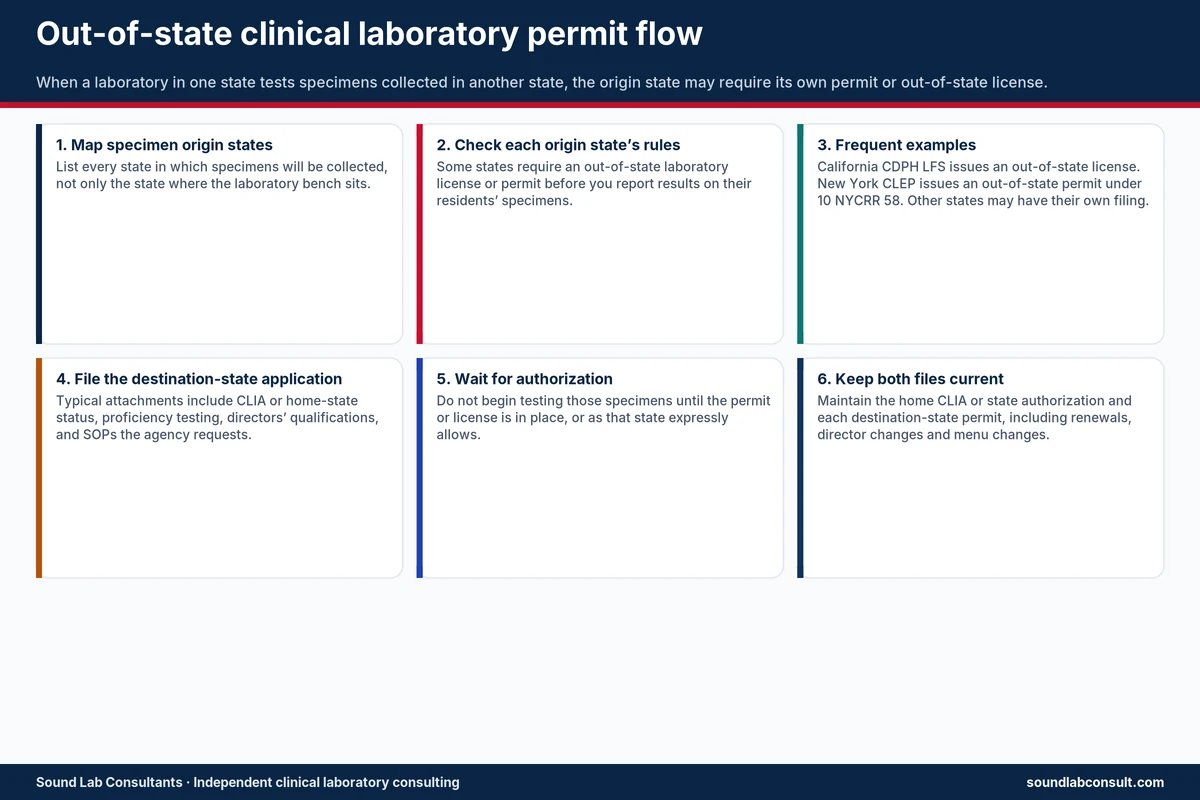
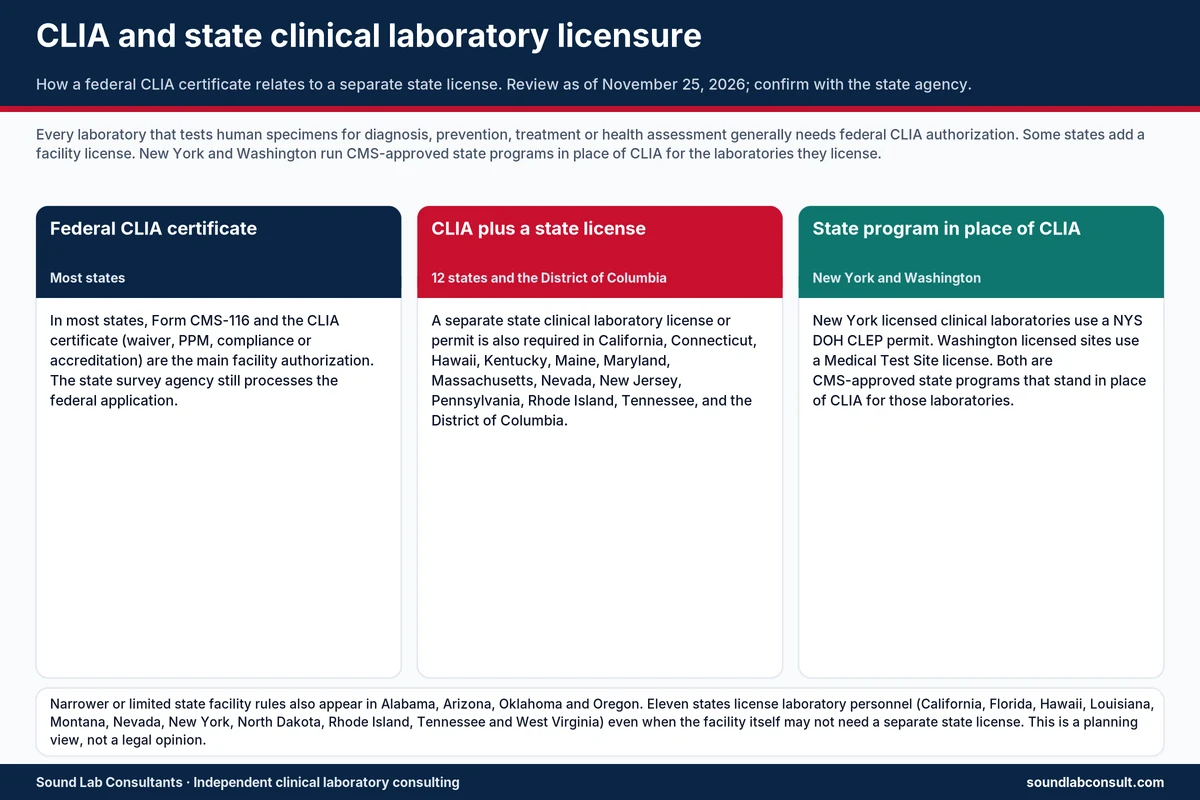
- Valid CLIA certificate covering the tests
- Home-state license or approval where required
- Written confirmation from CT DPH FLIS on any Connecticut requirement
- Connecticut collection sites: licensing review before opening
- Reportable findings to Connecticut health authorities
Connecticut resources
- connecticutlabconsultant.com
- Connecticut Lab Consultant: CT DPH License, CLIA, Startup & Validation
- Connecticut CLIA & State Lab License Guide 2026: § 19a-36-D22
- CT DPH § 19a-36-D22 Clinical Lab License & Out-of-State Lab Guide
- Hire a Lab Director or Technical Consultant in Connecticut
- CLIA Consultant Hartford, New Haven & Stamford Connecticut
Get help with Connecticut laboratory licensing
Book a free consultation with Sound Lab Consultants. Bring the state, the test menu and any forms already started.
Book a free consultationFrequently asked questions
Are research-only labs exempt in Connecticut?
Yes, under § 19a-36-D22(b).
Can DPH inspect a licensed lab?
Yes, upon request, under § 19a-36-D23.
What does this guide cover under “Application checklist”?
Renewals must describe changes in the prior period and renew any related registrations (§§ 19a-36-A25 to A33). DPH may inspect quarters, facilities, and records at any time (§ 19a-36-D23). Source: CT Public Health Code, clinical laboratories.
Sources
- CMS Form CMS-116, CLIA application for certification
- CMS Clinical Laboratory Improvement Amendments (CLIA) program
- 42 CFR Part 493, Laboratory Requirements (CLIA)
Related pages
Last reviewed November 25, 2026. Sound Lab Consultants is an independent laboratory consulting firm. This page is general information, not legal advice; confirm current requirements with CMS, your state agency and your accreditor. We are not affiliated with or endorsed by CMS, CDC, FDA, OSHA, CAP, COLA, The Joint Commission, any state agency or any instrument manufacturer. Illustrations are original works by Sound Lab Consultants. Sound Lab Consultants, 25 Arizona Pl, Chandler, AZ 85225.