
Short answer: Molecular diagnostics identifies DNA or RNA (and, in a broader sense, some protein markers) from a patient specimen. Common methods include PCR and other amplification assays, Sanger and next-generation sequencing, hybridization (FISH and microarrays), isothermal amplification and CRISPR-based detection. Most clinical molecular tests are high complexity under CLIA; a smaller number of commercial assays are categorized as moderate complexity or waived.
Last reviewed November 25, 2026. Primary sources: 42 CFR 493.17, 42 CFR 493.1101, 42 CFR 493.1253.
What molecular diagnostics means
In clinical use, molecular diagnostics usually means tests that detect or characterize nucleic acids — DNA or RNA — in a human specimen. The target may be a pathogen gene, a somatic or germline variant, a fusion transcript, a viral load, or a set of alleles used for pharmacogenomics or HLA typing.
Some educational materials also place certain protein or peptide methods (for example mass spectrometry in a proteomic workflow) under a broader “molecular” umbrella. This page treats nucleic acid testing as the core definition and notes protein methods where they sit beside it on the same bench or in the same department.
Molecular testing is not a single instrument or a single disease area. A physician-office laboratory running one waived molecular cartridge and a hospital laboratory running oncology NGS are both doing molecular diagnostics. The methods, personnel and quality system have to match the complexity and the intended use.
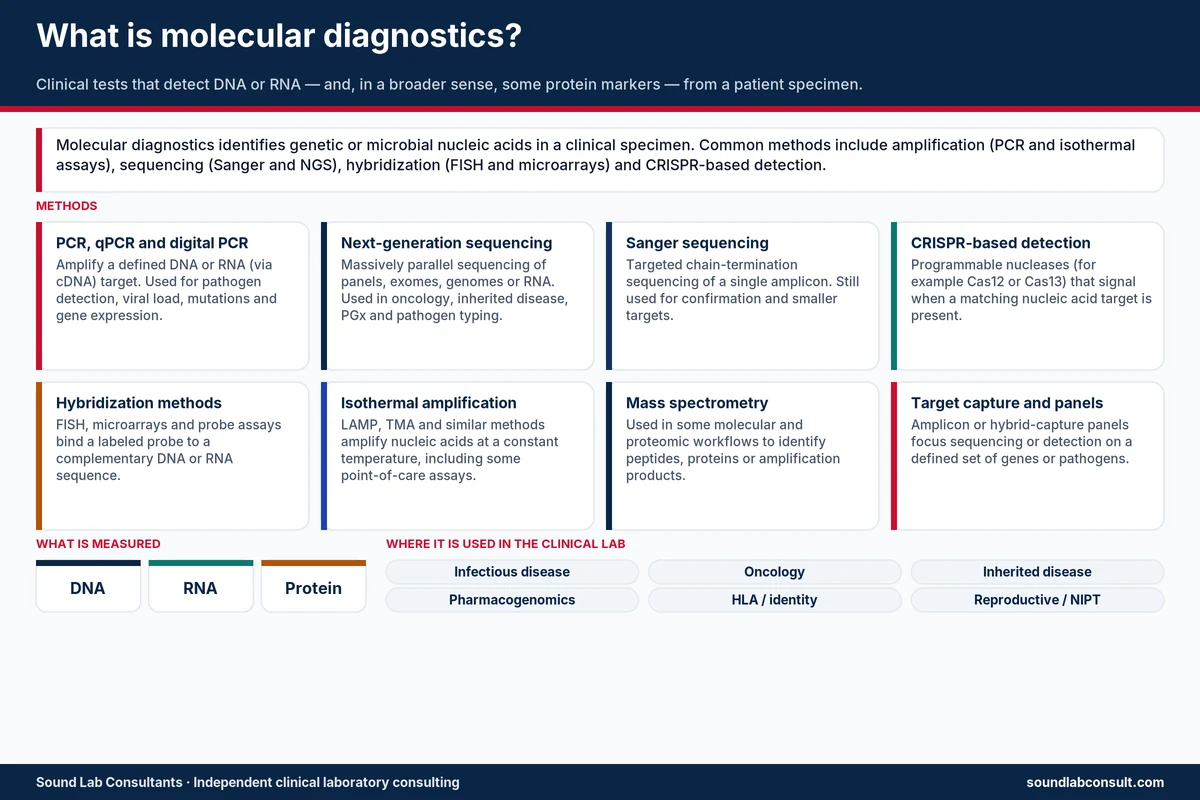
The main methods
These are the method families you will see on most clinical molecular menus. Brand names vary; the chemistry does not change the CLIA obligation to verify or validate the method the laboratory actually uses.
- PCR, qPCR and digital PCR. Amplify a defined DNA target, or RNA after conversion to cDNA. Real-time PCR supports qualitative detection and quantitative results such as viral load. Digital PCR partitions the reaction when a precise copy number or a rare variant fraction is needed.
- Next-generation sequencing (NGS). Massively parallel sequencing of a panel, an exome, a genome or an RNA library. Used in oncology, inherited disease, pharmacogenomics, HLA work and some pathogen typing.
- Sanger sequencing. Targeted chain-termination sequencing of a single amplicon. Still used for confirmation and for smaller defined targets.
- Hybridization. A labeled probe binds a complementary sequence. FISH, microarrays and some qualitative probe assays belong here.
- Isothermal amplification. LAMP, TMA and related methods amplify nucleic acids at a constant temperature. Some are designed for rapid or near-patient use.
- CRISPR-based detection. Programmable nucleases such as Cas12 or Cas13 can signal when a matching nucleic acid target is present. Clinical use is still more limited than PCR or NGS, but the method is now part of the field.
- Mass spectrometry and target-capture panels. Some laboratories identify amplification products, peptides or proteins by mass spectrometry, or use amplicon or hybrid-capture panels to focus sequencing on a defined gene or pathogen set.
DNA, RNA and protein targets
DNA tests look at genomic DNA from the patient or from an organism in the specimen — for example a resistance gene, a germline variant or a somatic mutation in tumor tissue.
RNA tests start with RNA and usually convert it to cDNA before amplification or sequencing. They are used for RNA viruses, some fusion transcripts and gene-expression work.
Protein methods are not nucleic acid tests, but they appear on some “molecular pathology” or special-chemistry menus (for example peptide quantification by LC-MS/MS). If the laboratory reports those results, they still need a verified or validated method, quality control and personnel who meet the complexity of that test.
Where molecular diagnostics is used
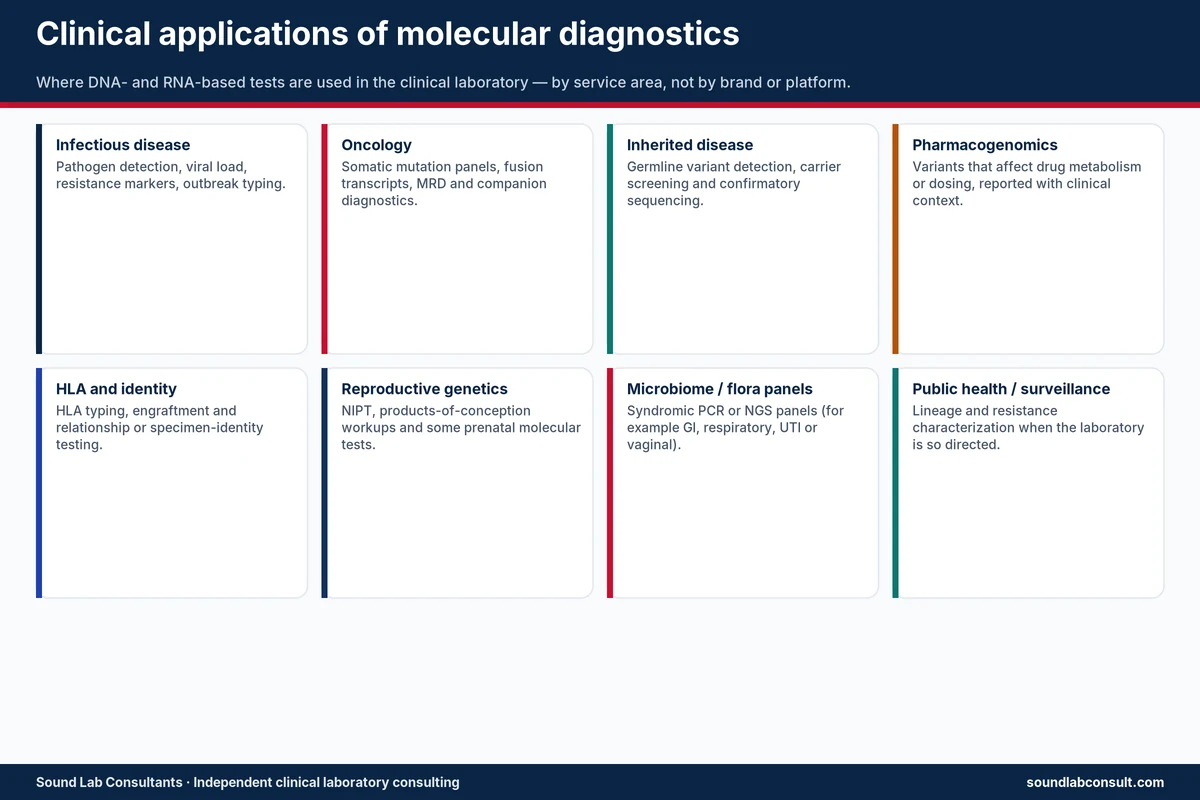
The same core methods support several clinical services:
- Infectious disease — pathogen detection, viral load, selected resistance markers and, in some laboratories, outbreak or lineage typing.
- Oncology — somatic mutation panels, fusion transcripts, measurable residual disease and some companion diagnostics.
- Inherited disease — germline variant detection, carrier screening and confirmatory sequencing.
- Pharmacogenomics — variants that affect drug metabolism or dosing, reported with a defined gene list and stated limitations.
- HLA and identity — HLA typing, engraftment monitoring and specimen-identity or relationship testing.
- Reproductive genetics — including noninvasive prenatal testing and some products-of-conception workups, when the laboratory is set up for that work.
Planning a molecular, PCR or NGS laboratory?
Talk through your test menu, space, instruments and compliance plan with Sound Lab Consultants.
Book a free consultationHow a molecular test runs
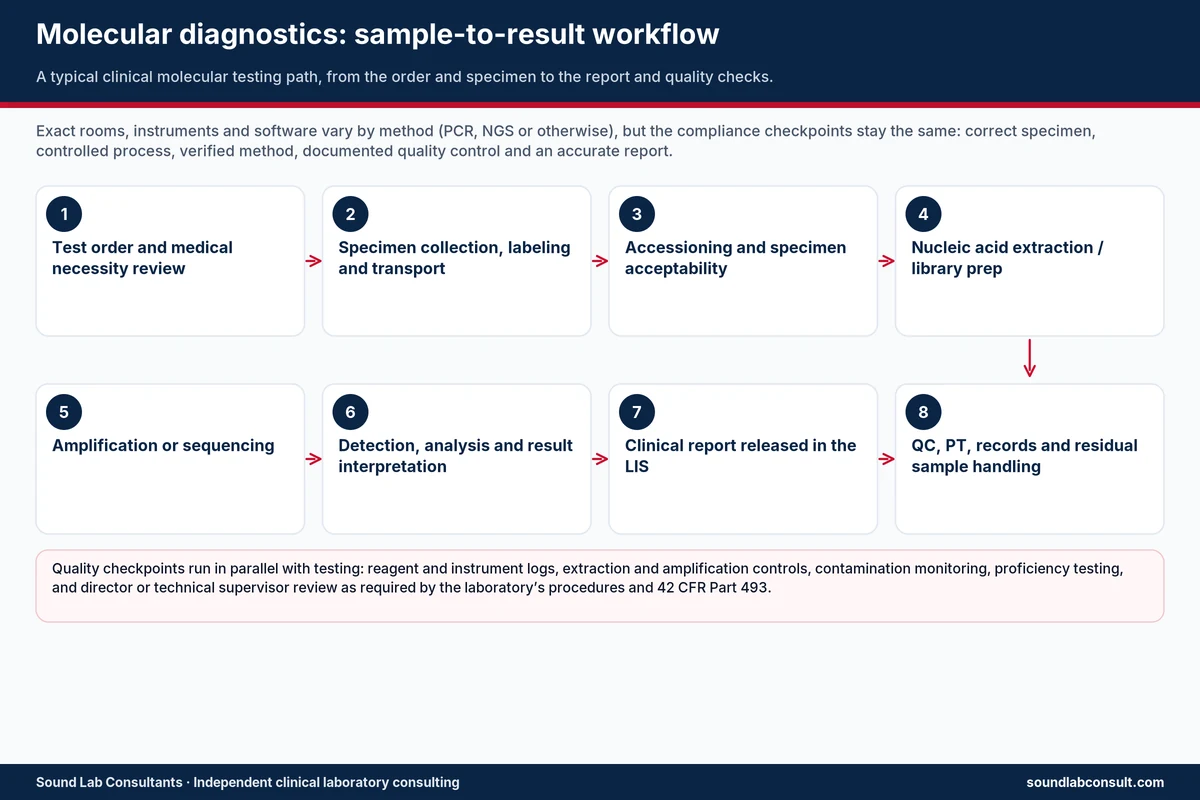
Rooms, instruments and software differ for a cartridge PCR, a batch qPCR and a clinical NGS assay. The compliance path is more stable:
- A valid order, and any consent the test or state law requires.
- Collection, labeling and transport that match the specimen type the method accepts.
- Accessioning and an acceptability check before the sample is consumed.
- Nucleic acid extraction, or a closed cartridge that includes extraction.
- Amplification, sequencing or another detection step.
- Analysis and interpretation under a written procedure, including a validated bioinformatics pipeline when NGS is used.
- A clinical report in the laboratory information system.
- Quality control, proficiency testing, records and residual-sample handling in parallel with the run.
For amplification methods, laboratories commonly use a unidirectional workflow — clean reagent preparation, then specimen preparation, then amplification, then any post-amplification work — so amplicons do not move backward into clean rooms. See unidirectional workflow and molecular lab design.
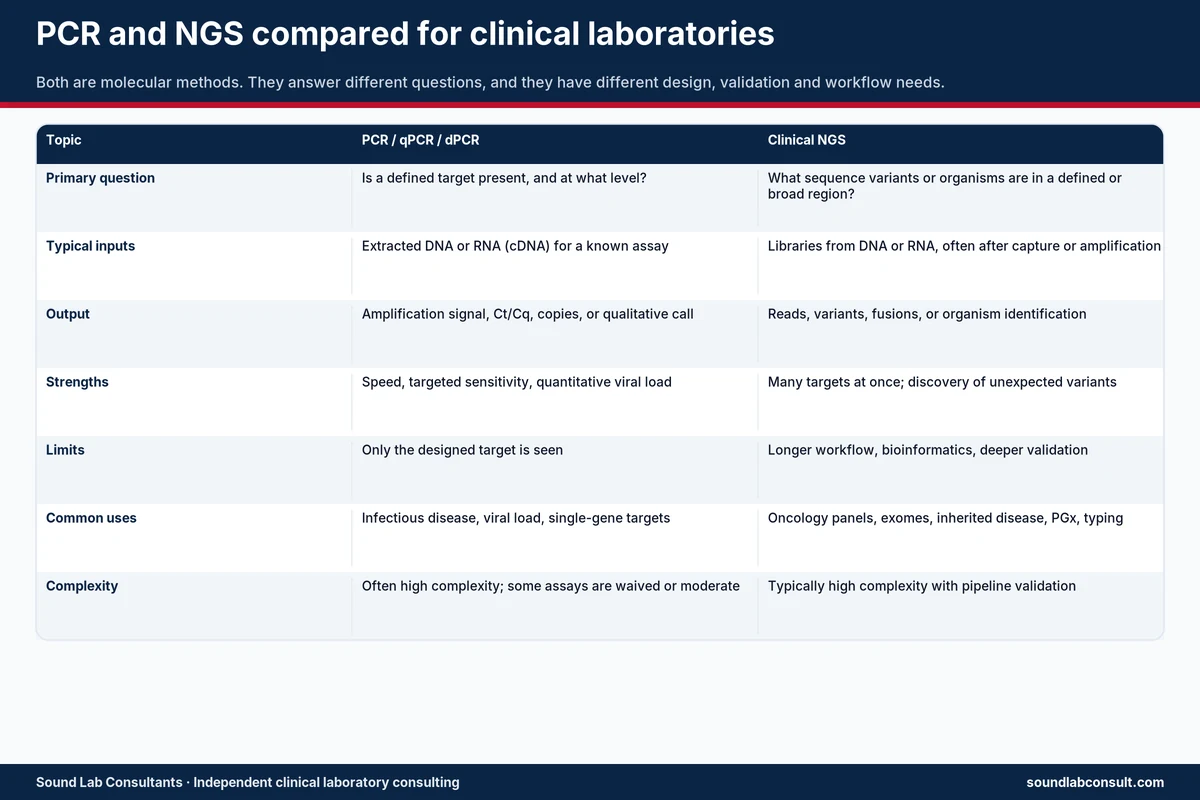
PCR and NGS compared
PCR answers a defined question: is this target present, and at what level? NGS asks what sequence is present in a defined or broader region. PCR is usually faster and is the usual choice for viral load and many infectious-disease targets. NGS is the usual choice when many genes or unexpected variants matter, at the cost of a longer workflow, bioinformatics and a deeper validation.
A laboratory can offer both. Each method still needs its own verification or validation, quality control, proficiency testing and standard operating procedures. See PCR and molecular lab consulting and NGS consulting.
CLIA complexity and what the laboratory must do
FDA categorizes commercial in vitro diagnostic tests as waived, moderate complexity or high complexity. Under 42 CFR 493.17 and related rules, laboratory-developed tests and tests used with a modification of the manufacturer’s instructions are high complexity.
Many molecular methods are high complexity. Some FDA-cleared molecular assays, including some point-of-care cartridges, are categorized as moderate complexity or waived. The laboratory has to know the categorization of each test it reports and follow the personnel, quality control, proficiency testing and verification rules that go with it.
Before reporting patient results, the laboratory verifies performance of an unmodified cleared or approved test, or establishes performance specifications for a modified or laboratory-developed test, under 42 CFR 493.1253. Facilities must be adequate for the testing performed (42 CFR 493.1101). High-complexity molecular sections also need a director and a technical supervisor who meet the specialty qualifications in Subpart M.
Sound Lab Consultants is not affiliated with or endorsed by CMS, FDA, CDC, CAP, COLA or The Joint Commission. Confirm current categorization and interpretive guidance with the agency or accreditor.
How Sound Lab Consultants helps
Sound Lab Consultants is an independent clinical laboratory consulting firm. We help practices, hospitals, independent laboratories and diagnostic developers plan, verify and run molecular, PCR and NGS testing under CLIA, remotely or on site, in all 50 states.
- Test-menu and complexity planning
- Room flow and contamination control for amplification methods
- Method verification and laboratory-developed test validation studies the director can sign
- Quality systems, proficiency testing and survey response
- Independent of instrument and reagent manufacturers
Talk through your molecular testing plan
If you are adding PCR, a syndromic panel or clinical NGS, we can review the method, the space and the CLIA file before you report patient results.
Book a free consultationFrequently asked questions
What is molecular diagnostics in simple terms?
It is clinical laboratory testing that looks for a specific DNA or RNA target — or, in some broader panels, a related protein marker — in a specimen such as blood, a swab, urine, stool or tissue. The result helps identify a pathogen, a genetic variant or another defined marker.
Is PCR the same thing as molecular diagnostics?
PCR is one molecular method, and it is the most widely used. Molecular diagnostics also includes sequencing (Sanger and NGS), hybridization methods such as FISH, isothermal amplification (for example LAMP or TMA) and some CRISPR-based detection assays.
How is molecular diagnostics different from clinical chemistry or microbiology?
Chemistry measures metabolites, proteins, electrolytes and similar analytes, often with spectrophotometry or immunoassay. Traditional microbiology grows or stains organisms. Molecular methods detect nucleic acid sequence. The same laboratory may offer all three, and some infectious-disease work now uses molecular panels alongside culture.
Are molecular tests always high complexity under CLIA?
Many are. Laboratory-developed tests and modified cleared tests are high complexity. FDA also categorizes some commercial molecular assays as moderate complexity or waived. Personnel, quality control, proficiency testing and verification follow the complexity and specialties on the laboratory’s certificate.
Does a laboratory need a special room to start molecular testing?
CLIA requires facilities that are adequate for the testing performed. For amplification methods, laboratories commonly separate pre- and post-amplification work and use a unidirectional workflow to reduce amplicon contamination. The exact layout depends on the methods and volume.
Sources
- 42 CFR 493.17, Test categorization
- 42 CFR 493.1101, Facilities (unidirectional workflow)
- 42 CFR 493.1253, Establishment and verification of performance specifications
- 42 CFR 493.1443, Laboratory director qualifications (high complexity)
- 42 CFR 493.1449, Technical supervisor qualifications
- 42 CFR 493.1489, Testing personnel qualifications (high complexity)
- CDC MMWR, Good Laboratory Practices for Molecular Genetic Testing for Heritable Diseases and Conditions (2009)
- FDA CLIA test categorization database
- CMS Clinical Laboratory Improvement Amendments (CLIA) program
- CMS State Operations Manual Appendix C: Survey Procedures and Interpretive Guidelines for Laboratories
Related molecular lab guides
Sound Lab Consultants is an independent laboratory consulting firm. We are not affiliated with or endorsed by CMS, FDA, CDC, CAP, COLA, The Joint Commission, any state agency or any instrument manufacturer. This page is general information, not legal or billing advice; confirm requirements with the agency, accreditor or payer.