
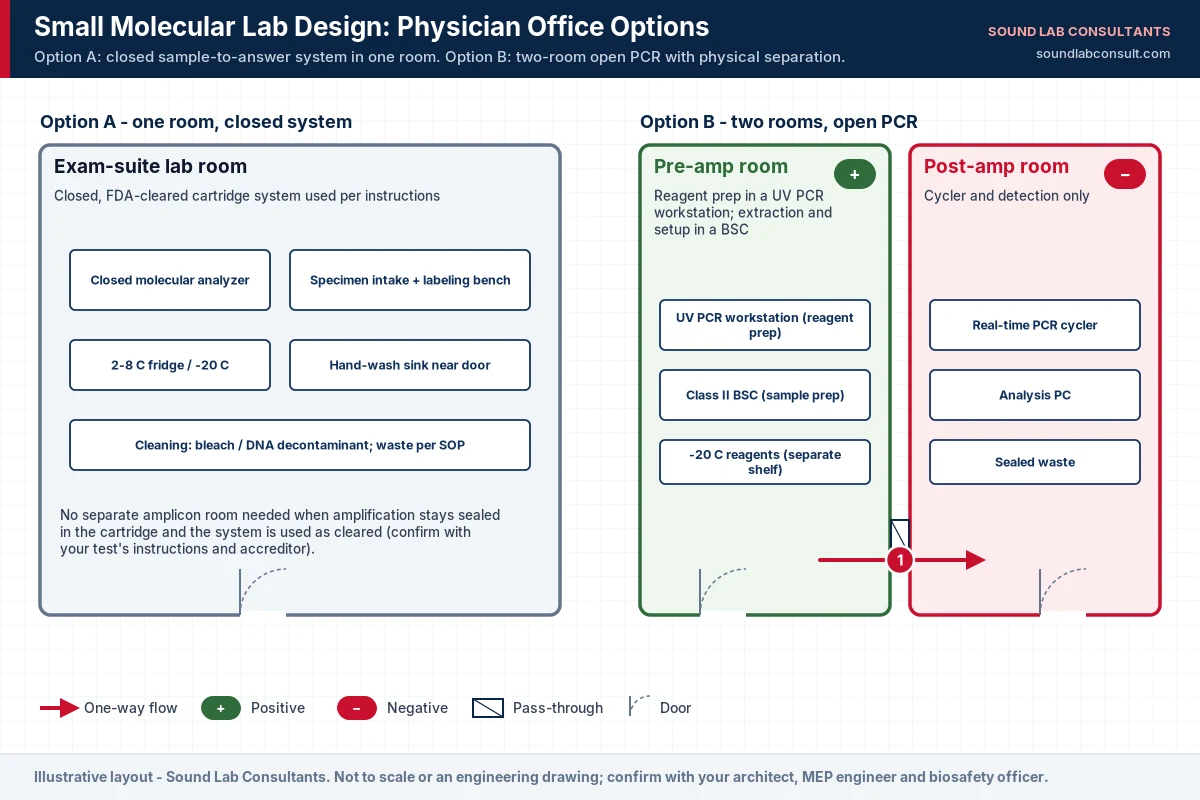
Short answer: A physician office can run a closed, FDA-cleared sample-to-answer molecular system in a single room, because amplification stays sealed in the cartridge. Open PCR needs the separate areas CLIA requires (42 CFR 493.1101(a)(3)); in a small office that usually means two rooms: a pre-amplification room with a UV PCR workstation for reagent prep and a biosafety cabinet for sample prep, and a separate post-amplification room for the cycler.
Last reviewed November 25, 2026. Primary sources: 42 CFR 493.1101, CMS State Operations Manual Appendix C, 42 CFR 493.17.
Start With the Platform Decision
The single biggest design decision for a small lab is whether testing is closed or open. Closed sample-to-answer cartridge systems keep extraction, amplification and detection sealed. Many are moderate complexity, and some are CLIA-waived; check each test in the FDA CLIA categorization database and the manufacturer's instructions. Open PCR (and most lab-developed molecular tests) is high complexity and needs physical separation.
Option A: One Room, Closed System
- A bench for the analyzer with ventilation clearance and a dedicated circuit (UPS recommended).
- A separate specimen intake and labeling area on the same or adjacent bench.
- Refrigerated and frozen storage for cartridges and controls per manufacturer instructions.
- A hand-wash sink near the door, cleanable surfaces and a biohazard waste container.
- Cleaning with a DNA-decontaminating agent or fresh dilute bleach per the instructions, and periodic wipe tests if your SOP calls for them.
Even with a closed system, keep specimen handling tidy: a cracked cartridge or spilled specimen is still a contamination and biosafety event.
Option B: Two Rooms, Open PCR
In two rooms, the first room holds all pre-amplification work, separated within the room: reagent preparation inside an enclosed UV PCR workstation, and specimen preparation in a Class II BSC on a different bench. The second room is post-amplification only. Sealed plates go forward through a pass-through or in a sealed carrier; nothing comes back.
- Pre-amp room positive or neutral to the corridor; post-amp negative, if the building HVAC allows.
- Two sets of pipettes, racks, coats and consumables, color-coded.
- A schedule that starts each day in the pre-amp room.
- Separate storage for reagents and specimens even inside one room.
If you can only have one room, talk to your director and accreditor before buying an open platform: enclosed workstations can separate reagent and sample prep, but amplified product detection that opens tubes should not share the room.
Planning a new lab or a renovation?
Send us your floor plan or test menu. Sound Lab Consultants reviews layouts against CLIA, accreditation and biosafety expectations before you build.
Book a free consultationWhat a Compact Molecular Room Looks Like
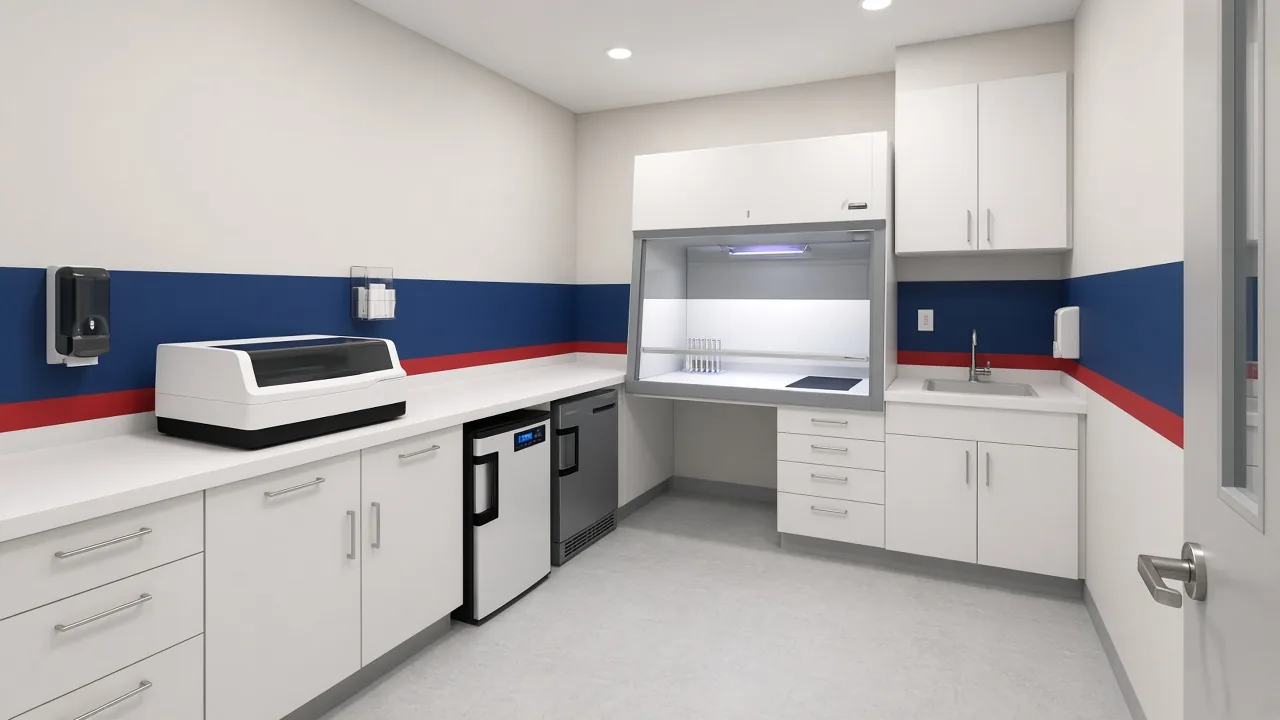
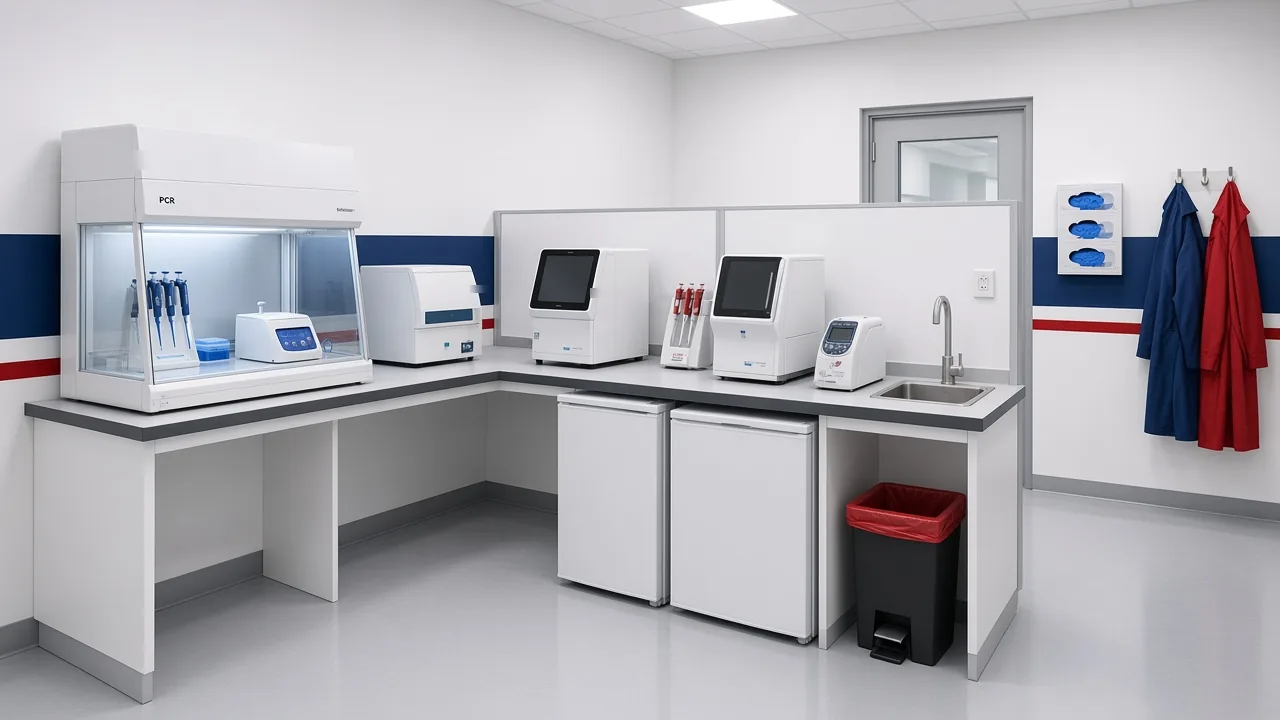
The render below shows a small room planned around a closed analyzer, with an enclosed workstation for any manual preparation, undercounter cold storage and a hand-wash sink at the exit.
What Each Room Looks Like, Down to the Equipment
What each room looks like when it is finished, down to the equipment: a render, a numbered layout and a placement table.
Physician Office Molecular Lab (One Room)
A small office lab running closed, sample-to-answer molecular systems can often work in one room. Open steps, such as reagent setup in a PCR workstation, stay at a clean end, apart from the analyzers.
Zone: Clean end and testing end in one room
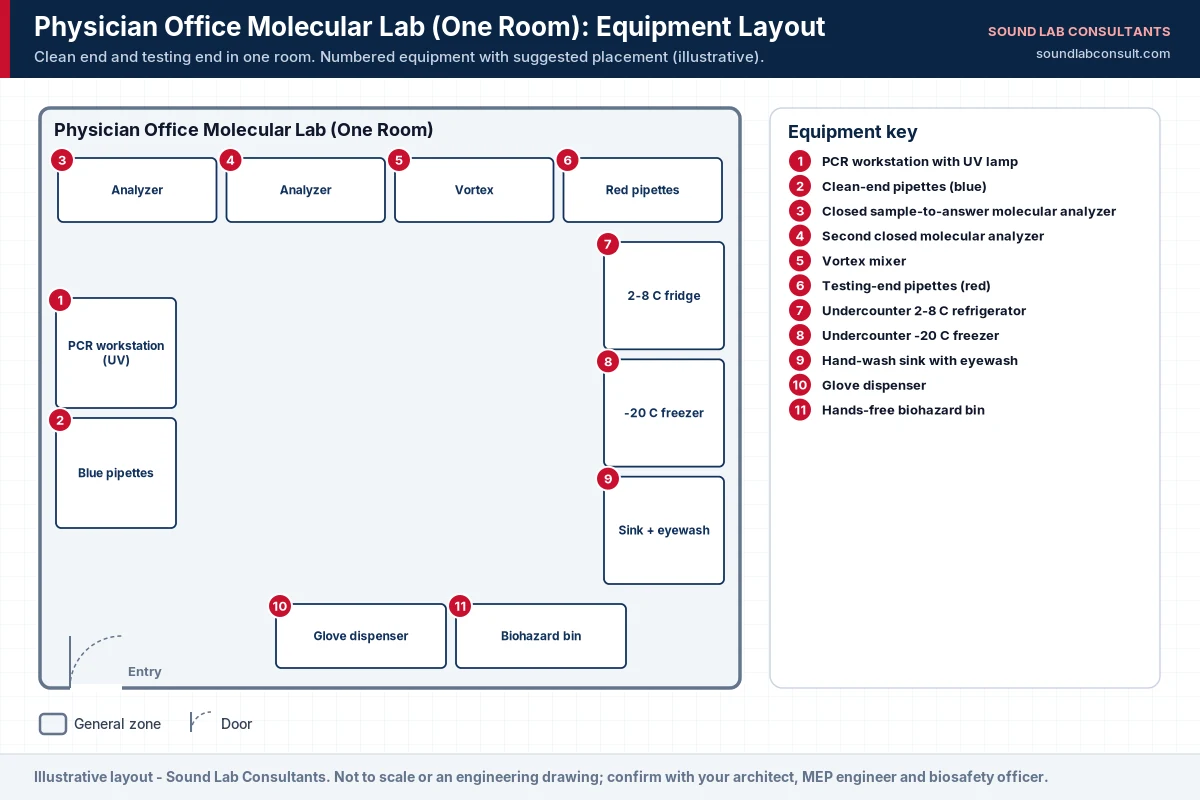
| # | Equipment | Purpose | Placement |
|---|---|---|---|
| 1 | PCR workstation with UV lamp | Any open reagent or sample setup | Clean end of the bench, farthest from the analyzers |
| 2 | Clean-end pipettes (blue) | Setup pipetting only | Inside the workstation |
| 3 | Closed sample-to-answer molecular analyzer | Runs cartridge-based tests | Testing end of the bench |
| 4 | Second closed molecular analyzer | Capacity or a second test menu | Testing end, beside the first |
| 5 | Vortex mixer | Specimen mixing | Testing end |
| 6 | Testing-end pipettes (red) | Specimen transfer to cartridges | Testing end |
| 7 | Undercounter 2-8 C refrigerator | Cartridges, reagents and specimens per instructions | Under the bench |
| 8 | Undercounter -20 C freezer | Frozen reagents if the menu needs them | Under the bench |
| 9 | Hand-wash sink with eyewash | Hand hygiene and eye flushing | End of the bench |
| 10 | Glove dispenser | Fresh gloves at the door | Wall by the entry |
| 11 | Hands-free biohazard bin | Cartridges and specimen waste | Under the testing end |
All rooms: room-by-room equipment guide.
Licensure and Legal Basics for In-Office Labs
The certificate type follows the test categorization: waived tests need a Certificate of Waiver, while moderate and high complexity testing needs a Certificate of Compliance or Accreditation with qualified personnel. Some states add their own license. Physician-owned labs also need healthcare counsel to review referral and billing structures under the Stark in-office ancillary services exception and the anti-kickback statute. See physician office PCR lab setup.
How Sound Lab Consultants Helps
Small and in-office molecular lab planning: choosing between closed and open platforms, one- and two-room layouts, CLIA certificate type, state licensure, verification, QC and staff training for practices and clinics.
- Floor plan and workflow review before construction, not after a survey finding
- Independent of instrument, casework and construction vendors
- Written design memos, SOPs and validation plans your director can sign
- Remote and on-site support in all 50 states, from Chandler, Arizona
Design your lab right the first time
Sound Lab Consultants helps practices, hospitals, reference labs and diagnostic companies plan, build, validate and run molecular and NGS laboratories under CLIA, remotely or on site, in all 50 states.
Book a free consultationFrequently asked questions
Can a doctor's office run PCR in one room?
Yes for a closed, FDA-cleared sample-to-answer system used per its instructions. Open PCR needs separate areas for specimen preparation, amplification and detection under 42 CFR 493.1101(a)(3).
How much space does a small molecular lab need?
A closed analyzer can fit on a few feet of bench in an existing lab room. Open PCR typically needs two small rooms or one room plus a separate post-amplification room. Size from your equipment list and clearances.
Is a PCR workstation enough to separate reagent prep?
In a small lab an enclosed UV PCR workstation is a common way to separate reagent preparation from specimen work in the pre-amplification room, but it does not replace a separate post-amplification area for open PCR.
Do waived molecular tests need special room design?
Waived tests must be performed per manufacturer instructions; follow any space, cleaning and handling instructions in the package insert and good contamination practice.
Sources
- 42 CFR 493.1101, Facilities (unidirectional workflow)
- CMS State Operations Manual Appendix C, Subpart J interpretive guidelines (D3005-D3007)
- 42 CFR 493.17, Test categorization
- FDA CLIA test categorization database
- CDC/NIH Biosafety in Microbiological and Biomedical Laboratories (BMBL), 6th edition
- 42 CFR 411.355(b), in-office ancillary services exception
Related lab design guides
Diagrams and renders on this page are original illustrations by Sound Lab Consultants, not engineering drawings; final designs need a licensed architect and engineer and must meet local codes. Sound Lab Consultants is an independent laboratory consulting firm. We are not affiliated with or endorsed by CMS, FDA, CDC, NIH, CAP, COLA, The Joint Commission, CLSI, any state agency or any instrument manufacturer. This page is general information, not legal advice. Sound Lab Consultants, 25 Arizona Pl, Chandler, AZ 85225.