
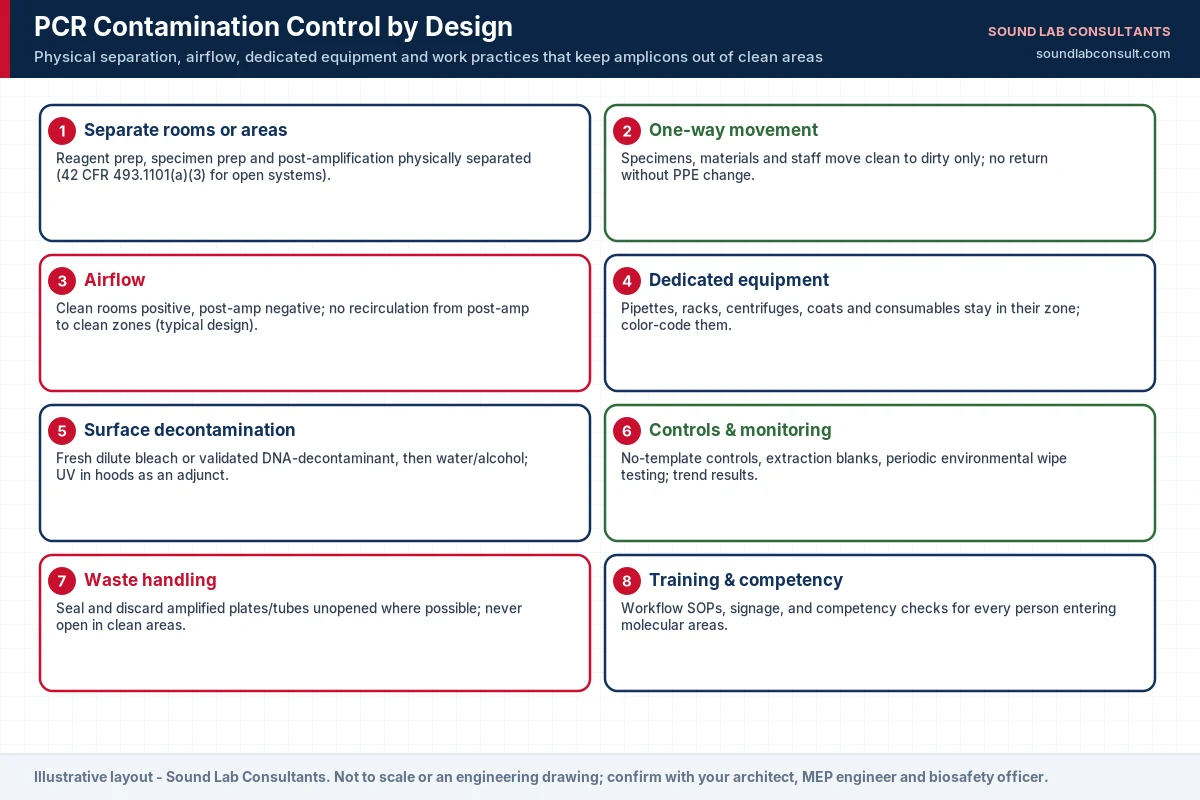
Short answer: Prevent PCR contamination with layered controls: physically separate reagent prep, specimen prep and post-amplification (required for open systems by 42 CFR 493.1101(a)(3)); move people and materials one way; keep clean rooms positive and post-amp negative; dedicate equipment and PPE to each zone; decontaminate surfaces with fresh dilute bleach or a validated DNA decontaminant; and monitor with no-template controls, extraction blanks and periodic wipe tests.
Last reviewed November 25, 2026. Primary sources: 42 CFR 493.1101, CMS State Operations Manual Appendix C, 42 CFR 493.1256.
Contamination Control in Layers
No single control is enough. Walls fail when doors are propped; UV fails when it is used as a substitute for cleaning; controls fail when they are only reviewed after a run is reported. Design every layer so the next one catches what the last one missed.
Physical Separation and One-Way Flow
Separate areas and one-way movement are the foundation, and a CLIA requirement for open amplification (42 CFR 493.1101(a)(3)). See PCR lab floor plan and unidirectional workflow for layouts.
Airflow and Pressure
Keep clean rooms positive and post-amplification negative, exhaust post-amp air, and keep doors closed. Visual pressure indicators at doors turn an invisible failure into something staff notice.
Sequencing labs apply the same controls across three zones. See NGS lab layout for the pre-amplification, amplification and post-amplification zones, color-coded gear and the NGS pressure cascade.
Planning a new lab or a renovation?
Send us your floor plan or test menu. Sound Lab Consultants reviews layouts against CLIA, accreditation and biosafety expectations before you build.
Book a free consultationWhat Each Room Looks Like, Down to the Equipment
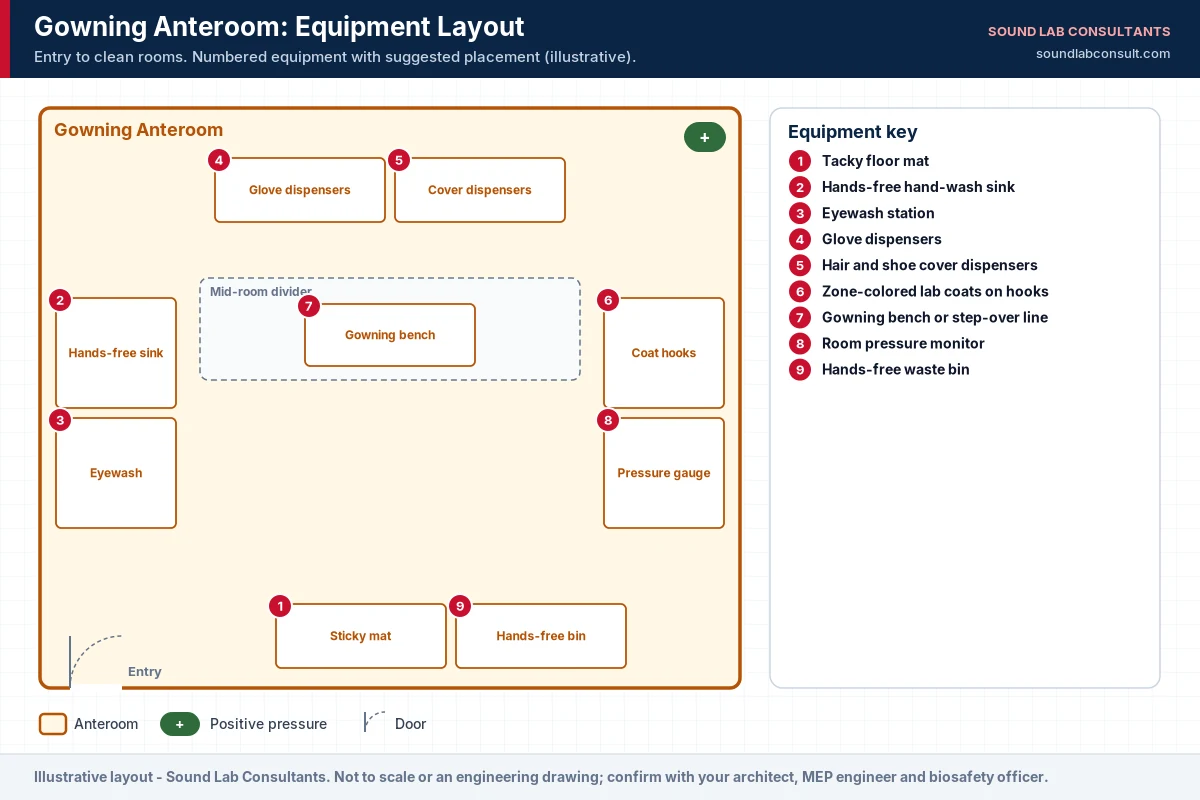
What each room looks like when it is finished, down to the equipment: a render, a numbered layout and a placement table.
Gowning Anteroom
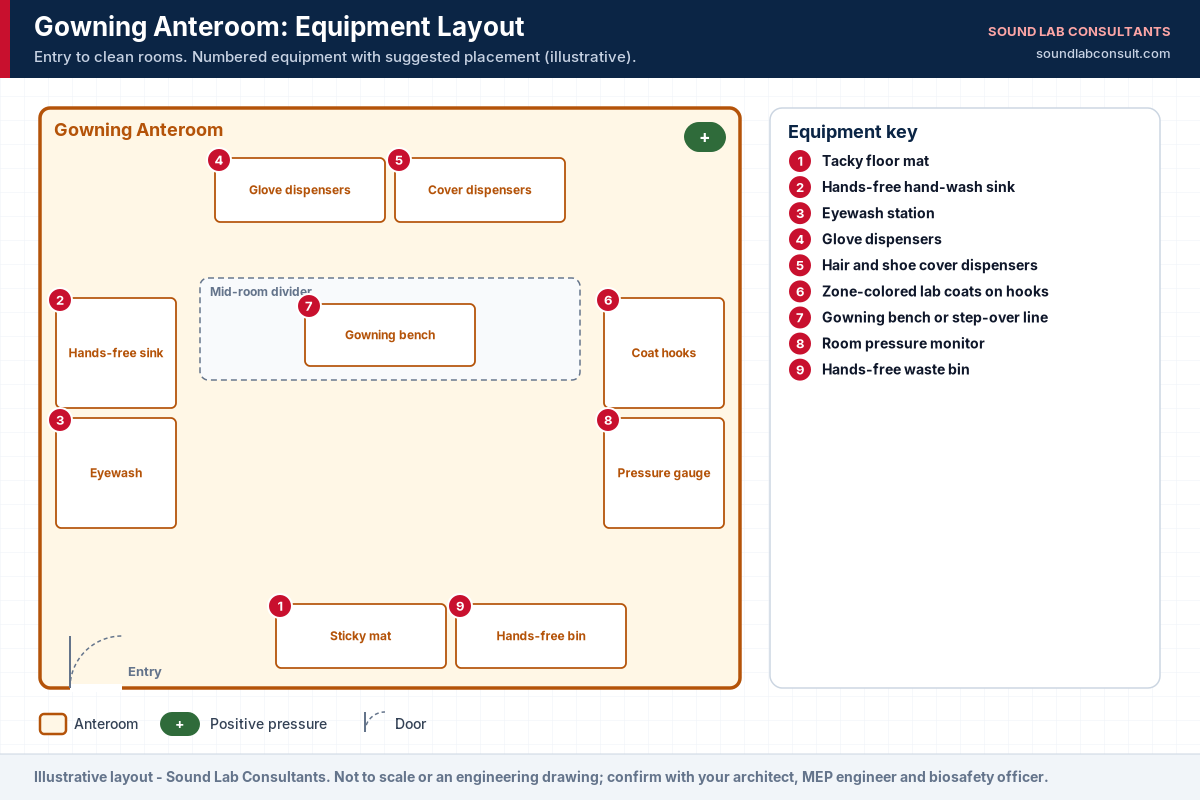
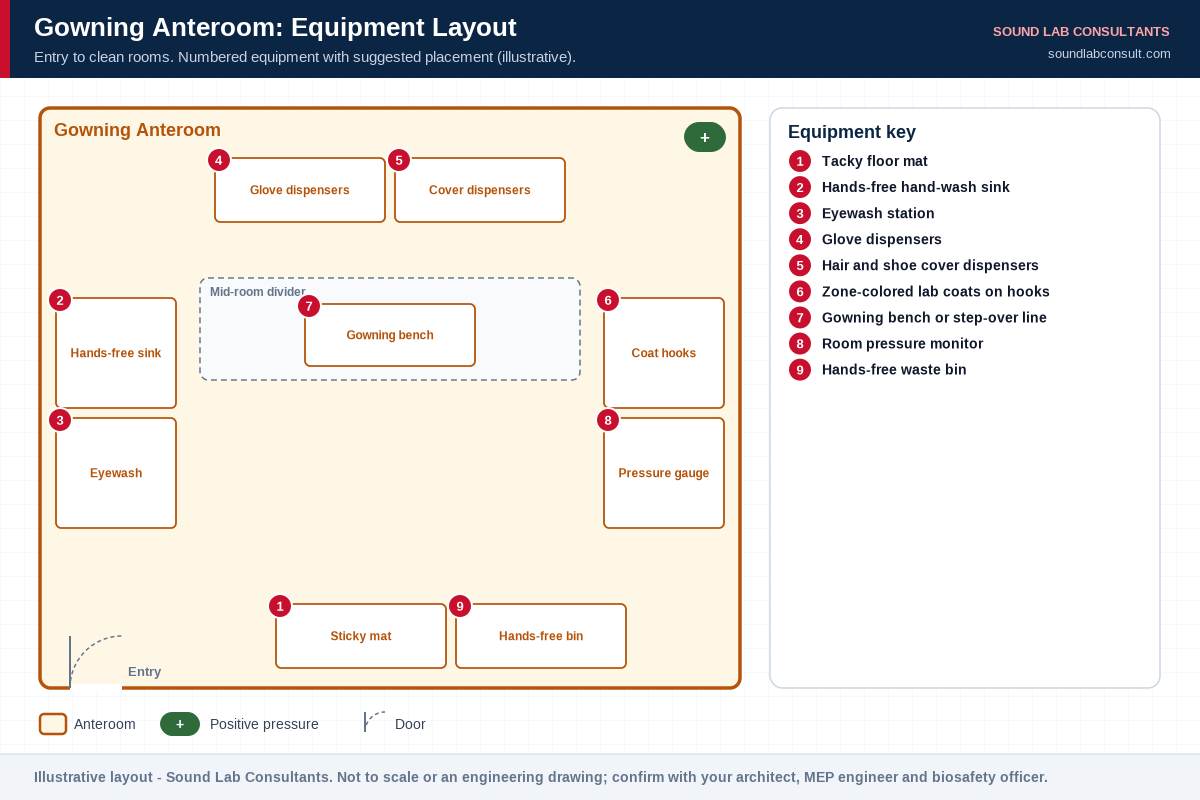
Staff change into room-dedicated PPE here before entering a clean room. The anteroom keeps corridor dust and amplified DNA on clothing out of pre-amplification space.
Zone: Entry to clean rooms · Air: positive pressure (design intent; your engineer sets values)
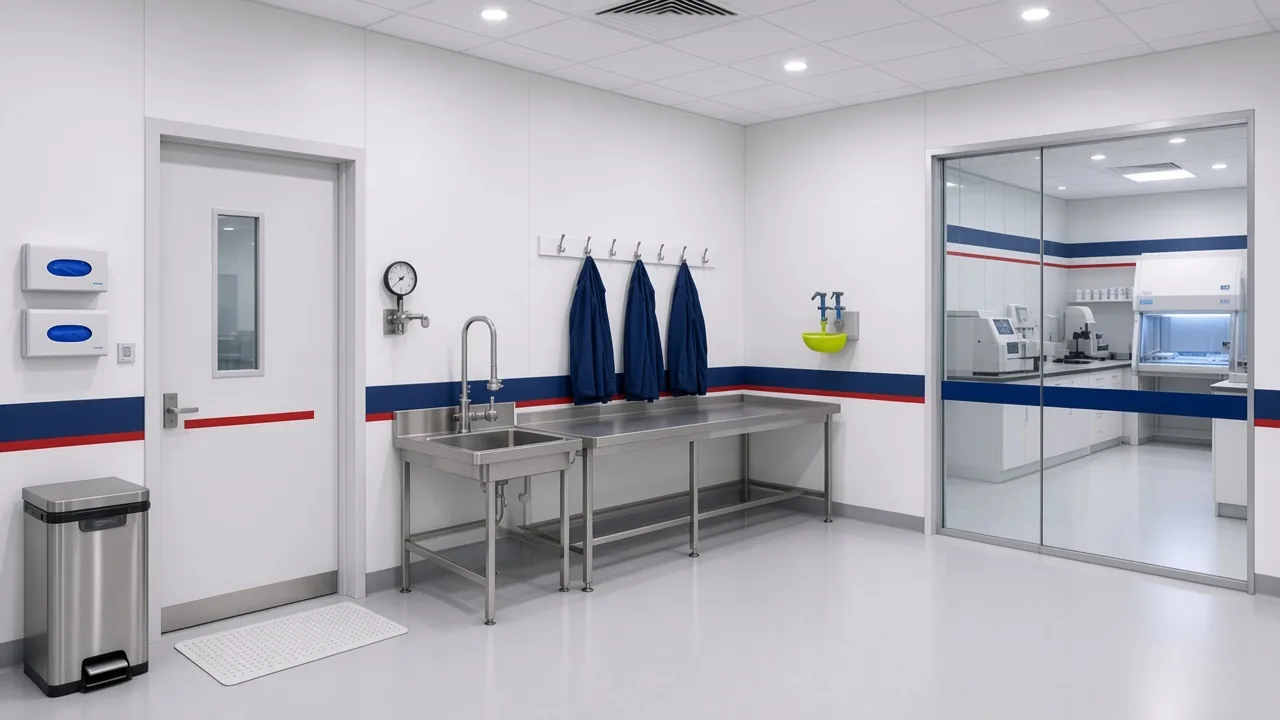
| # | Equipment | Purpose | Placement |
|---|---|---|---|
| 1 | Tacky floor mat | Captures particles from shoes | Floor in front of the inner door |
| 2 | Hands-free hand-wash sink | Hand hygiene before gloving | Near the corridor door |
| 3 | Eyewash station | Emergency eye flushing | Beside the sink |
| 4 | Glove dispensers | Fresh gloves on entry | Wall by the sink |
| 5 | Hair and shoe cover dispensers | Optional covers per SOP | Wall by the gowning bench |
| 6 | Zone-colored lab coats on hooks | One color per zone so misplaced coats are obvious | Clean side of the room |
| 7 | Gowning bench or step-over line | Divides corridor side from clean side | Across the middle of the room |
| 8 | Room pressure monitor | Confirms air flows out of the clean room | Beside the inner door |
| 9 | Hands-free waste bin | Used gloves and covers | Corridor side by the exit |
All rooms: room-by-room equipment guide.
Surface Decontamination and UV
- Clean work surfaces before and after work with freshly prepared dilute bleach (commonly 10% household bleach) or a validated DNA-decontaminating product, followed by water or alcohol to remove residue.
- Clean pipettes, racks and centrifuge rotors on a schedule.
- Use UV in workstations as an adjunct after cleaning, with lamp checks; UV does not penetrate dirt or reach shadows.
- Some assays include enzymatic carryover prevention (for example dUTP/uracil-N-glycosylase chemistry); follow the assay's instructions.
Controls and Environmental Monitoring
Run negative (no-template) controls and extraction blanks as your procedures and 42 CFR 493.1256 require, and review them before results are released. Many labs add periodic environmental wipe testing of benches, pipettes and door handles in clean areas, trending the results. A positive control in a negative well is a corrective-action event under 42 CFR 493.1282: stop, investigate, and document.
When contamination happens anyway: PCR contamination investigation.
People, PPE and Training
Room-specific lab coats (different colors for pre- and post-amp), glove changes when moving between tasks, and a daily rule of working from clean to dirty. Train everyone who enters, including cleaning and facilities staff, and include contamination control in competency assessment.
How Sound Lab Consultants Helps
Contamination control design and investigation for molecular labs: layout and airflow review, decontamination and monitoring SOPs, wipe-test programs, and root-cause investigation and corrective action when controls fail.
- Floor plan and workflow review before construction, not after a survey finding
- Independent of instrument, casework and construction vendors
- Written design memos, SOPs and validation plans your director can sign
- Remote and on-site support in all 50 states, from Chandler, Arizona
Design your lab right the first time
Sound Lab Consultants helps practices, hospitals, reference labs and diagnostic companies plan, build, validate and run molecular and NGS laboratories under CLIA, remotely or on site, in all 50 states.
Book a free consultationFrequently asked questions
What causes PCR contamination?
Most often amplified product (amplicon) carried from post-amplification areas on gloves, coats, pipettes or equipment, aerosols from opened tubes, and cross-contamination between specimens during extraction.
Does UV light eliminate PCR contamination?
UV helps decontaminate surfaces inside workstations but is an adjunct. It does not replace cleaning, separation and one-way workflow.
How do you clean a PCR workstation?
Clean surfaces with fresh dilute bleach or a validated DNA decontaminant, wipe residue with water or alcohol, then run the UV cycle if the workstation has one. Follow the manufacturer's instructions for materials.
How often should environmental wipe tests be done?
CLIA does not set a frequency; labs set one in their SOPs based on risk and history, and increase it after any contamination event.
Sources
- 42 CFR 493.1101, Facilities (unidirectional workflow)
- CMS State Operations Manual Appendix C, Subpart J interpretive guidelines (D3005-D3007)
- 42 CFR 493.1256, Control procedures
- 42 CFR 493.1282, Corrective actions
- CDC MMWR, Good Laboratory Practices for Molecular Genetic Testing for Heritable Diseases and Conditions (2009)
- CLSI MM19, Establishing Molecular Testing in Clinical Laboratory Environments
Related lab design guides
Diagrams and renders on this page are original illustrations by Sound Lab Consultants, not engineering drawings; final designs need a licensed architect and engineer and must meet local codes. Sound Lab Consultants is an independent laboratory consulting firm. We are not affiliated with or endorsed by CMS, FDA, CDC, NIH, CAP, COLA, The Joint Commission, CLSI, any state agency or any instrument manufacturer. This page is general information, not legal advice. Sound Lab Consultants, 25 Arizona Pl, Chandler, AZ 85225.