
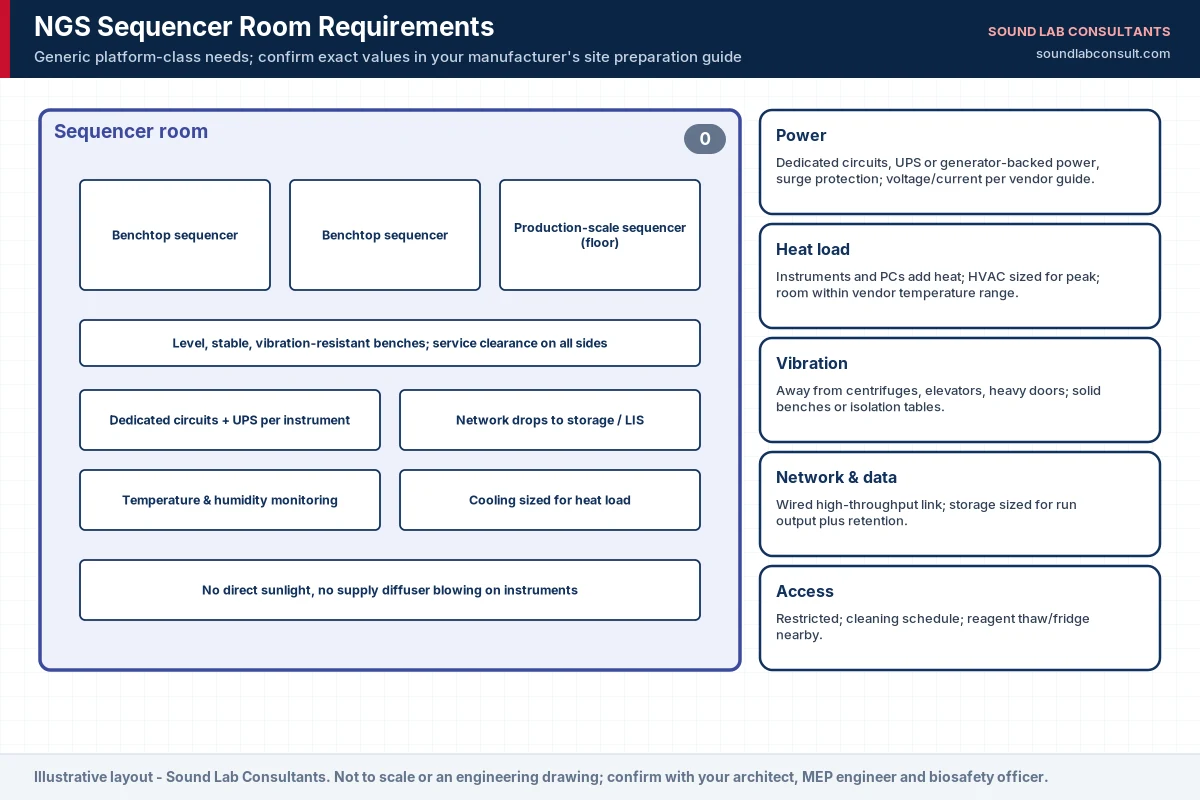
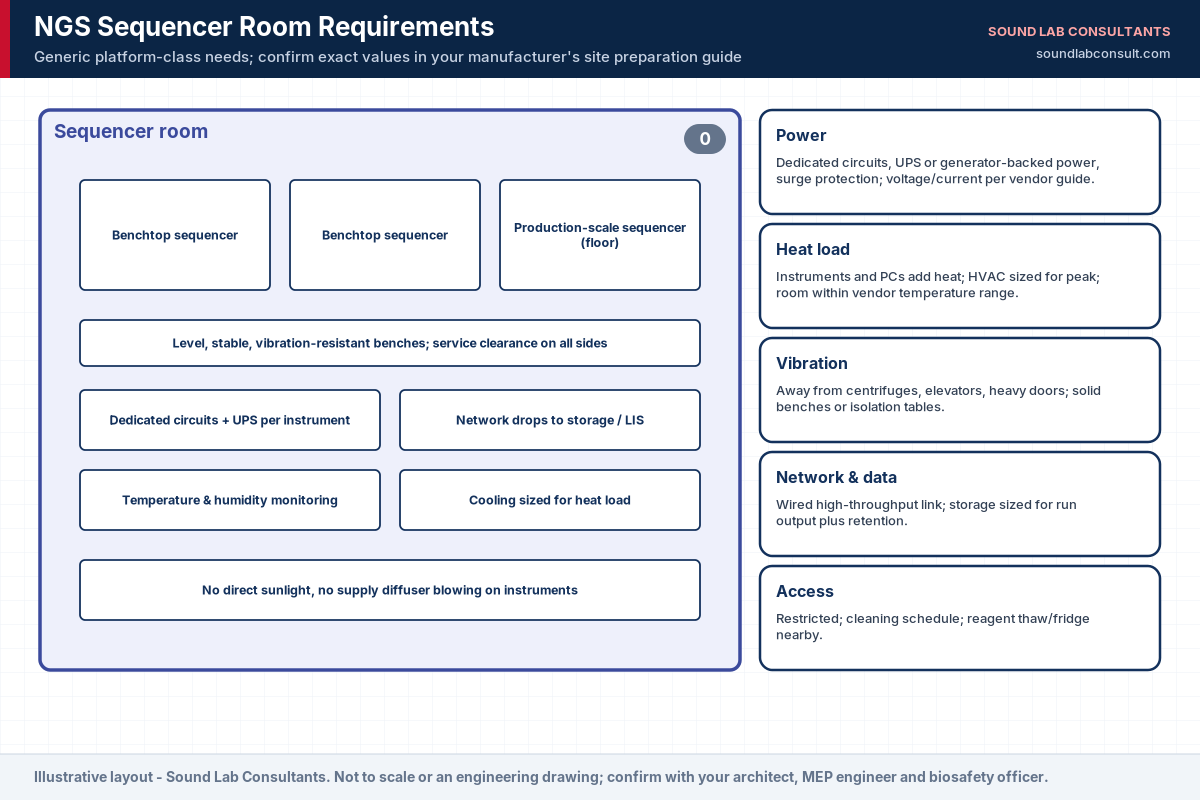
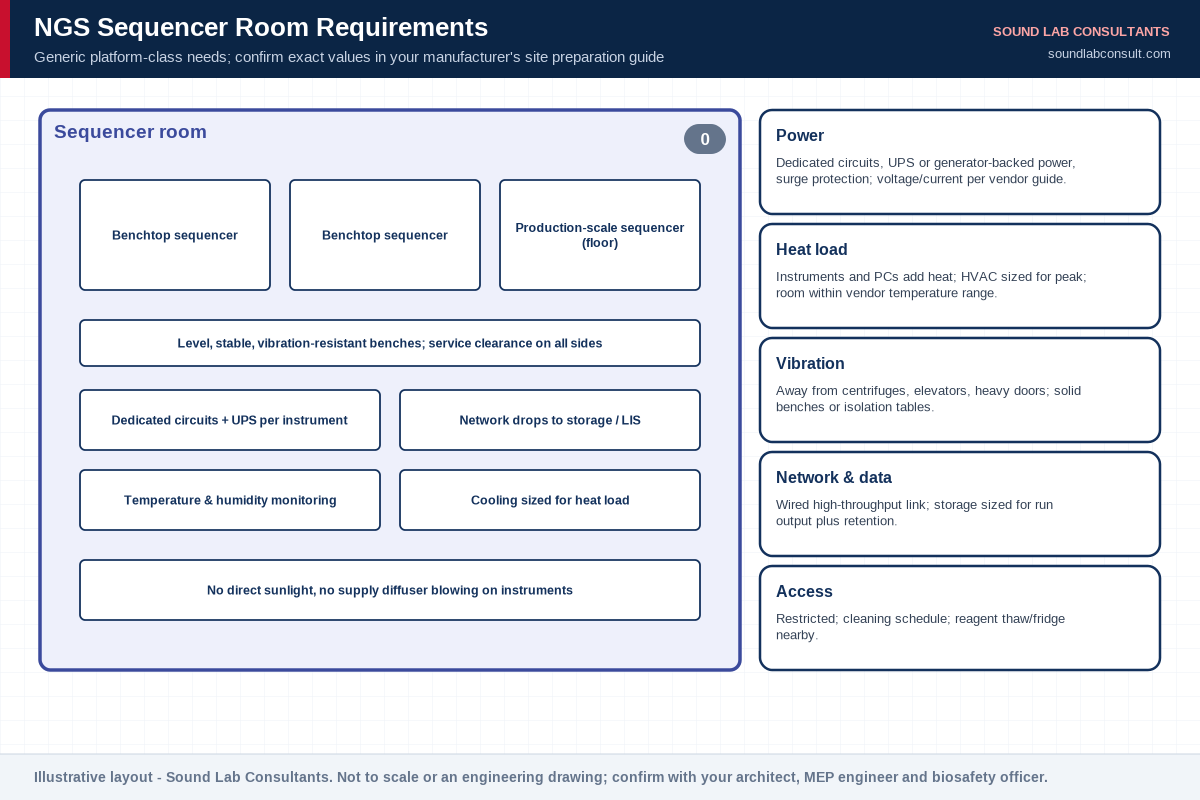
Short answer: A sequencer room needs dedicated electrical circuits with UPS or conditioned power, HVAC sized for instrument and computer heat that holds the manufacturer's temperature and humidity range, stable benches or floor locations away from vibration sources, service clearances, wired high-bandwidth network to storage, temperature monitoring and restricted access. Exact values come from each manufacturer's site preparation guide.
Last reviewed November 25, 2026. Primary sources: 42 CFR 493.1101, 42 CFR 493.1252, 42 CFR 493.1254.
Start From the Site Preparation Guide
Every sequencer manufacturer publishes a site preparation guide with power, environmental, space and network specifications, usually required before installation is scheduled. This page describes requirement categories common to platform classes so you can plan the room; it does not state any manufacturer's specifications. Always confirm exact power, environmental, clearance, vibration and network specifications in your sequencer manufacturer's current site preparation guide; values differ by platform and change between models.
Platform Classes and What Changes
| Platform class | Typical placement | Design implications |
|---|---|---|
| Benchtop short-read | Bench in post-PCR or instrument room | Dedicated outlet(s), UPS, bench stability, moderate heat |
| Production-scale short-read | Floor-standing in instrument room | Higher power and heat, floor loading, wider doors and service clearance, larger data output |
| Long-read and other chemistries | Bench or floor | Platform-specific environmental and network needs; some are sensitive to vibration or temperature swings |
What Each Room Looks Like, Down to the Equipment
What each room looks like when it is finished, down to the equipment: a render, a numbered layout and a placement table.
Sequencer Room
Pooled libraries are loaded and sequenced here. The room is built around the instruments: steady power, steady temperature, low vibration and a wired network.
Zone: Post-amplification (instrument room) · Air: neutral pressure (design intent; your engineer sets values)
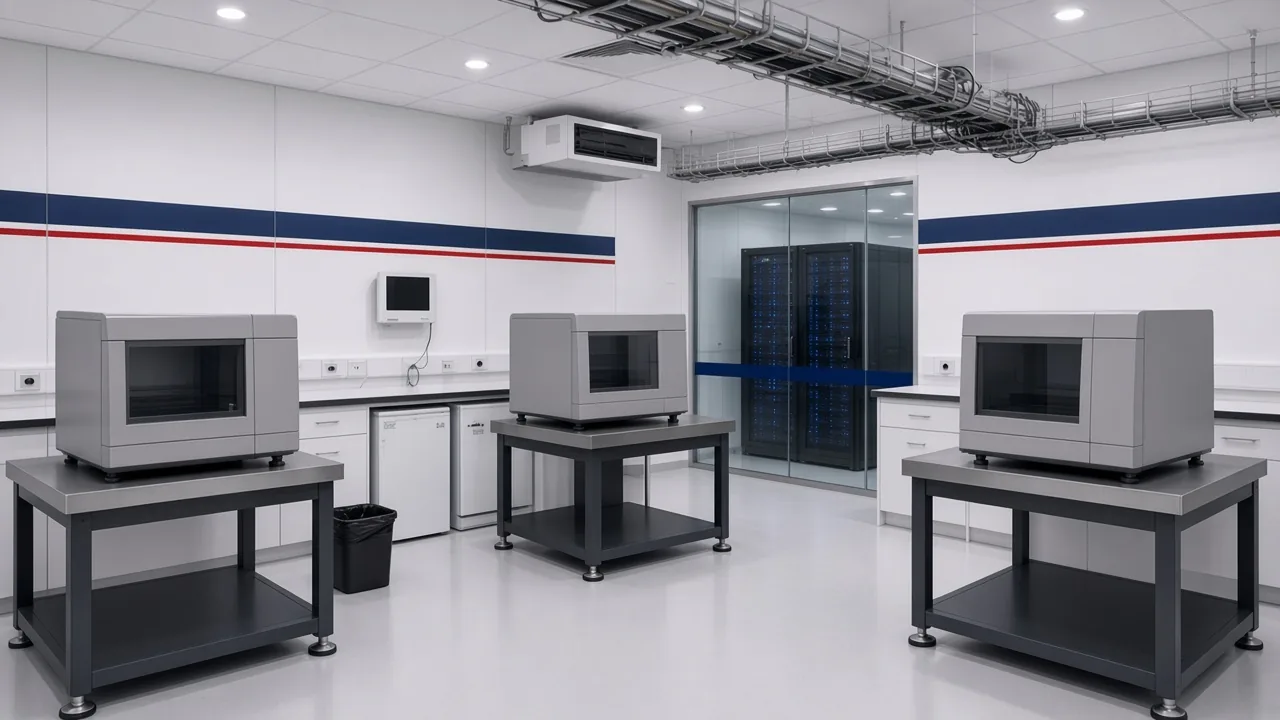
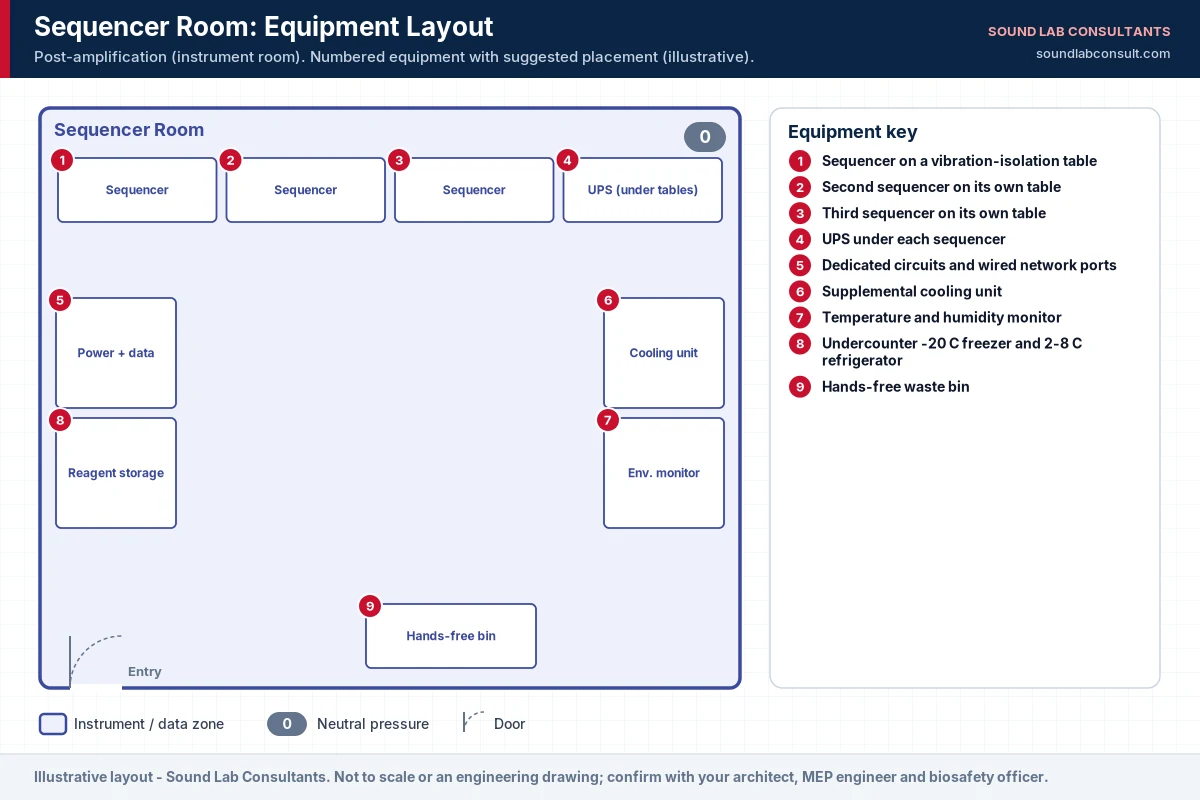
| # | Equipment | Purpose | Placement |
|---|---|---|---|
| 1 | Sequencer on a vibration-isolation table | Sequencing runs | Away from doors, foot traffic and vibrating equipment, with rear service clearance |
| 2 | Second sequencer on its own table | Capacity or a second platform | Spaced from the first for heat and service access |
| 3 | Third sequencer on its own table | Capacity growth | Same row, own circuit |
| 4 | UPS under each sequencer | Rides through short outages and protects runs | On the table shelf under each instrument |
| 5 | Dedicated circuits and wired network ports | Clean power and high-throughput data transfer | Wall outlets behind each table, per the site preparation guide |
| 6 | Supplemental cooling unit | Removes instrument heat to hold room temperature steady | Ceiling or high wall, not blowing directly on instruments |
| 7 | Temperature and humidity monitor | Records room conditions and alarms out of range | Wall near the instruments |
| 8 | Undercounter -20 C freezer and 2-8 C refrigerator | Sequencing reagent kits stored per the manufacturer | Side bench, on monitored power |
| 9 | Hands-free waste bin | Spent consumables | By the door |
All rooms: room-by-room equipment guide.
Power
- Dedicated circuits sized to nameplate and site guide; do not share with centrifuges or freezers.
- Online UPS or power conditioning sized for run protection or controlled shutdown.
- Emergency power for long runs where outages are a risk.
- Grounding and surge protection per the guide.
Planning a new lab or a renovation?
Send us your floor plan or test menu. Sound Lab Consultants reviews layouts against CLIA, accreditation and biosafety expectations before you build.
Book a free consultationHVAC and Heat Load
Sequencers and their PCs add continuous heat. Include instrument heat output in the cooling load, hold the room within the specified temperature and humidity range, and avoid supply diffusers blowing directly on instruments. Environmental monitoring and records support CLIA's environmental condition requirements (42 CFR 493.1252).
Vibration and Benches
- Solid, level benches rated for the instrument weight; some platforms specify bench types.
- Away from centrifuges, shakers, elevators, mechanical rooms and heavy doors.
- Consider isolation tables where the platform calls for them.
Network and Data
Plan wired, high-throughput connections from each sequencer to local storage, plus internet access if the platform uses cloud services or remote support. Size storage from expected output and retention. See NGS bioinformatics infrastructure.
Access, Clearance and Installation
- Restricted access; instruments logged in the maintenance program (42 CFR 493.1254).
- Service clearance on the sides the guide specifies.
- Delivery path: door widths, elevators, floor loading for crated instruments.
- Installation and operational qualification documented before validation.
How Sound Lab Consultants Helps
Sequencer room planning: translating site preparation guides into electrical, HVAC, structural and network requirements, coordinating with engineers and IT, and planning installation and qualification.
- Floor plan and workflow review before construction, not after a survey finding
- Independent of instrument, casework and construction vendors
- Written design memos, SOPs and validation plans your director can sign
- Remote and on-site support in all 50 states, from Chandler, Arizona
Design your lab right the first time
Sound Lab Consultants helps practices, hospitals, reference labs and diagnostic companies plan, build, validate and run molecular and NGS laboratories under CLIA, remotely or on site, in all 50 states.
Book a free consultationFrequently asked questions
What are the requirements for a sequencer room?
Dedicated power with UPS, HVAC that handles instrument heat and holds the specified temperature and humidity, stable benches away from vibration, service clearance, wired network to storage and restricted access, per the manufacturer's site preparation guide.
Does a sequencer need a dedicated circuit?
Most manufacturers specify dedicated circuits. Follow the site preparation guide for your model.
Can a sequencer go in the pre-PCR room?
No. Libraries loaded on sequencers are amplified; keep sequencers in post-PCR or a separate instrument room.
Where do I find sequencer site requirements?
In the manufacturer's site preparation guide for the specific instrument model, usually available from the manufacturer's support site.
Sources
- 42 CFR 493.1101, Facilities (unidirectional workflow)
- 42 CFR 493.1252, Test systems, equipment, instruments, reagents, materials and supplies
- 42 CFR 493.1254, Maintenance and function checks
- CLSI MM09, Nucleic Acid Sequencing Methods in Diagnostic Laboratory Medicine
- NIH Office of Research Facilities, Design Requirements Manual (laboratory design reference)
Related lab design guides
Diagrams and renders on this page are original illustrations by Sound Lab Consultants, not engineering drawings; final designs need a licensed architect and engineer and must meet local codes. Sound Lab Consultants is an independent laboratory consulting firm. We are not affiliated with or endorsed by CMS, FDA, CDC, NIH, CAP, COLA, The Joint Commission, CLSI, any state agency or any instrument manufacturer. This page is general information, not legal advice. Sound Lab Consultants, 25 Arizona Pl, Chandler, AZ 85225.