
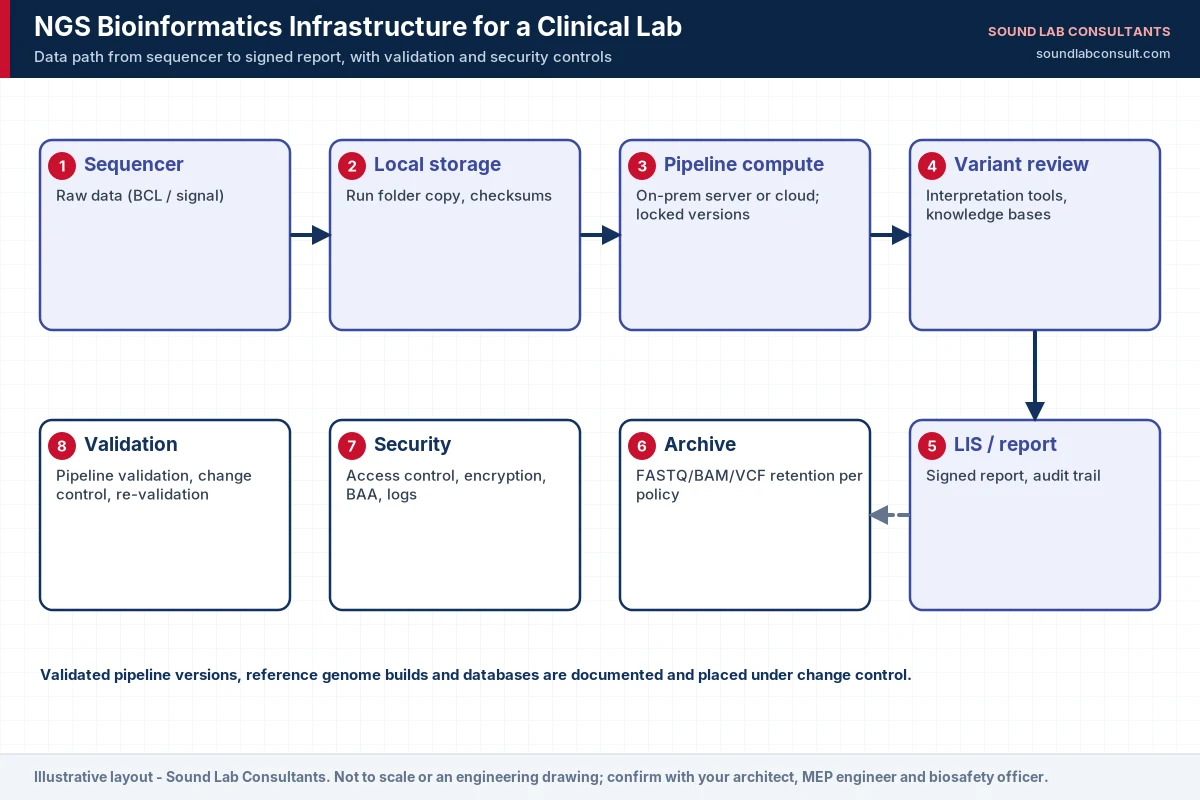
Short answer: Clinical NGS infrastructure moves data from the sequencer to local storage, through a validated pipeline on on-site or cloud compute, to variant review tools and the LIS for a signed report, with archive storage for retained files. It needs access control, encryption, audit trails and a business associate agreement for any vendor handling PHI, plus documented pipeline validation and change control as AMP/CAP guidance recommends.
Last reviewed November 25, 2026. Primary sources: Roy S, Jennings LJ, CDC and APHL Next Generation Sequencing Quality Initiative.
The Data Path
- Sequencer writes raw run data.
- Local storage receives a copy with integrity checks.
- Pipeline compute demultiplexes, aligns, calls and annotates variants with locked software versions.
- Variant review tools support interpretation by qualified staff.
- LIS receives the final, signed report.
- Archive retains files per your retention policy.
Storage Sizing
Estimate output per run for your platform and panel, multiply by runs per year, decide which file types you keep and for how long, and add backup copies and growth. CLIA record retention rules (42 CFR 493.1105) and accreditation requirements drive what must be kept; many labs keep VCFs and reports long term and raw data for a shorter defined period.
What Each Room Looks Like, Down to the Equipment
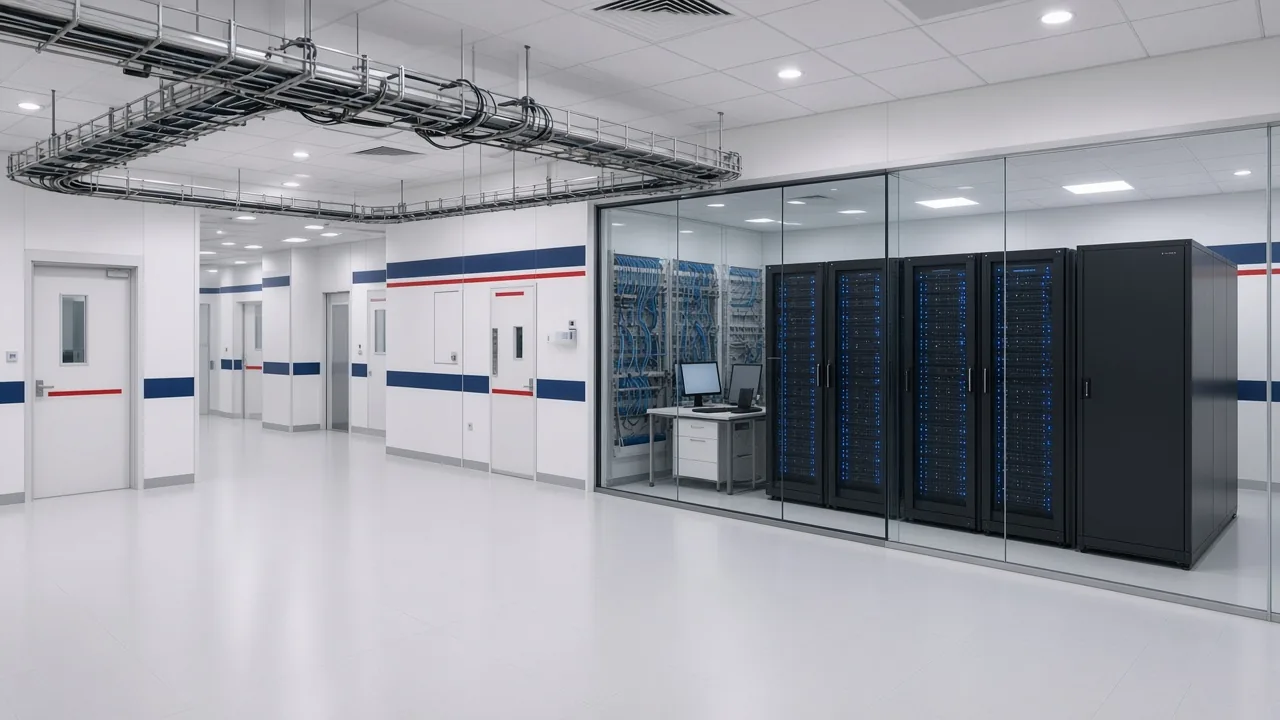
What each room looks like when it is finished, down to the equipment: a render, a numbered layout and a placement table.
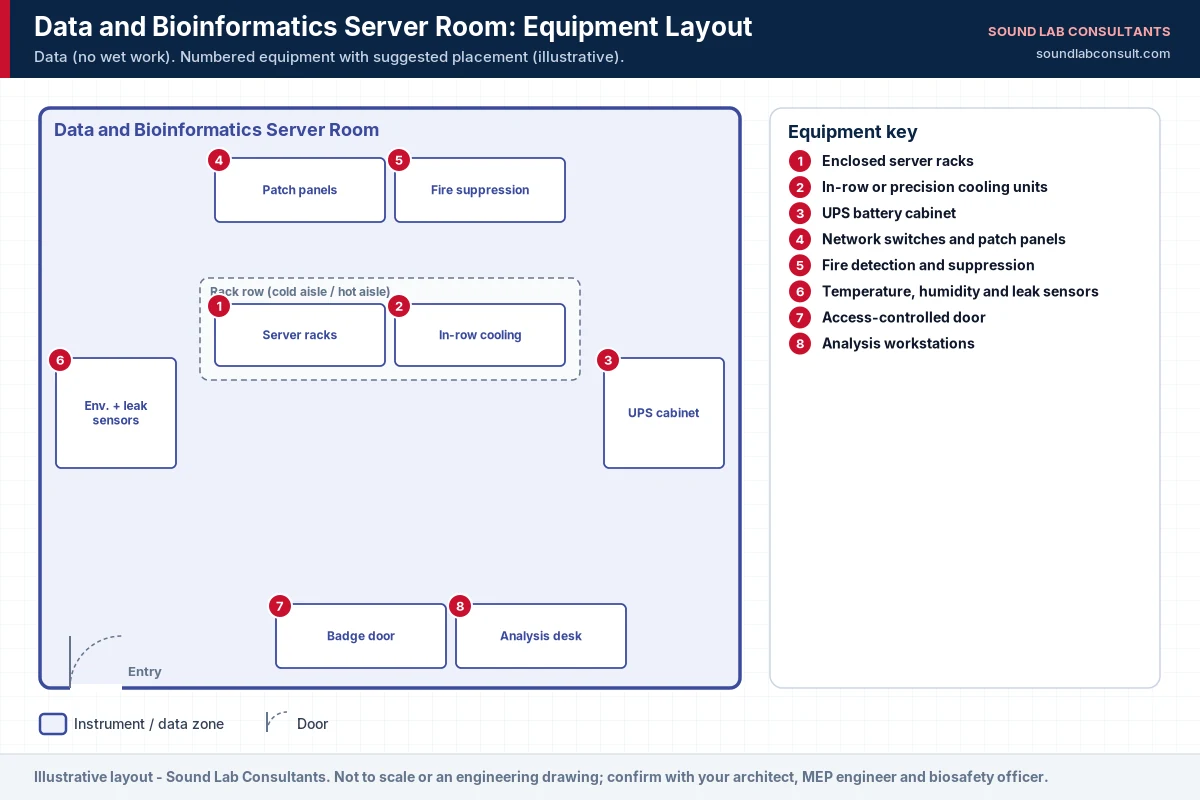
Data and Bioinformatics Server Room
Run data moves here for storage, pipeline analysis and archive. No samples or reagents enter. The design goals are cooling, clean power, physical security and network capacity.
Zone: Data (no wet work)
| # | Equipment | Purpose | Placement |
|---|---|---|---|
| 1 | Enclosed server racks | Pipeline compute and data storage | Rows arranged with cold and hot aisles |
| 2 | In-row or precision cooling units | Removes server heat | Between or beside the racks |
| 3 | UPS battery cabinet | Clean power and orderly shutdown | End of the rack row |
| 4 | Network switches and patch panels | Connects sequencers, storage and LIS | Top of racks or a network rack |
| 5 | Fire detection and suppression | Protects equipment and data per local code | Ceiling, designed by the fire protection engineer |
| 6 | Temperature, humidity and leak sensors | Alarms before equipment is at risk | In the aisles and under cooling units |
| 7 | Access-controlled door | Limits entry to authorized staff | Room entrance |
| 8 | Analysis workstations | Variant review and sign-out outside the server space | Outside the glass, in an office area |
All rooms: room-by-room equipment guide.
Planning a new lab or a renovation?
Send us your floor plan or test menu. Sound Lab Consultants reviews layouts against CLIA, accreditation and biosafety expectations before you build.
Book a free consultationOn-Site, Cloud or Hybrid
| Model | Pros | Watch-outs |
|---|---|---|
| On-site server | Full control, predictable cost, no egress fees | Capacity planning, power and cooling, backups, staff to maintain |
| Cloud | Scales with volume, managed infrastructure | BAA, data residency, cost control, validation of the environment |
| Hybrid | Local primary processing, cloud archive or burst | Two environments to secure and document |
Pipeline Validation and Change Control
The AMP/CAP bioinformatics pipeline recommendations call for validating the pipeline as part of the test, with documented versions of software, reference genome and databases, and re-validation proportional to any change. Build change control into the design: test environments, version pinning, and records that tie each patient report to the pipeline version that produced it.
Security and Privacy
- Role-based access and multi-factor authentication.
- Encryption in transit and at rest.
- Audit logs for access and changes.
- Business associate agreements with cloud and software vendors handling PHI.
- Backup and disaster recovery tested on a schedule.
How Sound Lab Consultants Helps
NGS informatics planning: data flow and storage sizing, on-site vs cloud decisions, pipeline validation planning, change control SOPs, security and privacy controls, and LIS reporting integration.
- Floor plan and workflow review before construction, not after a survey finding
- Independent of instrument, casework and construction vendors
- Written design memos, SOPs and validation plans your director can sign
- Remote and on-site support in all 50 states, from Chandler, Arizona
Design your lab right the first time
Sound Lab Consultants helps practices, hospitals, reference labs and diagnostic companies plan, build, validate and run molecular and NGS laboratories under CLIA, remotely or on site, in all 50 states.
Book a free consultationFrequently asked questions
What infrastructure does clinical NGS need?
Local storage, compute for a validated pipeline (on-site, cloud or hybrid), variant interpretation tools, LIS integration for reporting, archive storage, and security controls for PHI.
Does a bioinformatics pipeline need validation?
Yes. Professional AMP/CAP recommendations treat the pipeline as part of the test that must be validated, with re-validation when it changes.
Can clinical NGS data be processed in the cloud?
Yes, with a business associate agreement, appropriate security controls and validation of the pipeline in that environment.
How long must NGS data be kept?
CLIA and accreditation records rules apply; labs define retention for each file type in policy. Check your accreditor's current requirements.
Sources
- Roy S, et al. Standards and Guidelines for Validating NGS Bioinformatics Pipelines (AMP/CAP), J Mol Diagn 2018
- Jennings LJ, et al. Guidelines for Validation of NGS-Based Oncology Panels (AMP/CAP), J Mol Diagn 2017
- CDC and APHL Next Generation Sequencing Quality Initiative
- 42 CFR 493.1105, Retention requirements
- 42 CFR 493.1291, Test report
- College of American Pathologists, accreditation checklists
Related lab design guides
Diagrams and renders on this page are original illustrations by Sound Lab Consultants, not engineering drawings; final designs need a licensed architect and engineer and must meet local codes. Sound Lab Consultants is an independent laboratory consulting firm. We are not affiliated with or endorsed by CMS, FDA, CDC, NIH, CAP, COLA, The Joint Commission, CLSI, any state agency or any instrument manufacturer. This page is general information, not legal advice. Sound Lab Consultants, 25 Arizona Pl, Chandler, AZ 85225.